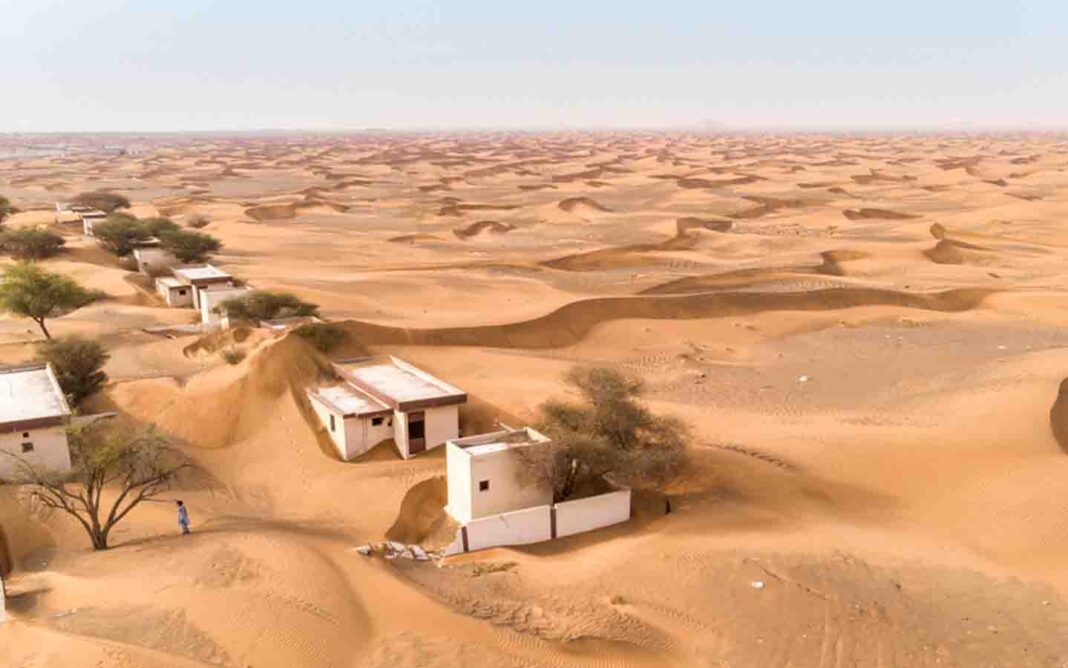

Nestled in the arid landscapes of Sharjah, United Arab Emirates, the Ad Madam Ghost Village whispers tales of a bygone era, a haunting reminder of the consequences of unsustainable urban development. As visitors explore its crumbling structures, the echoes of the past resonate with a poignant lesson—sustainable planning is not just a choice; it’s a necessity for the survival of our towns and villages. In this quest for sustainability, the visionary ideas of Egyptian architect Hassan Fathy shine as a guiding light, offering a blueprint for a future where planned villages may hold the key to resilient and harmonious communities.
Ad Madam’s Ghostly Chronicle:

Ad Madam, meaning “the home of the widows” in Arabic, weaves a tale of a once-thriving oasis settlement that succumbed to the ravages of time and unsustainable practices. The village, abandoned in the 20th century, stands as a stark testament to the perils of over-exploitation of natural resources, economic shifts, and inadequate waste management. Its deserted streets and dilapidated structures beckon tourists to reflect on the broader implications of such neglect, prompting the crucial question—how can we ensure our towns and villages stand resilient against the threat of abandonment?
Sustainable Lessons from the Past:

As we delve into the haunting beauty of Ad Madam, its ruins become a classroom where the curriculum is written in the remnants of a once-vibrant community. The village’s demise wasn’t just an isolated incident but a symptom of a global issue: unsustainable urbanization. Over-exploitation of resources, lack of environmental foresight, and economic instability are the ghosts that haunted Ad Madam, and they continue to haunt many communities today. The lesson is clear—sustainable development is not an ideal; it’s an imperative. It’s a great place to visit like the haunted Ottoman buildings in Lebanon, and the Disney village of palaces in Turkey.

The Visionary Legacy of Hassan Fathy:
Enter Hassan Fathy, an architect ahead of his time. In the mid-20th century, Fathy envisioned a radical departure from conventional urban planning, advocating for the creation of planned villages that harmonize with nature and culture. His ideas stand in stark contrast to the sprawling urban jungles that dominate our landscapes. Fathy’s model emphasizes compact, self-sufficient communities that integrate traditional building methods, locally-sourced materials, and sustainable technologies.
Fathy’s vision extends beyond bricks and mortar. It envisions a shift in mindset—a departure from the shortsightedness that led to the abandonment of places like Ad Madam. By decentralizing urban hubs and empowering communities, Fathy’s model seeks to create environments that are not only environmentally conscious but culturally rich and economically viable.
The Future in Planned Villages:

Fathy’s vision gains new relevance as we grapple with the challenges of the modern world. The haunting beauty of Ad Madam serves as a cautionary tale, urging us to reconsider our approach to urbanization. Planned villages, as envisioned by Fathy, may hold the key to a future where towns are not just structures but living, breathing organisms that adapt and thrive in harmony with their surroundings.

These villages, with their emphasis on sustainability and community engagement, offer a promising alternative to the sprawling, impersonal cities that often lead to the abandonment of smaller communities. By adopting Fathy’s principles, we can create environments that are not only environmentally sustainable but also socially and economically resilient.
Ad Madam, in its ghostly stillness, calls for responsible tourism that goes beyond mere observation. Tourists are not just visitors; they are custodians of the lessons embedded in the village’s ruins. Responsible tourism in Ad Madam involves engaging with local communities, understanding their challenges, and contributing to initiatives that promote sustainability.
Sharjah’s efforts to balance tourism with conservation in Ad Madam set a precedent for responsible development that respects the delicate balance between preservation and exploration.
In the dance between the ghosts of Ad Madam and the visionary legacy of Hassan Fathy, we find a roadmap for sustainable urban development. Ad Madam teaches us the consequences of neglect, urging us to rethink our approach to town planning. Hassan Fathy’s vision offers a hopeful alternative—a future where planned villages, rooted in sustainability and community, stand resilient against the ghosts of abandonment. As we navigate the challenges of the 21st century, Ad Madam and Fathy’s legacy beckon us to build not just structures but living, breathing communities that endure the test of time. It’s a call to embrace the past, shape the future, and ensure that the ghosts that haunt our towns are echoes, not warnings.
Above images except Hassan Fathy village via Bayt.com