

A rumor started on a Facebook group in Jaffa that the beloved Lebanese singer Fairuz would be performing. Fairuz is the Ella Fitzgerald of the Arab world and without doubt the biggest musical icon of the Arab world. She is popularly known as “the soul of Lebanon” and has achieved fame despite being a modern, secular woman in an ultra-conservative world lived in by most of her biggest fans.
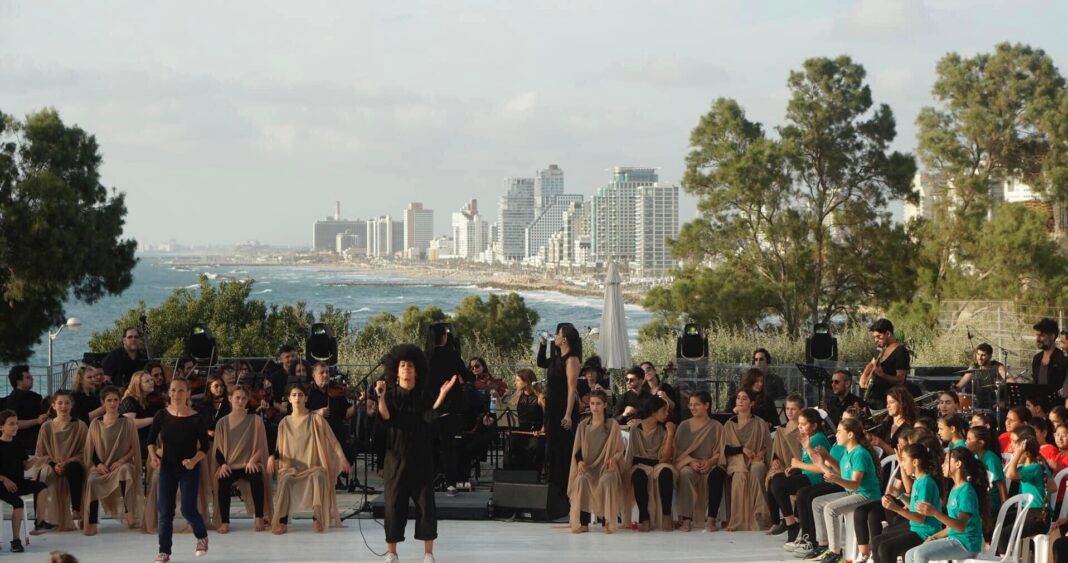
The 87-year-old singer did not perform that day in May, but in her spirit a dozen girls, Jewish and Arabic, with origins from the Holy Land and as far and wide as Canada and Ireland shared a common dance floor for change –– and led a dance with Faizuz’s music at a new local dance festival that took place in the Old City of Jaffa overlooking the Mediterranean Sea and Tel Aviv. They had been working on the piece since January.
The dance troupe, led by Dalia Chaimsky dance director of the Jewish Arab Center in Israel, embraced a crew of 100 other girls and boys from Arab-speaking schools in the Jaffa area. The idea was to create a safe space for meeting face-to-face in a city that is culturally and religiously divided between rich and poor, secular and traditional, or Jewish, Muslim and Christian.

The dance troupe of young women aged 12 to 14 elegantly embraced their role as dance mentors to the other children, as a Middle Eastern orchestra, The Jerusalem Orchestra East West played an entrancing piece made famous by Fairuz. Hand movements and pulses of dancers crowded the stage, but everyone, along with their families in the audience were excited about the moment that the cellphones were off and the children could express themselves. Having 113 children on stage was a bit chaotic but the excitement and deeper meaning palpable.
It’s been a trying time for bringing people with varying backgrounds together in Jaffa, an ancient port city of mixed Muslim, Jewish and Christian heritage that sits side-by-side with the ultra modern Tel Aviv to the north. There were rockets falling in the area a couple of months earlier and while Yulia a lazy seal stretched herself along a Jaffa shore uniting Jaffainians for a moment, the sense in the community was one of distrust, loss of hope and pain.
(Related: remember when Syrian kids danced through pain and the rubble?)
As a resident of Jaffa and a mother of 3 young boys there, Chaimsky had a personal and professional mission to unite people through culture and dance in her beloved city.

She tells Green Prophet: “After being part of the Jewish Arab Center for 6 years it was important for me to develop the dance culture for the kids in Jaffa, especially the ones in our center. But it’s also important that the dance culture would be developed in Jaffa so that people will see what we are doing and recognizing that art and dance is not only for fun but can connect communities.”
“Dance,” she adds, “can develop kids’ minds, their general knowledge, but also other aspects about their bodies, in music, and in choreography,” says the daughter of Lithuanian doctors who immigrated to Israel as a child. Chaimsky was a professional dancer before she took on the role of supervising the dance department at the Jewish Arab Center. Other disciplines found there include hip-hop, modern dance and ballet.
“The main thing we came out with the Fairuz Project was the 100-plus kids collaborating together from the Jaffa schools Kulna Yahad, Ajial and Al Alhua in Jaffa. We entered the schools with our dance teachers and did a dance project for kids who are non-dancers in their everyday life. It was important for me to choose music connected to the traditional Arabic culture in Jaffa and the Middle East,” Chaimsky explores.

“The emphasis was on Arabic traditional music so the Arabic kids will be proud of their culture and sound and so that it will be heard in the public area for the Jewish kids to know and hear another culture and tradition that’s not from home.
“The main thing is that we are learning about this culture through movement and that everyone can connect. It was for three months in the school, one hour per week, and in the end we set everything together to one dance and the city worked hard so we’d have a great orchestra to play, the Jerusalem Orchestra East and West.”
Watch the Best of Fairuz
https://www.youtube.com/watch?v=qaBYV-9g63o
It isn’t easy for Chaimsky, as a modern secular Jewish woman, to see young Arab women hidden from the public eye once they start puberty: “It’s important to say that in Jaffa by the age of 12 the girls stop dancing because of their traditions so it was important for me to emphasize Dance as something much more meaningful for life and which can connect the community.
“The fact that it comes out of Jaffa is a political statement,” she notes. “We are Jewish and Arab kids dancing together. We have different things to connect us now, not just the troubles, and yes we also have the good things. And you can see it onstage and you can see it in a very big festival like the one we had.
“But the main goal was to develop dance in the culture of Jaffa, within the kids,” Chaimsky, once a dancer, always a dancer, concludes.
The Fairuz Festival was in cooperation with and supported by the City of Tel Aviv-Jaffa, the Jewish Arab Center, The Mandel Center, the Old City of Jaffa, and the Pisgah Theatre in the Old City of Jaffa.