
Plants can speak

After working with plants and AI for years I’ve known it to be true. Dozens of cannabis growers I’ve interviewed knew it was true too. And now science proves it: plants emit sound, which means they can talk. Not like us: they talk more in clicks and ticks and using the help of artificial intelligence scientists have transformed plant talk into audible sounds we can hear. 

The click-like sounds, similar to the popping of popcorn, are emitted at a volume similar to human speech, but at high frequencies, beyond the hearing range of the human ear.

“We found that plants usually emit sounds when they are under stress, and that each plant and each type of stress is associated with a specific identifiable sound. While imperceptible to the human ear, the sounds emitted by plants can probably be heard by various animals, such as bats, mice, and insects,” the scientists announced. The paper was published in the prestigious scientific journal Cell.


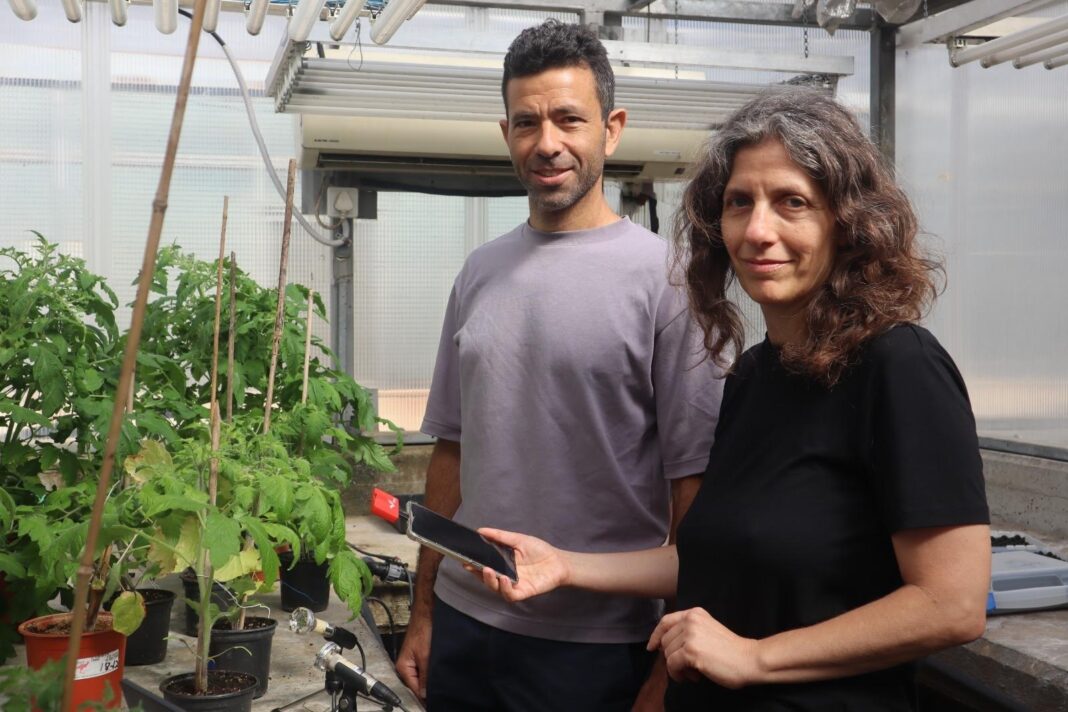
The study was led by Prof. Lilach Hadany (left)  together with Prof. Yossi Yovel at Tel Aviv University, . 

“From previous studies we know that vibrometers attached to plants record vibrations. But do these vibrations also become airborne soundwaves – namely sounds that can be recorded from a distance? Our study addressed this question, which researchers have been debating for many years,” says Hadani.

How to record the sounds made by plants
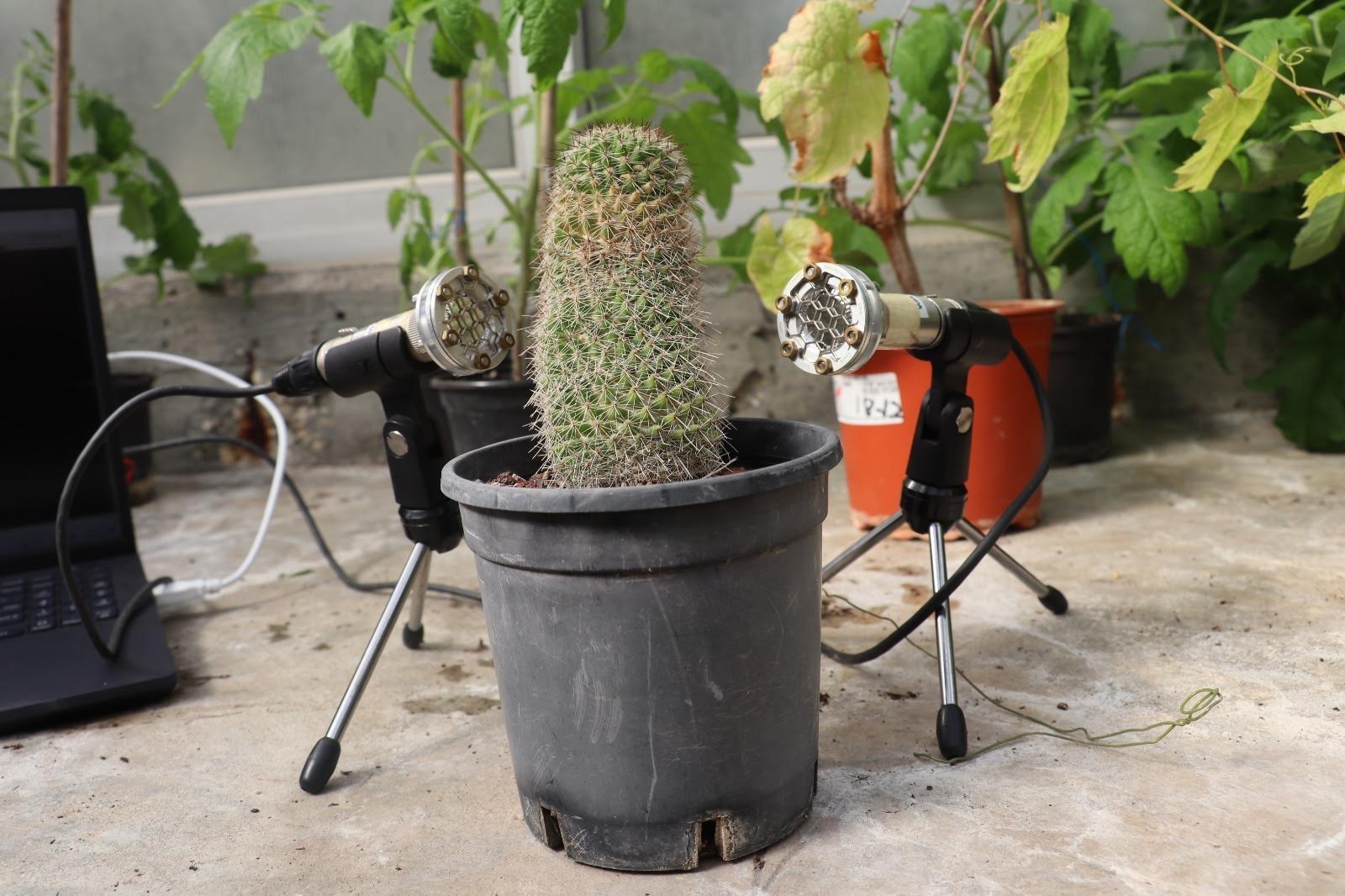
Recording sounds made by a cactus

At the first stage of the study the researchers placed plants in an acoustic box in a quiet, isolated basement with no background noise. Ultrasonic microphones recording sounds at frequencies of 20-250 kilohertz (the maximum frequency detected by a human adult is about 16 kilohertz) were set up at a distance of about 10cm from each plant.

The study focused mainly on tomato and tobacco plants, but wheat, corn, cactus and henbit were also recorded.

Prof. Hadany explains: Before placing the plants in the acoustic box we subjected them to various treatments: some plants had not been watered for five days, in some the stem had been cut, and some were untouched.

recording the sounds made by plants
Recording the sounds made by plants

“Our intention was to test whether the plants emit sounds, and whether these sounds are affected in any way by the plant’s condition. Our recordings indicated that the plants in our experiment emitted sounds at frequencies of 40-80 kilohertz. Unstressed plants emitted less than one sound per hour, on average, while the stressed plants – both dehydrated and injured – emitted dozens of sounds every hour.”

The recordings collected in this way were analyzed by specially developed machine learning (AI) algorithms. The algorithms learned how to distinguish between different plants and different types of sounds, and were ultimately able to identify the plant and determine the type and level of stress from the recordings.

Moreover, the algorithms identified and classified plant sounds even when the plants were placed in a greenhouse with a great deal of background noise. In the greenhouse the researchers monitored plants subjected to a process of dehydration over time and found that the quantity of sounds they emitted increased up to a certain peak, and then diminished.

“In this study we resolved a very old scientific controversy,” says Prof. Hadani. “We proved that plants do emit sounds. Our findings suggest that the world around us is full of plant sounds, and that these sounds contain information – for example about water scarcity or injury. We assume that in nature the sounds emitted by plants are detected by creatures nearby, such as bats, rodents, various insects, and possibly also other plants – that can hear the high frequencies and derive relevant information.

We believe that humans can also utilize this information, given the right tools – such as sensors that tell growers when plants need watering. Apparently, an idyllic field of flowers can be a rather noisy place. It’s just that we can’t hear the sounds.”

In future studies the researchers will continue to explore a range of intriguing questions: What is the mechanism behind plant sounds? How do moths detect and react to sounds emitted by plants? Do other plants also hear these sounds? 

Karin Kloosterman
Karin Kloostermanhttp://www.greenprophet.com
Karin Kloosterman is an award-winning journalist, innovation strategist, and founder of Green Prophet, one of the Middle East’s pioneering sustainability platforms. She has ranked in the Top 10 of Verizon innovation competitions, participated in NASA-linked challenges, and spoken worldwide on climate, food security, and future resilience. With an IoT technology patent, features in Canada’s National Post, and leadership inside teams building next-generation agricultural and planetary systems — including Mars-farming concepts — Karin operates at the intersection of storytelling, science, and systems change. She doesn’t report on the future – she helps design it. Reach out directly to [email protected]

Hot this week

The Fitness App Revolution: Building the Future of Wellness Through Strategic Development

In an era where smartphones are ubiquitous and health consciousness is at an all-time high, the fitness industry has undergone a radical digital transformation. Fitness applications have moved far beyond simple pedometers, evolving into comprehensive wellness platforms that serve as personal trainers, nutritionists, and community hubs right in our pockets.

A Brief History of Basil From India to Italy

Beloved, fortunate, sweet, and royal; an herb with a long and storied history in Asia and across the world. Called by many names, basil has featured in previous Green Prophet articles, so enjoy another serving, a brief history of basil.

How Renewable Energy is Revolutionizing the Way We Power Our World

Solar has become the star of the transition thanks to modular hardware and straightforward installation. It fits dense cities and remote towns alike. Many companies are turning to rooftop arrays and carport systems - and exploring commercial solar installation as a practical way to lock in future savings.

How does one start prepping?

Faced with an extreme winter storm this year, Americans wonder how to be prepared for catastrophe. Miriam has lived through wars in the Middle East - so she's prepared on giving you a guide to prepping.

Fishermen sue tire manufacturers on behalf of the salmon

A federal trial in San Francisco has brought US tire manufacturers, fishing groups, and environmental scientists into court over a chemical most drivers have never heard of — but which scientists say may be silently reshaping aquatic ecosystems.

Topics

The Fitness App Revolution: Building the Future of Wellness Through Strategic Development

In an era where smartphones are ubiquitous and health consciousness is at an all-time high, the fitness industry has undergone a radical digital transformation. Fitness applications have moved far beyond simple pedometers, evolving into comprehensive wellness platforms that serve as personal trainers, nutritionists, and community hubs right in our pockets.

A Brief History of Basil From India to Italy

Beloved, fortunate, sweet, and royal; an herb with a long and storied history in Asia and across the world. Called by many names, basil has featured in previous Green Prophet articles, so enjoy another serving, a brief history of basil.

How Renewable Energy is Revolutionizing the Way We Power Our World

Solar has become the star of the transition thanks to modular hardware and straightforward installation. It fits dense cities and remote towns alike. Many companies are turning to rooftop arrays and carport systems - and exploring commercial solar installation as a practical way to lock in future savings.

How does one start prepping?

Faced with an extreme winter storm this year, Americans wonder how to be prepared for catastrophe. Miriam has lived through wars in the Middle East - so she's prepared on giving you a guide to prepping.

Fishermen sue tire manufacturers on behalf of the salmon

A federal trial in San Francisco has brought US tire manufacturers, fishing groups, and environmental scientists into court over a chemical most drivers have never heard of — but which scientists say may be silently reshaping aquatic ecosystems.

Listening to Water: Tarek Atoui’s Next Work for Tate Modern

Born in Beirut, Lebanon in 1980 and now living in Paris, Atoui has spent years building instruments that don’t sit comfortably in concert halls. Many of them involve water, glass, and ceramics — materials that react to sound instead of simply producing it.

Leading Through a Dual-Energy Transition: Balancing Decarbonisation with Energy Security

Experience in one area of the energy industry isn't enough to guarantee readiness across all the others. That's where a structured program like an MBA in energy can come in. Today's advanced curricula explore energy economics, finance, policy, and strategic management alongside the technical subjects. And when pursuing an energy MBA online, professionals can skill up and retrain without having to step out of the labor market -- an important perk at a time when skilled professionals are already in short supply.

From Green Energy to Healthy Societies: Why old systems thinking is becoming relevant again

Across the Middle East and North Africa, large investments are being made in green hydrogen, renewable energy, water infrastructure and sustainability. Most of these efforts are discussed in the context of climate change, decarbonization and economic diversification. That framing is important, but it may not capture their full value.

Related Articles

Popular Categories