
If you believed that you were the self-made genius behind an electric car company, a space launch & telephone company and a hole boring company, wouldn’t you want any debate to take place on your home turf where you set the rules? The strategy behind Elon Musk’s $44 billion purchase of Twitter is up for debate but perhaps this is a good time to give him credit for a long overdue overhaul of social media.
Anyone who has watched social media evolve from Bulletin Board System (BBS) FidoNets to USENET newsgroups through SecondLife and MySpace to Twitter and Facebook will have seen how much social media changed our lives. Twitter played a role in the Arab Spring, Brexit, protests and elections in several nations. At its peak more than 450 million Twitter profiles were active each month. But this number included imposters, alter-egos, doppelgangers, scam artists, trolls, cult-leaders, politicians, oligarchs and bots. This virtual garden of human minds has the same flaw as the original garden of Eden. People have used Twitter as a weapon to destroy lives, spread lies and undermine civilizations.
Twitter’s partial anonymity was a double-edged sword. Until Twitter’s recent purge of journalists, it allowed muckrakers, whistleblowers and vulnerable minorities to speak truth to power without becoming targets for persecution. But anonymity was also like the Ring of Gyges, a shield of invisibility which fed our inner trolls and empowered the dark side of the human heart.
Some countries allow social media corporations to profit from destructive user content while shielding them from liability. Even when moderation didn’t conflict with profits, Twitter’s rapid pace often left moderators behind. But Twitter’s new CEO seems to believe that the company had too much moderation! Autocrats, subversive influencers, racists and Nazis were invited back even as journalists were banned.
Mastadon is like Paris in the 1920s
Advertisers who could not afford to taint their brand began searching for other social media platforms. Vulnerable minorities that had relied on Twitter’s imperfect moderation fled for their own safety. Hundreds of thousands of Twitter users were searching for a new online home.
This influx of new users yearning to be safe reminds us of other places and times when immigrants brought energy and creativity. With its large number of dispossessed artists, musicians and writers, parts of Mastodon resemble Paris in the 1920s.
What is Mastodon?
Mastodon not a company or a single server. It is a decentralized social network application which allows web servers to join an interoperable social network known as the Fediverse. Eugen Rochko of Germany, also known as Gargon, is the Founder, CEO and lead developer of Mastodon. Christine Lemmer-Webbe, co-author of the ActivityPub specification explains that Mastodon is only one one of many possible implementations of this web communication standard. She shared some helpful documentation on her Mastodon profile:
High level intro to ideas:
Tech tour: https://spritely.institute/news/blast-off-spritely-institutes-tech-tour.html
Computer scientist and opensource advocate Simon Phipps has a good introduction to the Fediverse which includes Mastodon instances and an interoperable family of social network applications such as PixelFed photos, Castopod podcasts and Peertube videos. If Flickr, LinkedIn, Mozilla or Bluesky decide to create ActivityPub compatible services, they can also become part of the Fediverse. Mastodon gained the most attention in recent weeks because it allows favoriting, replying and boosting short text messages which resemble Twitter’s tweets.
More than a decade ago I joined another decentralized social media called Diaspora. Unfortunately Facebook and Twitter had already drawn many people into their centralized “walled gardens” where few were aware that they were locking themselves, their friends and families into communicating only through these corporations. This profit-first ethos is why you couldn’t use your Android phone to Facetime family on iPhones even during Covid-19 lockdowns. It’s why you couldn’t view friend’s Facebook photos from your Twitter account or browse an friend’s iPhoto album from a Windows PC. Corporations segregated us behind their paywalls of unnecessary incompatibility. We believed we were their customers but we have always been their product.
Twitter said this quiet part out loud on December 18th, 2022 with an announcement that tweets and accounts will be removed for sharing outgoing links to Facebook, Instagram, Mastodon and other competing social media platforms. The announcement was later replaced with a 404: Page not found error but not before convincing more people that Twitter’s new management doesn’t value the free speech of people who aren’t already wealthy and powerful.
Getting started with Mastadon
What is a Mastodon “instance”?
If you’re not old enough to remember email, ask your parents or grandparents but back in the old days people had to choose an email server. Some used one belonging to their company or internet service provider. Others used yahoo.com, aol.com, mac.com, myInternetCafe.com, myUniversity.edu… It didn’t really matter because with rare exceptions, any email could go to and from any email server because the Simple Mail Transfer Protocol (SMTP) wasn’t owned by a single company, it was an international standard.
Mastodon instances are somewhat like email servers or old style bulletin board systems (BBSs.) People in one instance can follow or send messages to people in other instances. Anyone who has set up a BBS, a cloud-based web or MineCraft server is capable of configuring a Mastodon instance. But for most of us the cost of hosting, moderation and security make it more efficient to join and contribute to the running costs of existing one.
How do I choose an instance?
The large number of possible Mastodon “instances” (servers) to choose from presents one of the biggest barriers to joining but it also points to a big advantage. Some instances are focused on a particular region, language or area of interest. Some encourage posting on, maps, animals, art, science, photography or history. Some allow longer posts, some are focused on the needs of writers and journalists, others have a high concentration of tech people. Some prioritize regional content or a particular language. Instances resemble Facebook groups but they are not controlled by a single company. Unlike ad-funded corporate media, Mastodon instances are funded by user donations. Try to find one which uses a donation portal you would trust. If you can’t get into your chosen instance, try another one.
Check local laws
Comedian Groucho Marx quit the Friar’s club with the remark, “I don’t want to belong to any club that would have me as a member!” It’s helpful to choose an instance with a moderation policy that fits your beliefs and the legal requirements of your home. Try to find an instance that is managed by someone who takes moderation and security more seriously than Twitter’s current leadership does. I began with a regional instance which several of my techie friends had already joined. Here is a map of Mastodon instances. And here are some in the Middle East and north Africa:
https://mastodon.com.tr
https://tooot.im
https://mastodon.tn
https://sasa.africa
Mastodon is currently strong in Japan and Europe. The European Commission recently decided to help fund it.
Choose an instance based on your interests
The website https://joinmastodon.org* allows you to search instances by region and area of interest. Here are some which may be of interest to GreenProphet readers:
Climatejustice.rocks
Earthstream.social
Urbanists.social
Fediscience.org
If you can’t get into your chosen instance, try another one. If your chosen instance isn’t working well for you, it is possible to move. Your follows and followers can come with you. Data scientist Danielle Navarro wrote a more detailed look at this and many other aspects of using Mastodon.
*When discussing Twitter’s recent ban, a journalist mistakenly wrote that Twitter had banned “John Mastodon, the founder of a competing social network.” That mistake is now trending as a series of jokes and memes within the Fediverse and a fictional founder account:
https://mastodon.social/@JohnMastodon
How to Say Hello to Mastodon?
Its customary to write an #introduction containing hashtags describing your interests. For me it might be #Environmentalism, #Writing, #History, #Photography, #Science, #Sailing, #A11Y… This post will appear under these hashtags which will help you connect to others with similar interests. But you may wish to “lurk”, listen and watch how people interact before you introduce yourself.
Mastodon currently has a high concentration of gentle and creative people. Women, BIPOC, LGBTQIA, people with disabilities, neurodiverse, artists, musicians, poets, scientists and “Woke” (aka compassionate) people. Mastodon is not a clone of Twitter and many uses hope it will never try to become Twitter. In some ways it’s the opposite of what has become a wretched hive of scum and villainy.
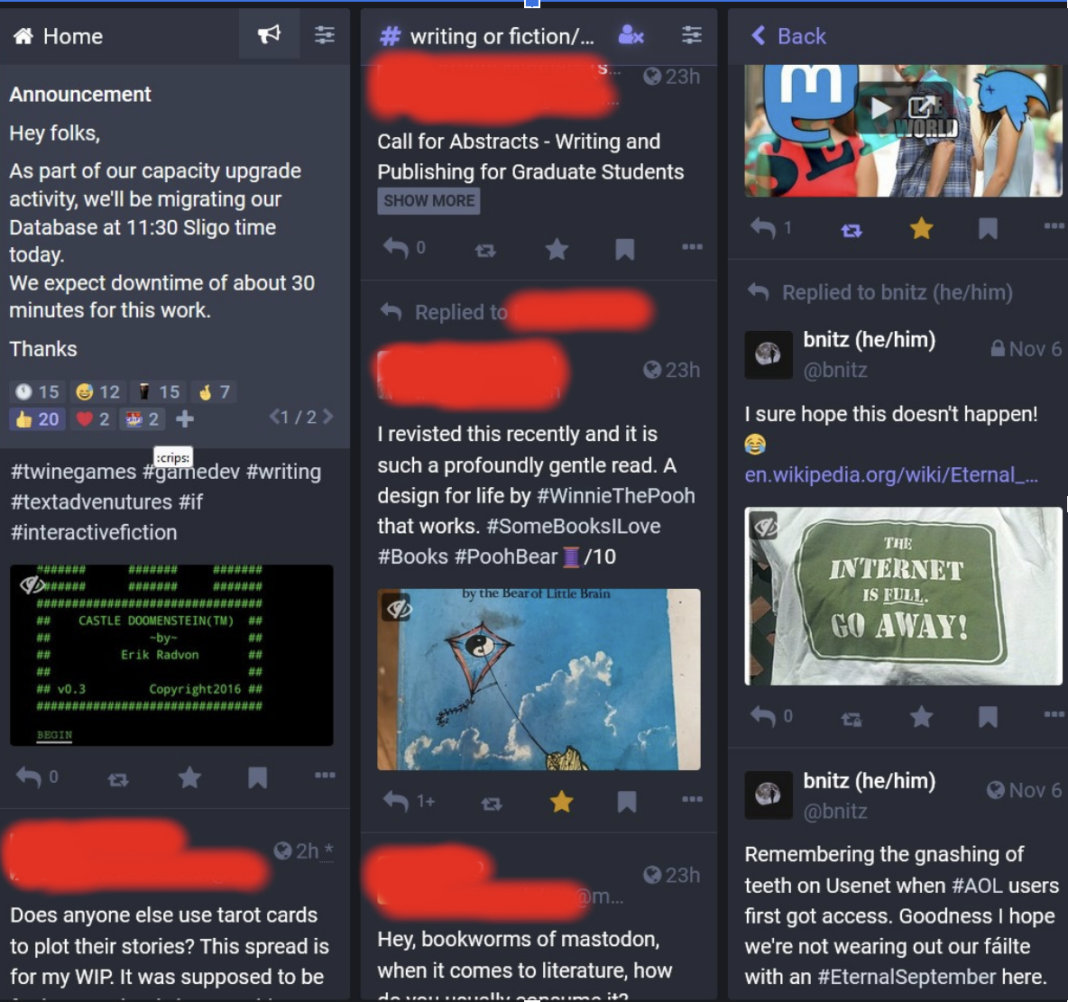
Some people who’ve settled into this kinder place do not want to be reminded of their abusers elsewhere. Mastodon added several million users over the past few weeks. It will certainly face growing pains but kindness is one area where it excels. Users are encouraged to use content warnings (CWs.) They are simple to add and actually increases the chances your post will be “boosted” (retweeted). So you’ll see CWs for politics, book and movie spoilers, images NSFW or displaying direct eye contact. You’ll also see CWs for mentions of Twitter.
It’s also customary to add text descriptions to images for people with limited vision. Mastodon makes it easy to do this. There are no profit-driven algorithms which reward hate-driven engagement, instead ordinary people choose to boost posts from others who perform these simple acts of kindness. One blind user explained that he had seen more text descriptions on Mastodon in 24 hours than he had on Twitter over several years.
Who/What should I follow?
Again there is no one-size-fits-all list of people and hashtags to follow, but here are some which may be particularly interesting to GreenProphet readers:
Hashtags:
#climate
#environmentalism
#deepecology
#socialecology
#renewableenergy
Users:
How to say goodbye to Twitter?
There is never a good way to say goodbye. My personal Twitter account has been battened down and nearly untouched since Musk’s takeover but another has suddenly become a magnet for “followers”, most of which are bots who’ve joined since October 2022.
“The safest way to use computers is still abstinence”
– Christine Lemmer-Webber (2018)
While this is excellent advice, she also explains that you should not delete your Twitter account. Someone could take your handle and become an imposter. Deleting your account is also not very useful. Elon Musk already has all of your tweets whether or not you “delete the account.”
Will Mastodon Make Twitter Extinct?
The growth of Mastodon seems to have unsettled Twitter’s leadership. It has already reduced the number of targets for profitable hate. People who parked or deleted Twitter accounts are no longer seeing ads there. But $44 billion won’t disappear overnight
An artist in my family explained how Twitter helped connect freelance artists to commissions. The number of Mastodon users grew rapidly in recent weeks but it remains far below the number on Twitter. I wanted to learn how artists are using this new tool so I joined a small instance which focuses on visual art. It has a strong moderation policy and recently closed to new users in order to remain a stable, well-moderated and gently beautiful art gallery. Artists connect with one another and with those who support their work. Its curator “defederated” from some large and under-moderated instances in order to protect the artists.
People I had known from open-source communities were becoming early adopters of Mastodon. They had fought Microsoft back when its applications trapped users into a closed and outdated operating system. To go against a near-monopoly felt like jousting at windmills. In the end we didn’t beat them and we didn’t join them, they joined us. Microsoft Windows, Apple OSX, Google Android, cloud computing and the internet of things all rely on the work of open-source visionaries.
Twitter may limp along for years with haphazard management slowly bleeding away $44 billion and struggling to find a path that avoids discussing the Mastodon in the room. But its not going away.
Mastodon user @d4doome explained it this way:
It might be an unpopular thought here but I’d like to see both Twitter and Mastodon thrive. They’re different and there’s room for both.
Twitter is like having an apartment in the big bad city and you go out at night to sample the nightlife. It’s scary and dangerous if you don’t know what you’re doing, it’s a bit sleazy, but it’s exciting and fun.
Mastodon is like having a little cottage in the country and going to the picturesque village pub for a few quiet ales.
You can enjoy both.
Like going to a village pub for a few quiet ales. Critics wondered aloud about the wisdom in purchasing what may become a massive legal liability for a price based on a marijuana meme but if it helped launch global creative communities in Mastodon-themed virtual pubs, it is $44 billion well spent. Here’s to the man who made this possible. Cheers to Elon Musk!