Microplastics you breathe from dust in the desert

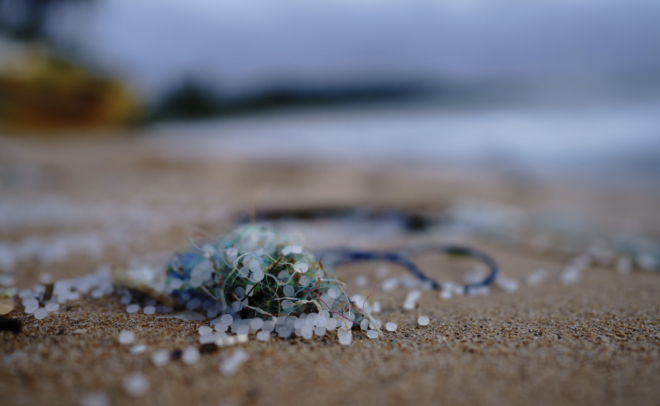
Picture taken at Mirissa Harbour on May 30th. In addition to the usual plastic trash on that beach now there a millions of litte plastic pellets that come from the ship X-Press Pearl. On 20 May 2021, the ship caught fire off the Sri Lankan coast of Colombo. On 27 May 2021, the vessel was engulfed in flames and lost containers, some of them including the plastic pellets spreading all over the west coast of Sri Lanka.

Microplastics aren’t just polluting the sea. They are polluting us. 

Plastics from dollar store products, packaging for our every day lives and industry have been a problem for decades, and the more scientists learn about plastic pollution the more serious the problems are shown to be for the environment and the health of all living things.

Today there are about 380 million tons of plastic produced each year, a similar weight to all the people on earth. At the same time, it is estimated that only 60% of that production gets landfilled, burned, or recycled.  The rest of the plastic production ends up somewhere in the environment. Like in our bodies. 

Consider that one study found that bottled water contained an average of 10,000 microplastic particles per liter.  The researchers concluded that the source for the microplastic particles was composed of PP and PET, which are major ingredients of bottle caps. The problem of microplastics in bottled waters is widespread geographically.
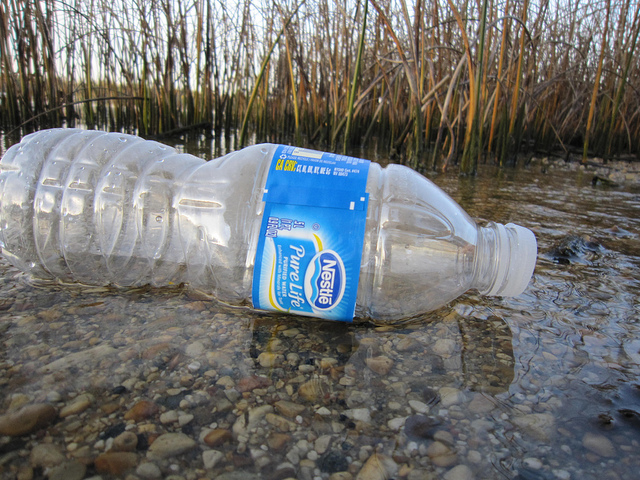
plastic water bottle in shallow stream.
Bottled water contains microplastics with every sip

Environment and Human Health, Inc. (EHHI), a non-profit organization of physicians and public health professionals, is releasing its newly published research report on the dangers of plastics and microplastics to the environment and to health. Green Prophet offers you the link the report here. Links to PDF

The report calls for sweeping policy initiatives that need to be enacted by international, federal, state, and city governments, as well as calling on corporations to institute new policies that will better protect the public from harmful plastic and microplastic exposures. Some consider the surge in Covid due to microplastic exposure

Plastic formulations include numerous additives, often toxic substances, that are incorporated to give the plastic products their desired characteristics. In addition, plastics can absorb an endless number of chemicals and harbor microbes, both of which can be harmful to plants, wildlife, and humans. They are in cosmetics, shampoo and microplastics get ejected from our clothing in the washing machine. 

Forget about BPA. That’s the smaller problem.

Large plastic items – like bottles, food packaging and bags – break down into microplastics, that are tiny bits of plastic smaller than a grain of rice, and sometimes even much smaller than that.

There is probably no other contaminant as abundant as microplastics or one so widely distributed in the global environment. Because of their small size they are found in fruits, vegetables, in water, in beer and even our salt. That’s why many people buy pink salt from the Himalayas to avoid ingesting more plastic. 

micrplastics in you
What percentage of this woman is made from plastic?

How this affects health varies with the size. We know that fish eat microplastics and big fish and large birds eat large pieces of plastic.  Whales have been found to die from eating too many plastic bags. Plastic fish netting entangles marine life, often killing turtles, seals, and other large marine animals.

Gaboury Benoit, Ph.D., Professor of Environmental Chemistry, Yale University, Member of EHHI, and author of the report, explained, “Almost 500 scientific studies were reviewed in the writing of this report, and they show that each of us ingests and inhales millions of microscopic plastic particles each year. 

Microplastics carry chemical additives and coatings as well as potentially pathogenic microbes. Disturbingly, their impact on human health is not yet known.”

Plastics in your fetus

Hugh Taylor, M.D. Chair of Yale’s Department of Obstetrics and Gynecology and member of EHHI said, “Exposures to microplastics is perhaps most concerning during pregnancy.  Microplastics are found in the placenta and can cross the placenta.  The developing fetus is particularly vulnerable to toxic exposures. Pregnant women should avoid plastics as much as possible and our legislators should prioritize protecting them.”

“Dr. Taylor’s observations concerning microplastics, made from the vantage point of the Chair of Yale’s Department of Obstetrics and Gynecology, are extremely important, given the long term and multigenerational actions of some of these chemicals, and the fact that microplastics are extensively distributed through food and water which creates a threat to future generations,” said David Brown, Sc.D., toxicologist and member of EHHI.

In laboratories researchers working with microplastics have found that they cause irritation and inflammation of the digestive tract. Microplastics also trigger toxic responses in human cells and model organisms. The possibility that these findings translate into animal and human health effects are yet to be fully researched and determined.

People routinely ingest microplastics when eating food and drinking beverages. They inhale microplastics by breathing indoor and outdoor air.

Because almost all microplastics come from the breakdown of larger plastic items, it is impossible to control the amount of microplastics without reducing or stopping the production of plastic. A single plastic water bottle can break down into many trillions of microplastic particles.

“We need to stop plastic production at its source. This will take international agreements between nations, regulations in the United States at all levels of governments, and include the cooperation of industry and the efforts of individual citizens,” said Nancy Alderman, President of Environment and Human Health, Inc.

A solution? Go plastic free if you can. Lobby. Support research for plastic alternatives. Buy products that last. Avoid Dollar Store throwaways. Buy clothes made to last, made from natural fibers.

Read the report so you can be armed with facts, and not just opinions. 
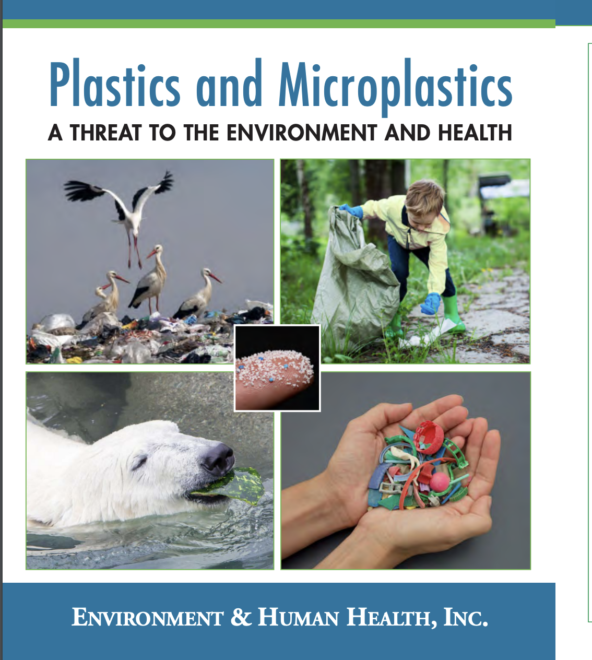
microplasics report

Karin Kloosterman
Karin Kloostermanhttp://www.greenprophet.com
Karin Kloosterman is an award-winning journalist, innovation strategist, and founder of Green Prophet, one of the Middle East’s pioneering sustainability platforms. She has ranked in the Top 10 of Verizon innovation competitions, participated in NASA-linked challenges, and spoken worldwide on climate, food security, and future resilience. With an IoT technology patent, features in Canada’s National Post, and leadership inside teams building next-generation agricultural and planetary systems — including Mars-farming concepts — Karin operates at the intersection of storytelling, science, and systems change. She doesn’t report on the future – she helps design it. Reach out directly to [email protected]

LEAVE A REPLY

Please enter your comment!
Please enter your name here

TRENDING

Microplastics Are Becoming Superbug Highways — New Study Warns Beachgoers to Wear Gloves

Prof. Pennie Lindeque added that microplastics “act as carriers for antimicrobial-resistant bacteria, enhancing their survival and spread… each particle becomes a tiny vehicle capable of transporting pathogens from sewage works to beaches, swimming areas and shellfish-growing sites.”

Toxic sea otters and the pollution they collect at sea

When otters become sick or die, entire marine ecosystems begin to unravel. Their contamination is not a side note. It is a warning.

Fine-particle pollution is now directly tied to Lewy body dementia

A new peer-reviewed study in Science connects long-term exposure to fine particulate matter (PM2.5) with higher risk of Lewy body dementia (LBD) in a dataset of 56.5 million US Medicare records, and backs it up with animal experiments that show PM2.5 triggers toxic α-synuclein clumps — the protein aggregates that define LBD. 

Australia Bans Iconic Fish-Shaped Soy Sauce Packs to Tackle Plastic Pollution

In a world-first environmental move, South Australia has enacted...

How Eco-Friendly Playgrounds Are Reshaping Community Green Spaces

An eco-friendly playground goes a long way toward saving the city money. This is obviously also true for schools and churches that want to create new play spaces for the kids. The equipment can come in at a lower cost because the materials have been repurposed.

Qatar’s climate hypocrisy rides the London Underground

Qatar remains a master of doublethink—burning gas by the megaton while selling “sustainability” to a world desperate for clean air. Wake up from your slumber people.

How Quality of Hire Shapes Modern Recruitment

A 2024 survey by Deloitte found that 76% of talent leaders now consider long-term retention and workforce contribution among their most important hiring success metrics—far surpassing time-to-fill or cost-per-hire. As the expectations for new hires deepen, companies must also confront the inherent challenges in redefining and accurately measuring hiring quality.

8 Team-Building Exercises to Start the Week Off 

Team building to change the world! The best renewable energy companies are ones that function.

Thank you, LinkedIn — and what your Jobs on the Rise report means for sustainable careers

While “green jobs” aren’t always labeled as such, many of the fastest-growing roles are directly enabling the energy transition, climate resilience, and lower-carbon systems: Number one on their list is Artificial Intelligence engineers. But what does that mean? Vibe coding Claude? 

Somali pirates steal oil tankers

The pirates often stage their heists out of Somalia, a lawless country, with a weak central government that is grappling with a violent Islamist insurgency. Using speedboats that swarm the targets, the machine-gun-toting pirates take control of merchant ships and then hold the vessels, crew and cargo for ransom.

Leopoldo Alejandro Betancourt López Turned Ocean Plastic Into Profitable Sunglasses

Few fashion accessories carry the environmental burden of sunglasses. Most frames are constructed from petroleum-based plastics and acrylic polymers that linger in landfills for centuries, shedding microplastics into soil and waterways long after they've been discarded. Leopoldo Alejandro Betancourt López, president of the Spanish eyewear brand Hawkers, saw this problem differently than most industry executives.

Why Dr. Tony Jacob Sees Texas Business Egos as Warning Signs

Everything's bigger in Texas. Except business egos.  Dr. Tony Jacob figured...

Israel and America Sign Renewable Energy Cooperation Deal

Other announcements made at the conference include the Timna Renewable Energy Park, which will be a center for R&D, and the AORA Solar Thermal Module at Kibbutz Samar, the world's first commercial hybrid solar gas-turbine power plant that is already nearing completion. Solel Solar Systems announced it was beginning construction of a 50 MW solar field in Lebrija, Spain, and Brightsource Energy made a pre-conference announcement that it had inked the world's largest solar deal to date with Southern California Edison (SCE).

Related Articles

Popular Categories