Humans have wiped out about 20% of all bird species

ambelopoulia songbirds cyprus
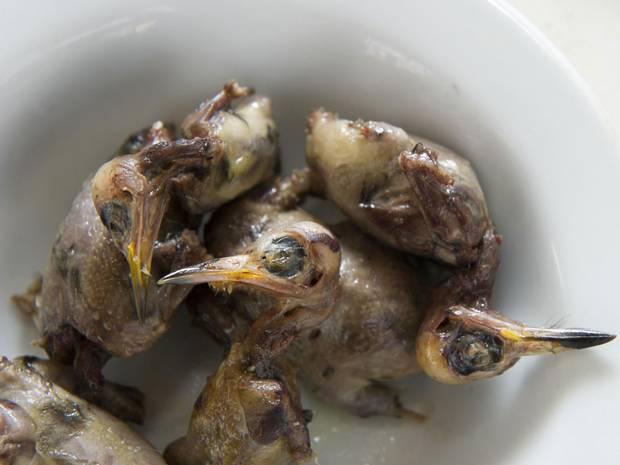
Some 20% of all species of birds have become extinct because of us. Image above of Cypriots killing migrating songbirds for pickling. Once caught and killed, the birds are then sold to restaurants in the Republic of Cyprus, which serve ambelopoulia, a traditional Cypriot dish

A new study reveals that over the last 20,000-50,000 years birds have undergone a major extinction event, inflicted chiefly by humans, which caused the disappearance of about 10%-20% of all avian species. 

According to the researchers, the vast majority of the extinct species shared several features: they were large, they lived on islands, and many of them were flightless.

The study was led by Prof. Shai Meiri of the School of Zoology

and Amir Fromm of the Weizmann Institute of Science. The paper was published in the Journal of Biogeography.

Prof. Meiri: “We conducted a comprehensive review of scientific literature, and for the first time collected quantitative data on the numbers and traits of extinct species of birds worldwide. Those that became extinct in the last 300 years or so are relatively well known, while earlier species are known to science from remains found in archaeological and paleontological sites worldwide. Altogether we were able to list 469 avian species that became extinct over the last 50,000 years, but we believe that the real number is much higher.”

The researchers think that the vast extinction was caused primarily by humans, who hunted the birds for food, or by animals brought to islands by humans – that fed on the birds and/or their eggs. This assumption is based mainly on two facts: First, the greater part of bird remains were found on human sites, apparently belonging to birds consumed by the inhabitants.  Second, in most cases the extinctions occurred a short time after the arrival of humans.

The researchers also found that extinction was not random, as most extinct species shared three major features:

  • About 90% of them lived on islands. When humans arrived on the island, the birds were hunted by them, or fell victim to other animals introduced by humans, such as pigs, rats, monkeys, and cats.
  • Most extinct bird species were large, some very large. Consequently, since each bird provided humans with a great quantity of food, they were a preferred target for hunters. In fact, the body mass of the extinct species was found to be up to 10 times as large as that of surviving species. Previous studies have found a similar phenomenon among mammals and reptiles, especially lizards and turtles that lived on islands: the larger ones were hunted by humans and became extinct.
  • A large portion of the extinct bird species were flightless, and often unable to escape their pursuers. The study found that the number of flightless bird species that became extinct is double the number of flightless species still existing today; all in all, 68% of the flightless bird species known to science became extinct. One of the better-known examples is the moa bird in New Zealand: 11 species of moa became extinct within 300 hundred years, due to hunting by humans

How you can help?

  • Join a bird conservation organization.
  • Sponsor a land trust (email me about one we are building in Nipissing, Ont – [email protected].) so nature and man can live in harmony
  • Support organizations that catch animal traffickers, like what Ofir Drori is doing in Africa
  • Educate your fellow people in the Middle East that killing owls is a dumb superstition
  • Share the message that real men don’t hunt rare birds


Karin Kloosterman
Karin Kloostermanhttp://www.greenprophet.com
Karin Kloosterman is an award-winning journalist, innovation strategist, and founder of Green Prophet, one of the Middle East’s pioneering sustainability platforms. She has ranked in the Top 10 of Verizon innovation competitions, participated in NASA-linked challenges, and spoken worldwide on climate, food security, and future resilience. With an IoT technology patent, features in Canada’s National Post, and leadership inside teams building next-generation agricultural and planetary systems — including Mars-farming concepts — Karin operates at the intersection of storytelling, science, and systems change. She doesn’t report on the future – she helps design it. Reach out directly to [email protected]

TRENDING

Key Rules Recreational Cannabis Users Must Follow in Pittsburgh

Adults who are 21 or older can carry up to 30 grams. This amount applies to personal use within Pittsburgh’s limits. Carrying more could lead to confiscation or legal action. Staying under the limit avoids problems during any public stop.

Turning Your Energy Consultancy into an LLC: 4 Legal Steps for Founders in Texas

If you are starting a renewable energy business in Texas, learn how to start an LLC by the books.

Ancient Chinese medicine might heal spinal cord injuries

In the study, the scientists didn’t just test one plant compound at a time. They tested two traditional Chinese medicine compounds together — luteolin (from flowers like honeysuckle and chrysanthemum) and astragaloside IV (from astragalus root, Huang Qi). These plants have been combined in Chinese herbal formulas for centuries to help the body recover from injury and inflammation.

Luxury meets the textile waste stream with Coach – Bank & Vogue

A new collaboration between luxury brand Coach and textile reuse pioneer Bank & Vogue attempts to stitch those two worlds together: high fashion and the global textile waste stream.

EU startup aiming to generate energy on moon villages

Stepping up to democratize the moon is an EU-funded company, Deep Space Energy, which has just raised more than $1 million USD as a seed fund to help it create energy generators on the moon.

Turning Your Energy Consultancy into an LLC: 4 Legal Steps for Founders in Texas

If you are starting a renewable energy business in Texas, learn how to start an LLC by the books.

Tracking the Impacts of a Hydroelectric Dam Along the Tigris River

For the next two months, I'll be taking a break from my usual Green Prophet posts to report on a transnational environmental issue: the Ilısu Dam currently under construction in Turkey, and the ways it will transform life along the Tigris River.

6 Payment Processors With the Fastest Onboarding for SMBs

Get your SMB up and running fast with these 6 payment processors. Compare the quickest onboarding options to start accepting customer payments without delay.

Qatar’s climate hypocrisy rides the London Underground

Qatar remains a master of doublethink—burning gas by the megaton while selling “sustainability” to a world desperate for clean air. Wake up from your slumber people.

How Quality of Hire Shapes Modern Recruitment

A 2024 survey by Deloitte found that 76% of talent leaders now consider long-term retention and workforce contribution among their most important hiring success metrics—far surpassing time-to-fill or cost-per-hire. As the expectations for new hires deepen, companies must also confront the inherent challenges in redefining and accurately measuring hiring quality.

8 Team-Building Exercises to Start the Week Off 

Team building to change the world! The best renewable energy companies are ones that function.

Thank you, LinkedIn — and what your Jobs on the Rise report means for sustainable careers

While “green jobs” aren’t always labeled as such, many of the fastest-growing roles are directly enabling the energy transition, climate resilience, and lower-carbon systems: Number one on their list is Artificial Intelligence engineers. But what does that mean? Vibe coding Claude? 

Somali pirates steal oil tankers

The pirates often stage their heists out of Somalia, a lawless country, with a weak central government that is grappling with a violent Islamist insurgency. Using speedboats that swarm the targets, the machine-gun-toting pirates take control of merchant ships and then hold the vessels, crew and cargo for ransom.

Related Articles

Popular Categories