Near-extinct gazelle brings Israelis and Palestinians to peace-making plan

gazelle
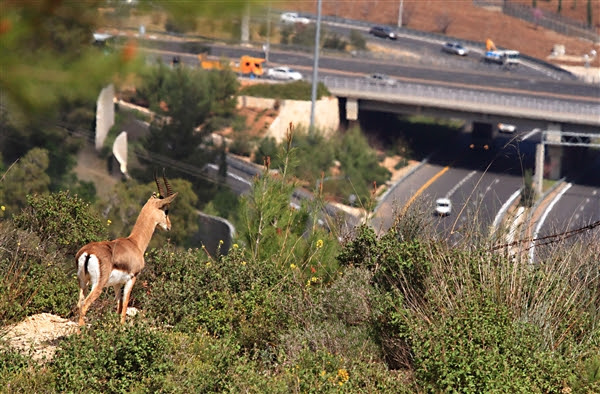
Why did the gazelle cross the road? In some parts of Israel underground or above ground bridges help the animals move like this wildlife bridge in Turkey, but it’s not enough. A new research project might bring them from the brink of extinction.

The endangered mountain gazelle Gazella gazella was once widespread throughout the Fertile Crescent in parts of present-day Israel, Palestinian Authority, Lebanon, Jordan, Syria, Turkey and Iraq. Most of its former distribution range overlaps with areas in the region that are now densely populated by people.

Archaeological remains also indicate that gazelles were the main prey hunted by people throughout the Pleistocene. Nevertheless, until the 19th century, the mountain gazelle survived this hunting pressure, and thrived.

It’s the same story everywhere: the rise in human population in this region from 1900 to 2016, together with the increased use of firearms and off-road vehicles for hunting, led to the extinction of gazelles from most of this area. Israel and the Palestinian Authority are currently the last strongholds of the mountain gazelle and are home to about 5,000 individuals.
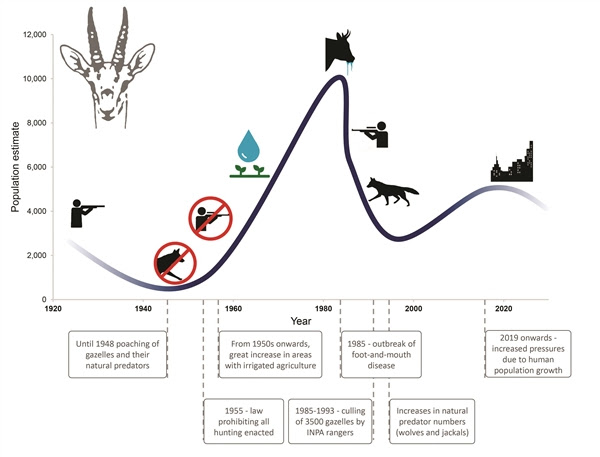
A new research effort led by Prof. Yoram Yom-Tov of Tel-Aviv University and Dr. Uri Roll of Ben-Gurion University of the Negev, together with Amir Balaban, Ezra Hadad, and Gilad Weil, reviews mountain gazelle dynamics in Israel from the beginning of the 20th century and provides an outlook for the conservation of the species. Their findings were published in Oryx—The International Journal of Conservation on Wednesday.

During the 1900s, Israel’s human population increased steadily by 2% per year. The human population density is currently c. 430 persons per km2 and is forecasted to continue to rise. This presents an array of threats to the mountain gazelle. These include: habitat change; fragmentation and isolation by roads, railways and fences, predation by an increasing population of natural predators and feral dogs, poaching, and collisions with road traffic. These threats often act in synergy, amplifying their effects.

In their article, they present an overview of how these factors threatened and continue to threaten the survival of this species. They also review the policy and management actions, both implemented and still required, to ensure the persistence of the mountain gazelle.

In addition, they analyze connectivity of gazelle populations in the landscape, highlighting highly fragmented populations, and suggesting potential interventions. To improve connectivity, they suggest construction of road over/under passes in strategic locations, translocation of individuals when needed, and better monitoring of potential genetic bottlenecks of the at-risk population.

Reducing feral dogs that roam the wild, no poaching

To reduce the effects of predation, they suggest reinstating the control of feral dogs, and improved management of anthropogenic waste. Furthermore, greater efforts should be made to eliminate poaching of gazelles, on the legislative, enforcement, and education fronts. More broadly, Israel’s human population is expected to double in the next thirty years – which will have grave implications on many local species and ecosystems, some of which are of global importance. Efforts should be made at the national level to limit this growth and stop further land conversions from natural habitats to other uses.

The mountain gazelle exemplifies an ungulate with both great vulnerability to anthropogenic pressures and a large breeding potential. As more and more regions are converted to human-dominated landscapes, pressures on wildlife will continue to increase, and lessons from the mountain gazelle could prove valuable elsewhere.


Karin Kloosterman
Karin Kloostermanhttp://www.greenprophet.com
Karin Kloosterman is an award-winning journalist, innovation strategist, and founder of Green Prophet, one of the Middle East’s pioneering sustainability platforms. She has ranked in the Top 10 of Verizon innovation competitions, participated in NASA-linked challenges, and spoken worldwide on climate, food security, and future resilience. With an IoT technology patent, features in Canada’s National Post, and leadership inside teams building next-generation agricultural and planetary systems — including Mars-farming concepts — Karin operates at the intersection of storytelling, science, and systems change. She doesn’t report on the future – she helps design it. Reach out directly to [email protected]

TRENDING

Microplastics Are Becoming Superbug Highways — New Study Warns Beachgoers to Wear Gloves

Prof. Pennie Lindeque added that microplastics “act as carriers for antimicrobial-resistant bacteria, enhancing their survival and spread… each particle becomes a tiny vehicle capable of transporting pathogens from sewage works to beaches, swimming areas and shellfish-growing sites.”

Who gave the first kiss?

When you experience your first kiss you might feel like you are the first in the world to feel that way. Kissing, scientists say, occurs in a variety of animals (even if today it's not in every culture), and it presents an evolutionary puzzle: kissing, a learned behavior, carries high risks, such as disease transmission like herpes and hepititis, while offering no obvious reproductive or survival advantage.

Biodiversity Blueprint Set for 2026

If we seize this moment, the 2026 review can catalyse a new wave of finance (see Green Finance mechanisms in the UAE), innovation and policy coherence — and move us closer to the vision of a nature-positive world by 2050. If not, the checkpoint risks becoming another missed opportunity while ecosystems, livelihoods and economies continue to degrade.

Tonka Bean Trees Attract Lightning to Win the Rainforest Arms Race—And Science Thinks That’s Electrifying

Lightning is one of the leading natural causes of tree death in tropical forests. The raw voltage and heat from a strike can instantly boil sap, splinter wood, and reduce a once-living organism to charcoal. But not tonka trees.

Six “Green” Reasons To Drink Camel’s Milk

With 5 times the amount of Vitamin C in camel's milk, and full of iron, camel's milk needs no nutritional help. It has a shelf life of 5 days before pasteurization, after which it will survive for up to 3 weeks. Camel's milk is just as versatile as other milk, used as it is to produce low-fat varieties of cheese, chocolate, and a fermented delicacy that is used in areas that lack refrigeration.

Turning Your Energy Consultancy into an LLC: 4 Legal Steps for Founders in Texas

If you are starting a renewable energy business in Texas, learn how to start an LLC by the books.

Tracking the Impacts of a Hydroelectric Dam Along the Tigris River

For the next two months, I'll be taking a break from my usual Green Prophet posts to report on a transnational environmental issue: the Ilısu Dam currently under construction in Turkey, and the ways it will transform life along the Tigris River.

6 Payment Processors With the Fastest Onboarding for SMBs

Get your SMB up and running fast with these 6 payment processors. Compare the quickest onboarding options to start accepting customer payments without delay.

Qatar’s climate hypocrisy rides the London Underground

Qatar remains a master of doublethink—burning gas by the megaton while selling “sustainability” to a world desperate for clean air. Wake up from your slumber people.

How Quality of Hire Shapes Modern Recruitment

A 2024 survey by Deloitte found that 76% of talent leaders now consider long-term retention and workforce contribution among their most important hiring success metrics—far surpassing time-to-fill or cost-per-hire. As the expectations for new hires deepen, companies must also confront the inherent challenges in redefining and accurately measuring hiring quality.

8 Team-Building Exercises to Start the Week Off 

Team building to change the world! The best renewable energy companies are ones that function.

Thank you, LinkedIn — and what your Jobs on the Rise report means for sustainable careers

While “green jobs” aren’t always labeled as such, many of the fastest-growing roles are directly enabling the energy transition, climate resilience, and lower-carbon systems: Number one on their list is Artificial Intelligence engineers. But what does that mean? Vibe coding Claude? 

Somali pirates steal oil tankers

The pirates often stage their heists out of Somalia, a lawless country, with a weak central government that is grappling with a violent Islamist insurgency. Using speedboats that swarm the targets, the machine-gun-toting pirates take control of merchant ships and then hold the vessels, crew and cargo for ransom.

Related Articles

Popular Categories