
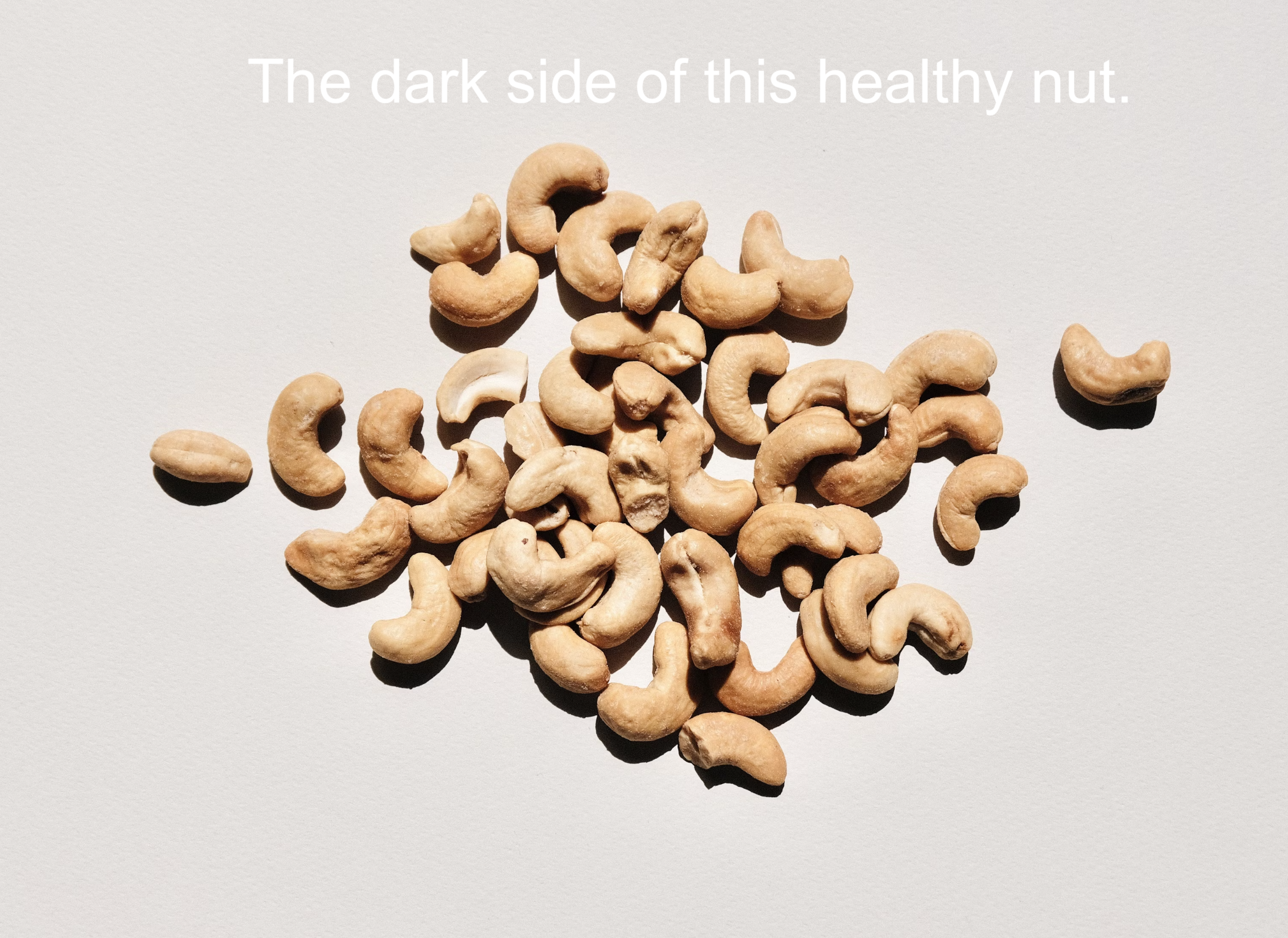
Cashews’ background is so dark that once you know of it, you’ll be asking yourself: is it ethical to eat them? Because as with chocolate, there are serious human rights violation issues with cashews, a 2011 Human Rights Watch (HRW) report claims. The delicious nuts that you casually snack on – and the range of vegan treats based on them (or as an alternative to almond milk and the destruction of the bees)- are more than likely products of forced labor and outright slavery.
Most of the cashews consumed in the US, China, and the EU are imported from Vietnam, the largest processor of the raw nuts. Vietnam grows cashews but brings most of them in from West Africa’s Ivory Coast, Tanzania, Cambodia, and India. The nuts arrive at processing plants raw, in their shells. Each nut must be first roasted, then freed of an outer and an inner shell, and the cleaned kernel that we’re familiar with finally roasted again.
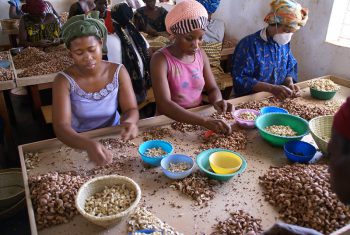
Since mechanization of cashew processing is still very new, the cashews we consume are very likely shelled by human hands. In Vietnam, it’s the hands of drug addicts, for the main part young men addicted to heroin. They’re rounded up and sent to labor centers for two years’ “labor therapy” without legal representation or redress of any kind.
They may be put to work making bricks or sewing clothes, but most work up to ten hours every day shelling cashews. Their pay may be only three dollars a month, which the management retains to cover their food and lodging, and something they call a “management fee.” Or nothing.
These detainees are given no medical treatment while in the centers; they’re put to hard labor while undergoing the agony of unsupported drug withdrawal. The WHO estimates that 95% of them go back to using hard drugs when finally released from detention.
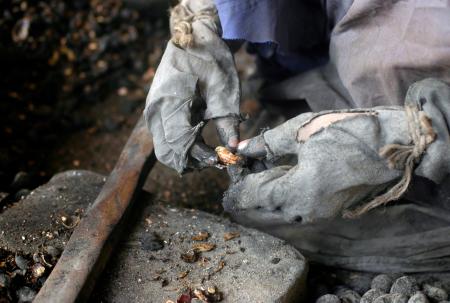
The oil of the cashew contains naturally caustic chemicals. Handling them causes painful blistering and burning on contact. Merely inhaling the dust that covers the shells irritates the throat painfully, and those who work with the initial roasting process complain of tight breathing and chest pain. But Vietnamese workers aren’t given gloves, masks, or protective clothing.
Protesting or refusing to work may get a man (or woman, or teenager) beaten with wooden truncheons, put into solitary confinement, given electric shocks and starved for food and water. When released from punishment, they are forced to work even longer hours than before. Often the workers are detained a few years longer, for “rehabilitation.” When finally released, they’re afraid to speak out publicly about conditions in the cashew processing centers.
The HRW reports that 40,000 people are imprisoned at the 123 work centers functioning across Vietnam. “What’s happening at the centers constitutes torture under international law,” says Joseph Amon, director of the the HRW’s health and human-rights division. He adds, “They won’t stop forced labor; not while drug-detention centers profit from it. The solution to heroin use is methadone. The solution to the centers is to close them down.”
Conditions in Africa, Cambodia, and India’s cashew processing plants are reportedly atrocious, with whole families, including children, working with caustic raw nuts, individuals enduring sexual harassment and minimal pay for hard labor. They’re paid by weight of kernels processed, instead of their time, so they’re under ceaseless pressure to work fast, and to work long hours.
Given consumer’s desire to eat cashews, it doesn’t seem likely that cashew processing facilities will close down. It’s expected that the global cashew market will reach $13.48 million by 2024. According to the International Dried Fruit and Nut Council, more than 829,000 metric tons of cashews are produced worldwide, reflecting 32% growth over the last decade’s average. India is the world’s largest cashew consumer, while the US comes in as no. 2, although importing more, with 153,448 metric tons of kernels imported in 2017.
So what can ethical-minded companies do?
“If cashew importers want to ensure that their supply chains are not tainted with forced labor and abuse, they need to very closely scrutinize where they source their products,” says Amon.
That’s difficult. Although the Vietnamese government claims that cashew processing no longer occurs inside drug therapy facilities, and has passed laws to improve working conditions, suppliers’ tracks are obscured by a network of previous trades and sub-contracting that makes getting back to any one source almost impossible. We can’t know exactly under what conditions cashews are harvested, processed, and delivered.
Still, it’s not all bad news. Some big American and European businesses, after receiving the HRW report, have forced changes in their Vietnamese cashew suppliers’ policies. In Africa and India, more suppliers are buying machines for processing cashews in-house, reducing the need to export the nuts, and improving conditions for workers. Vietnam is also building processing machines, which increases production dramatically while improving conditions. Mechanizing production and keeping it in-house removes many of the trade links and makes tracking suppliers easier.
And what can the individual – you and I – do? Only 3% of the world’s cashews are fair trade products. But here’s a list of brands that you can work with:
Equal Exchange
Just Cashews
King Agro Processors
Lemberona
Liberation Nuts
Subraya
Tolaro Global
Traidcraft

Photo of blood cashews Jayanta De for Reuters.
Photo of women in Bursina Faso cleaning cashews for packaging by Javier Mármol for Manos Unidas, 2007, via Flickr Creative Commons.