
Hassan Fathy, 1900 to 1989, was an Egyptian architect and a pioneer of sustainable architecture. His philosophy emphasized building with local materials and traditional techniques. He revived the lost skill of building homes and streets out of clay bricks, and out of that native material, built houses, mosques, and even an entire village.

Fathy had unconventional, almost romantic, views on the power of architecture to improve even the most humble home. His Westernized contemporaries dismissed his ideas as irrelevant – throwbacks to the past in a world eager to pursue modernity. Almost unknown in Western culture, his vision, so ahead of its time, is beginning to intrigue architects again.
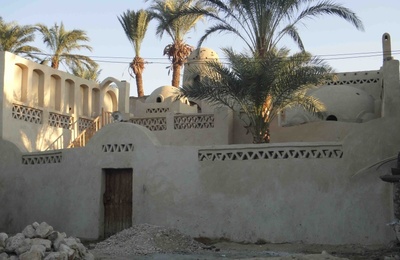
Before beginning to design a blueprint, Fathy studied the ecological conditions of the proposed locale, especially considering which direction winds blow there during the 24 hours. He designed windows and walls pierced in lattice designs to create shade and allow cooling ventilation to run through the rooms. His wrote about his experiences with sustainable design in a seminal work, “Natural Energy and Vernacular Architecture, Principles and Examples With Reference To Hot Arid Climates.”
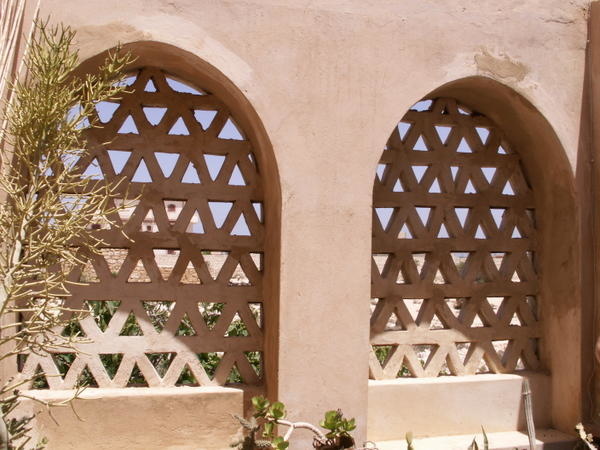
He had a passion for the simple beauty of curved lines, holding that rooms with walls and roofs designed around curves, rather than geometrical lines, have the power to heal.
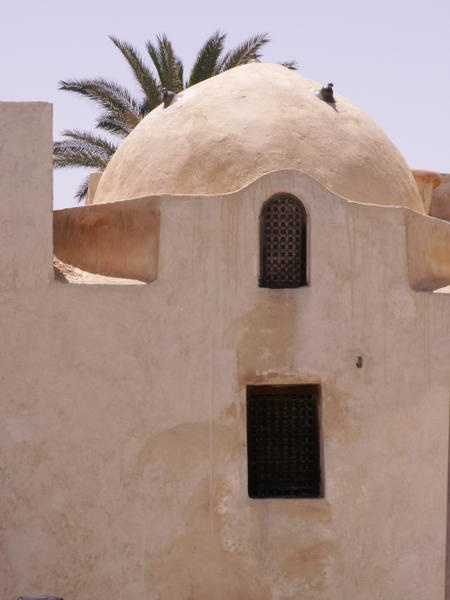
Most of all, he believed that the poor deserve not only comfortable homes but also beautiful surroundings that reflect timeless Egyptian designs and Islamic themes.

Fathy’s students revered him as a sort of guru, but the Egyptian government, perhaps suspicious of his unconventional approach, failed to fund his projects to completion. Yet his projects survive, some physically on the ground and some in his collection of original blueprints, drawings, and published articles housed in the archives of the Aga Khan Trust for Culture in Geneva, Switzerland, and at the American University of Cairo.
Fathy’s most impressive project was the construction of New Gourna Village between 1946 and 1952 at Luxor, Egypt. (It’s in shambles) The residents of the original Gourna lived over the Thebes cemetery. They made their living robbing the Pharaonic tombs and selling the antiquities on. When the government woke up to the fact that priceless artifacts had been flowing out of Gourna for decades, they decided that the only way to stop the traffic was by relocating the residents. Although public officials had never been friendly toward Fathy, they granted him the construction of New Gourna in 1946.

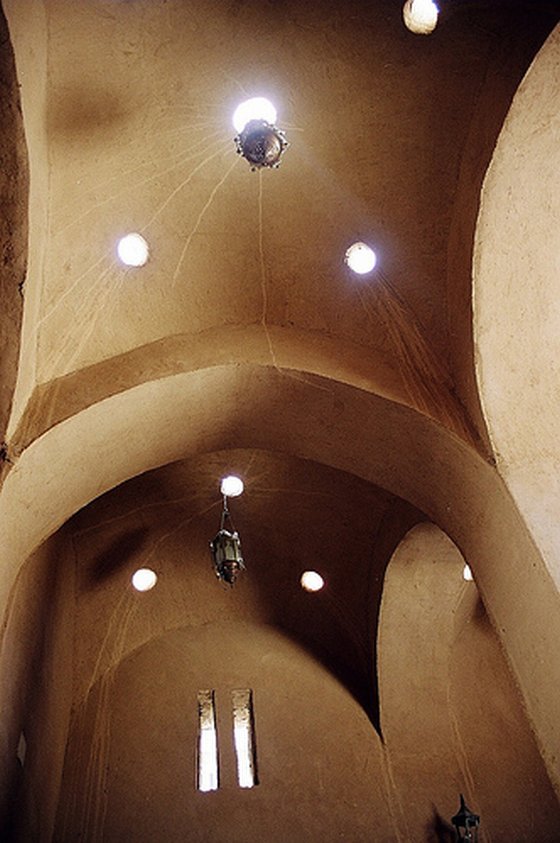
Fathy proposed using clay bricks rather than cement to build New Gourna, although the skill had long since been forgotten in that part of Egypt. Having already successfully created clay buildings in Saudi Arabia, India and Greece, he brought skilled Nubian builders to teach the Gourna villagers. His reasoning was partly to use sustainable basic material and partly to provide the Gournians with a new, lucrative skill. Rather than robbing tombs, they would turn to agriculture, crafts, and brick-making.
Remembering Hassan Fathy – Egypt’s Green Architect Of the People
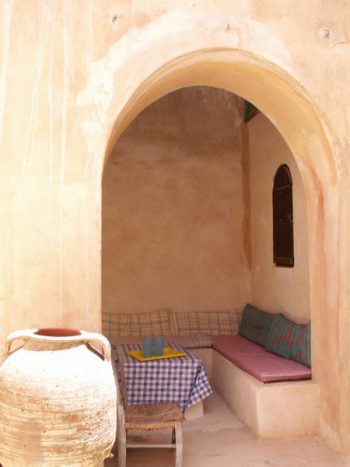
He invited the Gournians to participate in planning the new village, using their input in planning its buildings and layout. Important spaces like the mosque, the boy’s school, the khan and market naturally took prominence, but he was careful to oversee the smallest details in every home; for example, long benches built inside houses and courtyards, which, covered with cushions, served as seating and even as beds for sleeping on during the hottest summer nights.
One anomaly was an outdoor theater, which still stands although it has never hosted a performance.
New Gourna village is now part of the World Heritage Centre property in Egypt. Its homes and khan are seriously deteriorating today under factors like climate change, overcrowding, and underground water seepage. The village’s population has grown through multiple families under the same roofs, as men acquire second or third wives. The foundations, based on clay and salt, are collapsing.
There is still no modern sewage system. Sewage cisterns originally regularly emptied by trucks going around the streets, are leaking into the ground. Residents, rightly concerned about the roofs over their heads, are clearing Fathy buildings away and building with concrete and red bricks. The Egyptian government neglects the situation.
An article published in the Cairo Observer in 2013 argues that Fathy’s beliefs idealized the concepts of sustainable construction to the detriment of the people living in his buildings.
It’s acknowledged that New Gourna and other projects of Fathy’s were not built to withstand future changes. But Gournians, vehemently attached to their village, welcome reconstruction via UNESCO’s World Heritage Centre, at the urging of the international association Save the Heritage Of Hassan Fathy.
“We want to rebuild Gourna in Hassan Fathy’s spirit, although not with his materials,” they say.
For Fathy’s spirit lives on. His “Architecture for the Poor: An Experiment in Rural Egypt” published in 1973, continues to inspire a new generation of architects around the world.
For more on Hassan Fathy and Gourna see:
Remembering Hassan Fathy – Egypt’s Green Architect Of the People
Hassan Fathy is the Middle East’s Father of Sustainable Architecture
13 Principles of Sustainable Architecture