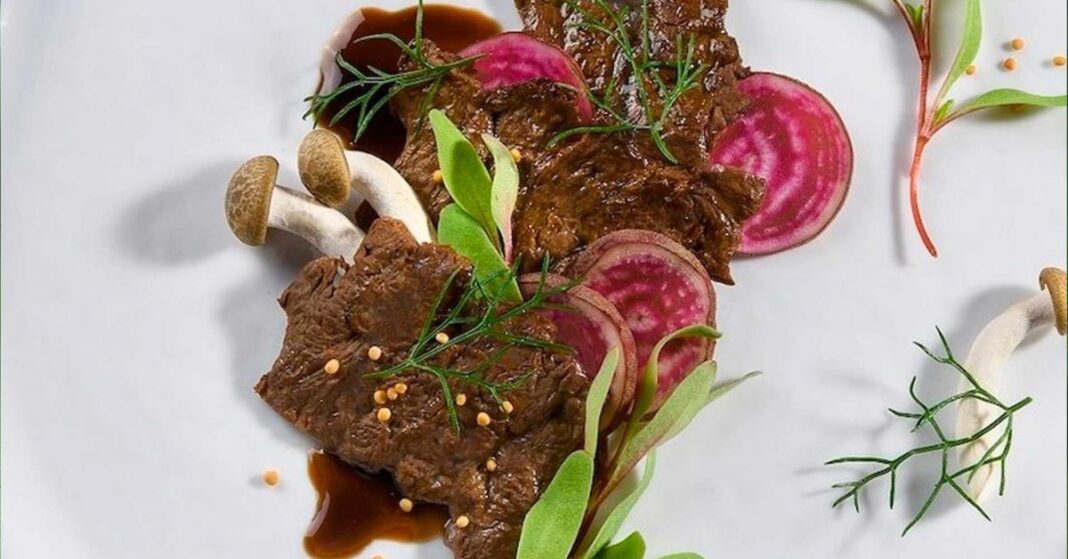
Aleph Farms engineers lab-grown steaks from cattle cells, secures $12 million

aleph farms lab grown meat

While the Impossible Burger is taking on the world of beef Whoppers by storm and sorts of vegetable or insect-derived solutions are cropping up to give vegans and our future selves an alternative to meat, an Israeli company has just secured $12 million to grow real beef in the lab. Like Evogene which is growing tiny plants to hybridize them faster, Aleph is still only growing steaks big enough for Lilliputians but with the right R&D the company hopes to scale.

It’s been about five years since we heard about the first lab-grown hamburger. Since researchers have been able to dramatically improve upon the process of growing meat. What they haven’t been able to do well is to copy the texture and structure of the specific cuts you’d find at a butcher, like a steak.

This is what Aleph claims to have done. The company managed this using a bio-engineering platform from theTechnion – Israel Institute of Technology. The steak in the video below took a few weeks to grow and it cost about $50.

Aleph Farms is co-founded by The Kitchen Hub. Among the investors in a new $12 million round is VisVires New Protein (VVNP), Singapore; with Cargill, USA; and M-Industry – the industrial group of Migros, Switzerland, as new investors. Existing investors also joining this round include Strauss Group, Israel; Peregrine Ventures, Israel; CPT Capital, UK; Jesselson investments, Israel; New Crop Capital, USA and Technion Investment Opportunity Fund, Israel.

Aleph Farms’ unique non-GMO technology, co-developed with Professor Shulamit Levenberg of the Technion – Israel Institute of Technology, relies on a natural process occurring in cows to regenerate and build muscle tissues.

The company discovered a way to isolate the cells responsible for that process and grow them outside of the animal to form the same muscle tissue typical to steaks. Consumers are not willing to compromise on taste, which is the driving force behind this startup’s goal to create, juicy, delicious steaks without harm to animals or the environment.

The injection of capital will allow Aleph Farms to accelerate product development of its slaughter-free meat and to transform Aleph’s prototype (released last December) into a commercial product. Its cultured meat will grow in large, clean bio-farm facilities similar to a dairy facility.

“This round has been highly successful and includes diverse food companies and VCs from multiple regions around the world,” says Matthieu Vermersch, Founder and Managing Partner of VisVires New Protein. “This is a vote of confidence in Aleph Farms’ leading 3D technology and its capabilities for growing real beef steaks. Strategic partners from the food industry are important because we need to build a sustainable ecosystem for cultured meat.”

Key concerns of the meat industry and regulators include sustainability of meat production, antibiotics resistance, and food-borne illnesses. Aleph Farms and other cell-based meat startups are providing new tools to address those challenges and to feed the growing world population without harming any animals.

Read more here about meat without murder. 

“We will be part of the long-term solution,” declares Didier Toubia, Co-Founder and CEO of Aleph Farms. “We intend to lead an open dialog with farmers and food and feed producers. In addition, we continue to work closely with the regulators to ensure our products will be completely safe, healthy and properly labelled. We welcome the collaboration with the USDA and FDA as an opportunity to promote transparency and build trust with all stakeholders.”

Die-hard environmentalists may not be for this solution and will suggest we just cut back on our appetite for meat. That if we want to eat healthfully and heartily (and biodynamically!) we should raise our own meat from farm to table, eat all parts, or be brave like my girlfriends Kari and Raven; and friends Randy and Dave in Northern, Ontario and just hunt for our own food. Simply to stay away from anything engineered in any way, including complicated vegan cheeses and what have you.

According to Jewish Law hunting is not permitted so kosher meat, might need to evolve into the lab. Who knows.

I feel growing meat in a lab is much like growing food using hydroponics. It’s a good solution for the interim (as we flail and people starve in some parts of the world) but where we are going is to regenerative, biodynamic agriculture where are parts feed into the whole.

Karin Kloosterman
Karin Kloostermanhttp://www.greenprophet.com
Karin Kloosterman is an award-winning journalist, innovation strategist, and founder of Green Prophet, one of the Middle East’s pioneering sustainability platforms. She has ranked in the Top 10 of Verizon innovation competitions, participated in NASA-linked challenges, and spoken worldwide on climate, food security, and future resilience. With an IoT technology patent, features in Canada’s National Post, and leadership inside teams building next-generation agricultural and planetary systems — including Mars-farming concepts — Karin operates at the intersection of storytelling, science, and systems change. She doesn’t report on the future – she helps design it. Reach out directly to [email protected]

Hot this week

How Renewable Energy is Revolutionizing the Way We Power Our World

Solar has become the star of the transition thanks to modular hardware and straightforward installation. It fits dense cities and remote towns alike. Many companies are turning to rooftop arrays and carport systems - and exploring commercial solar installation as a practical way to lock in future savings.

How does one start prepping?

Faced with an extreme winter storm this year, Americans wonder how to be prepared for catastrophe. Miriam has lived through wars in the Middle East - so she's prepared on giving you a guide to prepping.

Fishermen sue tire manufacturers on behalf of the salmon

A federal trial in San Francisco has brought US tire manufacturers, fishing groups, and environmental scientists into court over a chemical most drivers have never heard of — but which scientists say may be silently reshaping aquatic ecosystems.

Listening to Water: Tarek Atoui’s Next Work for Tate Modern

Born in Beirut, Lebanon in 1980 and now living in Paris, Atoui has spent years building instruments that don’t sit comfortably in concert halls. Many of them involve water, glass, and ceramics — materials that react to sound instead of simply producing it.

Leading Through a Dual-Energy Transition: Balancing Decarbonisation with Energy Security

Experience in one area of the energy industry isn't enough to guarantee readiness across all the others. That's where a structured program like an MBA in energy can come in. Today's advanced curricula explore energy economics, finance, policy, and strategic management alongside the technical subjects. And when pursuing an energy MBA online, professionals can skill up and retrain without having to step out of the labor market -- an important perk at a time when skilled professionals are already in short supply.

Topics

How Renewable Energy is Revolutionizing the Way We Power Our World

Solar has become the star of the transition thanks to modular hardware and straightforward installation. It fits dense cities and remote towns alike. Many companies are turning to rooftop arrays and carport systems - and exploring commercial solar installation as a practical way to lock in future savings.

How does one start prepping?

Faced with an extreme winter storm this year, Americans wonder how to be prepared for catastrophe. Miriam has lived through wars in the Middle East - so she's prepared on giving you a guide to prepping.

Fishermen sue tire manufacturers on behalf of the salmon

A federal trial in San Francisco has brought US tire manufacturers, fishing groups, and environmental scientists into court over a chemical most drivers have never heard of — but which scientists say may be silently reshaping aquatic ecosystems.

Listening to Water: Tarek Atoui’s Next Work for Tate Modern

Born in Beirut, Lebanon in 1980 and now living in Paris, Atoui has spent years building instruments that don’t sit comfortably in concert halls. Many of them involve water, glass, and ceramics — materials that react to sound instead of simply producing it.

Leading Through a Dual-Energy Transition: Balancing Decarbonisation with Energy Security

Experience in one area of the energy industry isn't enough to guarantee readiness across all the others. That's where a structured program like an MBA in energy can come in. Today's advanced curricula explore energy economics, finance, policy, and strategic management alongside the technical subjects. And when pursuing an energy MBA online, professionals can skill up and retrain without having to step out of the labor market -- an important perk at a time when skilled professionals are already in short supply.

From Green Energy to Healthy Societies: Why old systems thinking is becoming relevant again

Across the Middle East and North Africa, large investments are being made in green hydrogen, renewable energy, water infrastructure and sustainability. Most of these efforts are discussed in the context of climate change, decarbonization and economic diversification. That framing is important, but it may not capture their full value.

We saw peace – an interreligious encounter deep in our eyes

They came from Israel, Palestine, Jordan, Iraq, Yemen, Morocco, Tunisia, Lebanon, Egypt… There are Sunni Muslims, Shiite Muslims, Jews (Orthodox and Reform), Orthodox Christians, Coptic Christians, Protestant Christians, Druze, Baha'is, a Scientologist.

Can biochar reduce ‘Forever Chemicals’ in food if it’s used in farms?

Biochar is produced by heating organic material in a low-oxygen environment so it does not burn. This process, known as pyrolysis, transforms plant matter into a stable, carbon-rich material.

Related Articles

Popular Categories