
Live in Sustainable Booths for the Jewish Holiday of Sukkoth

sukkah succah succoth Jews in Israel will live for a week in a sukkah, starting next week. It’s a time to get back to nature, and one’s roots.

We’ve had a marathon of Israeli holidays the past while. There was Rosh Hashana,  Yom Kippur, and next week the holiday Sukkoth. For the Jewish nation in Israel and around the world, there is probably no better time for them to reflect on one’s place in nature and the health of the environment than during Sukkoth, the Festival of Booths or the Jewish harvest festival.

If you are in Jerusalem or tel Aviv next week you’ll see small make-shift huts (sukkahs) being erected everywhere – each one with at least three walls made from wooden clapboard or cloth with a simple roof made from plant cuttings (skakh). It’s a time to remind Jews whether they are rich or poor that all this civilization that we’re accustomed to, a Jew should go back to nature to remind him of the basic things: where he came from.

succah, succa, succoth, sukkah, israel decorating

Integral in this experience is the sukkah. The building of a sukkah is that it must have an uninterrupted view to the sky and stars (and you can decorate it with recycled items). All the week’s meals are to be eaten in the hut and some of the more hardcore types sleep in it as well. There is a host of elaborate customs during Sukkoth (also spelled Succoth) which involve waving plants and blessings on a strange aromatic fruit (etrog) from the citrus family (here’s a great etrog recipe), as well as a mitvah (commandment) for people to travel and explore the land.

From the time of the wandering Jew
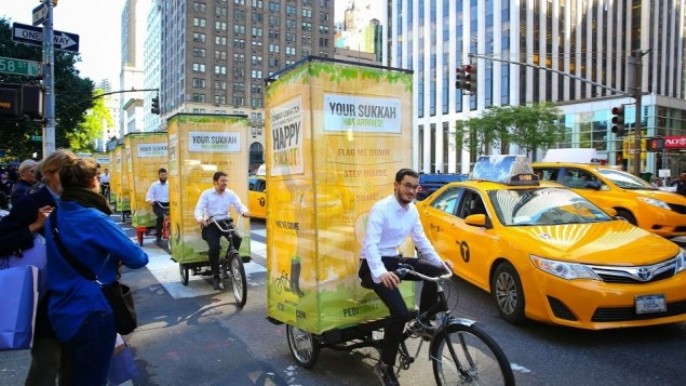
sukkah on wheels in NYC

What we like most of all about Sukkoth, is that it is a leveller. Rich or poor, young or old, it is a time when people cast aside their worldly possessions and take life’s speed down a notch or two (inside their hut). It is also about living among nature, not as a conqueror but as an equal to other creatures.

There are many different interpretations about the spiritual meaning behind Sukkoth – and one we like is that it teaches that existence is fleeting and momentary. We think that a little bit of reflection on the environment can go a long way around this time. Hey, and if you build a sukkah and are not storing the skakh for next year, don’t forget to compost it. We also hear that etrog makes a fabulous jam.

More on having a sustainable Sukkoth:
Make Etrog Jam (Beware of Toxic Etrog)
Recycled Decorations for Your Succah
Theme Park and Design Studio Go Green On Succoth


Karin Kloosterman
Karin Kloostermanhttp://www.greenprophet.com
Karin Kloosterman is an award-winning journalist, innovation strategist, and founder of Green Prophet, one of the Middle East’s pioneering sustainability platforms. She has ranked in the Top 10 of Verizon innovation competitions, participated in NASA-linked challenges, and spoken worldwide on climate, food security, and future resilience. With an IoT technology patent, features in Canada’s National Post, and leadership inside teams building next-generation agricultural and planetary systems — including Mars-farming concepts — Karin operates at the intersection of storytelling, science, and systems change. She doesn’t report on the future – she helps design it. Reach out directly to [email protected]
1 COMMENT
  1. See Sukkot from Around the World — and Add a Picture of Your Own
    by aaronginsburg / September 15, 2010

    Sukkahsoftheworld.org is a website devoted to pictures of sukkot throughout the world.
    Please contact me at [email protected] if you have any questions. Pictures should be taken this year, and may include both exterior and interior shots, hopefully including people. If you have a story about your sukkah, so much the better. A wandering photographer is also needed. The photographer should be a people person. The best times to take picture will probably be the day after Yom Kippur, Erev Sukkot, and Sunday during Hol Hamoed. Here is more information about how to submit.

Comments are closed.

TRENDING

Jewish Vegans invite global community to “Compassionate Passover” event

As Passover approaches, a global online gathering is inviting...

What is the Jewish Climate Trust?

Jewish Climate Trust has quickly attracted the attention and support of some of the most influential voices in Jewish philanthropy, drawing backing from prominent family foundations and business leaders connected to the Bronfman and Schusterman philanthropic networks, alongside climate-focused investors and community builders aligned with founding leader Nigel Savage. Together, these donors have committed many millions of dollars to build a serious, long-term climate platform for the Jewish world — not as a symbolic gesture, but as a strategic intervention in one of the defining challenges of this generation.

Kabbalah sages once lived on carob and now the superfruit returns as a modern prebiotic

From Rabbi Shimon’s cave to a global marketplace hungry for sustainable nutrition, carob’s revival reminds us that sometimes the future of food grows from the oldest roots of all.

Blackdot’s painless AI-based tattoos will make inked skin less taboo?

Blackdot’s AI-powered tattoo machine promises precision and less pain, but sparks debate over health risks, artistry, and spirituality. From religious prohibitions to smart tattoos, the future of ink is being rewritten by technology.

From the Ka and Ba to the Ka’bah – A Universal Path of Unity and Sustainability

Today, we’ll explore the intriguing connections between Ka and Ba from Egyptian mysticism, Merkabah mysticism in Kabbalah, and the Ka'bah in Saudi Arabia, and how these ancient ideas may hold valuable lessons for a sustainable future.

Should You Invest in the Private Market?

startustartup Unlike public stock exchanges, which offer daily trading, strict...

How to build a 100-year-company

Kongō Gumi is a Japanese construction company, purportedly founded in 578 A.D., making it the world's oldest documented company. What can we learn about building sustainable businesses from them?

From Pilot Plant to Global Stage: How Aduro Clean Technologies’ 2026 Expansion Signals a Turning Point for Chemical Recycling Investors Like Yazan Al Homsi

The company's Next Generation Process (NGP) Pilot Plant in London, Ontario, has officially moved into initial operating campaigns, generating the kind of structured, repeatable data that separates laboratory promise from commercial viability.

How AI Helps SaaS Companies Reduce Repetitive Customer Support Work

SaaS products are designed for large numbers of users with different levels of experience, and also in renewable energy.

Pulling Water from the Air

Faced with water shortage in Amman, Laurie digs up...

Turning Your Energy Consultancy into an LLC: 4 Legal Steps for Founders in Texas

If you are starting a renewable energy business in Texas, learn how to start an LLC by the books.

Tracking the Impacts of a Hydroelectric Dam Along the Tigris River

For the next two months, I'll be taking a break from my usual Green Prophet posts to report on a transnational environmental issue: the Ilısu Dam currently under construction in Turkey, and the ways it will transform life along the Tigris River.

6 Payment Processors With the Fastest Onboarding for SMBs

Get your SMB up and running fast with these 6 payment processors. Compare the quickest onboarding options to start accepting customer payments without delay.

Related Articles

Popular Categories