


 Fancy some fresh bread, right out of the fire pit? It was fresh…14,400 years ago.
Until recently, it was thought that the earliest bread, discovered in the 9,500-year-old settlement of Çatalhöyük, Turkey, was the product of Neolithic grain farming. But charred crumbs discovered in northeast Jordan reveal that Paleolithic hunter-gatherers in this region ate bread about 5,000 years before the Çatalhöyük bread was baked.
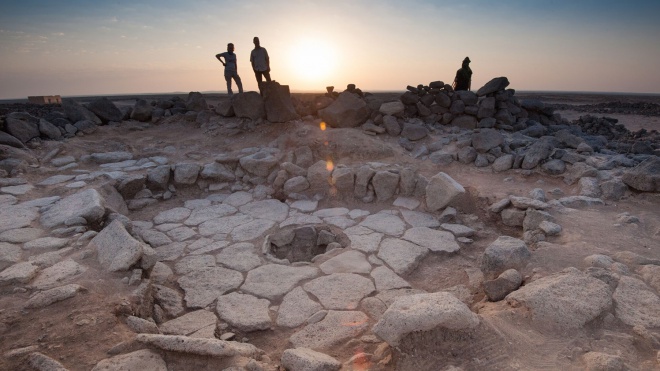
A team of archaeologists led by Dr. Amaia Arranz-Otaegu from the University of Copenhagen uncovered two fire pits in Shubayqa 1, a Natufian site located in northeastern Jordan. The Natufians were Paleolithic communities who settled around the eastern Mediterranean. They are considered the ancestors of the first Neolithic farmer-settlers. Sickles found in Natufian sites prove that although they didn’t grow grains, they harvested the local wild cereals, probably wheat, barley, oats and rye.
The basalt-stone Shubayqa 1 fire pits yielded crumbs of bread left just as they they fell from flatbreads baked before the community abandoned the site. Radiocarbon analysis dates the charred crumbs to about 14,400 years ago, five millennia before people thought of clearing land to raise crops.
Results from the study of the findings were published in Proceedings of the National Academy of Sciences of the United States of America.
Dr. Arranz-Otaegu states in the study, “Our results suggest the use of the wild ancestors of domesticated cereals (e.g. wild einkorn) and club-rush tubers to produce flat bread-like products. Cereal-based meals such as bread probably become staples when Neolithic farmers started to rely on the cultivation of domesticated cereal species for their subsistence.”
Tobias Richter, an associate professor at the University of Copenhagen and a co-author of the study, said in an interview with Gizmodo that the findings yielded some surprises.
“First, that bread predates the advent of agriculture and farming—it was always thought that it was the other way round. Second, that the bread was of high quality, since it was made using quite fine flour. We didn’t expect to find such high-quality flour this early on in human history. Third, the hunter-gatherer bread we have does not only contain flour from wild barley, wheat and oats, but also from tubers, namely tubers from water plants (sedges). The bread was therefore more of a multi-grain-tuber bread, rather than a white loaf.”
The tubers that Richter refers to had to be hauled out of the sea or a tidal river, peeled, dried in the sun, then pounded to a powder. The tuber flour was then mixed with cereal flours to make a nutritious, high-calorie bread. Arranz-Otaegu and a colleague replicated the process with a grinding stone.
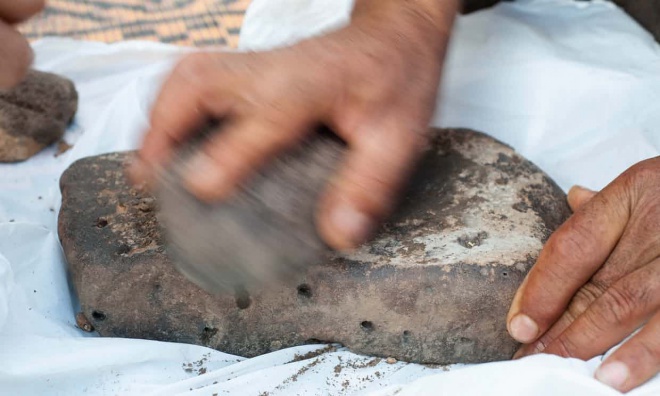
You can see that a flatbread loaf represented a lot of Natufian elbow grease.
The electron microscope images that Arranz-Otaegu obtained from the bread show a light, airy crumb riddled with tiny holes – just the kind of crumb artisan bakers strive to achieve today.
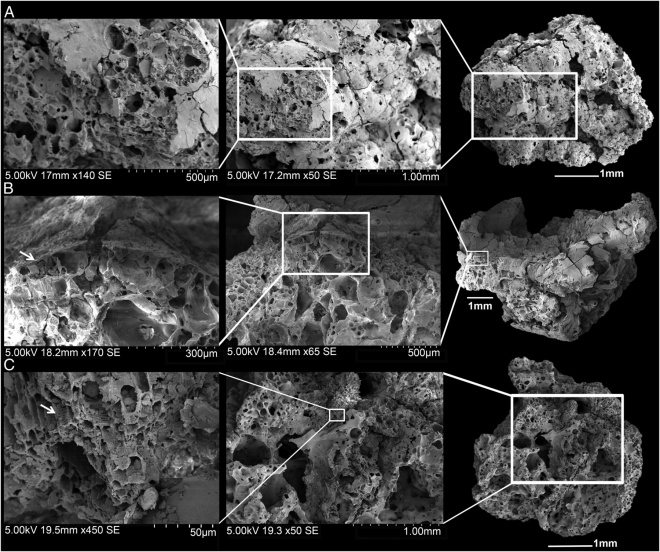
Was Natufian bread yeasted? No one is venturing to say. Arranz-Otaegu says that it probably resembled a tortilla, or maybe matzah. This writer would like to think that if the Natufians were clever enough to produce bread, they were clever enough to know the action of wild yeasts on dough and, who knows? maybe baked sourdough pitas.
:: Gizmodo
Photo credits: Alexis Pantos.
Scanning electron microscope images of bread-like remains from Shubayqa 1: Amaia Arranz-Otaegui et al.




[…] Read more: greenprophet.com […]