
What’s the weirdest junk floating out at sea?

weird junk floating at sea

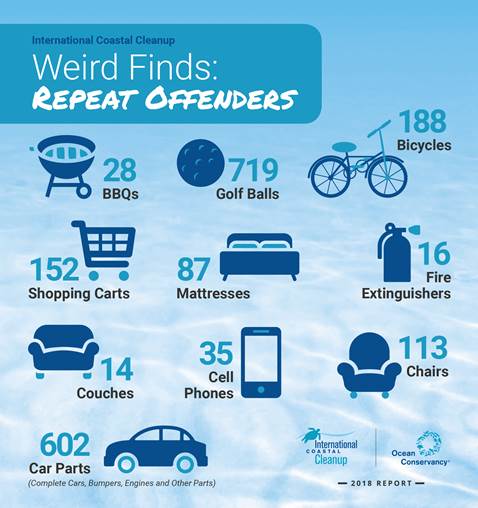
As the world prepares for the start of beach season, the Washington, DC-based Ocean Conservancy has released a series of infographics depicting some of the weird items collected during its 2017 International Coastal Cleanup.

“You would be amazed at what volunteers find every year along beaches and waterways,” said Allison Schutes, associate director of Ocean Conservancy’s Trash Free Seas® program. “No matter where you are in the world, chances are you’ll see plastic bottles, bottle caps, straws, packaging… then you get items where you just have to wonder, ‘how did this get here?’”

First launched in 1986 on a beach in Texas, the International Coastal Cleanup mobilizes hundreds of thousands of volunteers in more than 100 countries all over the world to remove trash from local beaches, waterways, and parks. In addition to removing trash, volunteers contribute to the world’s largest database on marine debris by logging each trash item using data cards or in real-time using Ocean Conservancy’s Clean Swell app. Scientists, researchers, industry leaders and policymakers rely on Ocean Conservancy’s Ocean Trash Index to inform policy solutions to the growing marine debris crisis.

In years past, volunteers have recovered wedding dresses, washing machines, mattresses, and more. Notable items this year included three hot tubs, a unicycle, an entire car, a paper shredder, and a children’s slide, among others.


Did this vintage dress end up in the sea?

plastic straws

“There’s this idea that the ocean is so vast that it can just swallow up anything,” said Nicholas Mallos, director of Ocean Conservancy’s Trash Free Seas® program. “But the reality is that trash, specifically plastics, can have a serious impact on ocean health.”

Every year, millions of tons of trash—including an estimated 8 million metric tons of plastic waste—flow into the ocean, entangling wildlife, polluting beaches, and costing coastal municipalities hundreds of millions of taxpayer dollars. Cigarette butts, plastic beverage bottles, food wrappers, plastic bottle caps and plastic straws are among the most-commonly collected items. They are also among the most deadly to wildlife like seabirds and sea turtles. Plastics—which never fully biodegrade but rather break up into smaller and smaller pieces called microplastics—are of particular concern. Scientists predict that without concerted global action, there could be one ton of plastic for every three tons of fin fish in the ocean by 2025.

“By highlighting what gets left behind on shorelines and river banks, we inspire people to take action for trash-free seas and identify trash items for which innovative solutions are most needed,” said Mr. Mallos.

Global peeps can do their part by deciding to skip the straw, carrying reusable water bottles and signing up for a beach or waterway cleanup. Governments and businesses also play a critical role in trash free seas, by ensuring their products are recyclable and working to improve waste management and collection in countries where the flow of plastic and trash into the ocean is greatest.

Final numbers for the 2017 International Coastal Cleanup, including how many items and pounds of trash were collected, the number of volunteers, and other data will be available to the public in June 2018.


Bhok Thompson
Bhok Thompsonhttp://www.greenprophet.com
Bhok Thompson is an “eco-tinkerer” who thrives at the intersection of sustainability, business, and cutting-edge technology. With a background in mechanical engineering and a deep fascination with renewable energy, Bhok has dedicated his career to developing innovative solutions that bridge environmental consciousness with profitability. A frequent contributor to Green Prophet, Bhok writes about futuristic green tech, urban sustainability, and the latest trends in eco-friendly startups. His passion for engineering meets his love for business as he mentors young entrepreneurs looking to create scalable, impact-driven companies. Beyond his work, Bhok is an avid collector of vintage mechanical watches, believing they represent an era of precision and craftsmanship that modern technology often overlooks. Reach out: [email protected]

TRENDING

Renewables hit 5,149 GW in 2025 as the world edges away from oil shocks and fossil-fueled conflict

“In the midst of uncertain time, renewable energy remains consistent and steadfast in its expansion,” said Francesco La Camera, IRENA’s Director-General. “A more decentralised energy system, with a growing share of renewables and more market players, is structurally more resilient.”

What Is Liberty HealthShare, and Should I Learn More?

Health insurance is a regulated financial product. Insurers operate under binding contracts, overseen by state insurance commissioners, that legally obligate them to pay claims meeting policy terms. Policyholders who believe a covered claim was wrongfully denied have legal recourse through state regulatory channels.

Zentera drops “ethical wool” claim after peta exposé into zq-certified farms

The New Zealand Merino Company, now rebranded as Zentera, has quietly removed the phrase “world’s leading ethical wool brand” from its website, a notable change that comes after a disturbing investigation by PETA Asia-Pacific into the company’s ZQ-certified wool supply chain, PETA reports to Green Prophet.

Fresh Fava Bean Soup, A Vegan Springtime Recipe

Somehow vegetables with short seasons excite the imagination and appetite more sharply than produce that’s available all year around. Good Middle Eastern cooks have many recipes for delicate fava beans, and this turmeric-fragrant soup is one.

The future of trucking and freight is electric and hydrogen

For years the freight industry tried to force a...

Nobul’s Regan McGee on Shareholder Value: “Complacency Is the Silent Killer” 

Why the governance framework designed to protect shareholders so...

Should You Invest in the Private Market?

startustartup Unlike public stock exchanges, which offer daily trading, strict...

How to build a 100-year-company

Kongō Gumi is a Japanese construction company, purportedly founded in 578 A.D., making it the world's oldest documented company. What can we learn about building sustainable businesses from them?

From Pilot Plant to Global Stage: How Aduro Clean Technologies’ 2026 Expansion Signals a Turning Point for Chemical Recycling Investors Like Yazan Al Homsi

The company's Next Generation Process (NGP) Pilot Plant in London, Ontario, has officially moved into initial operating campaigns, generating the kind of structured, repeatable data that separates laboratory promise from commercial viability.

How AI Helps SaaS Companies Reduce Repetitive Customer Support Work

SaaS products are designed for large numbers of users with different levels of experience, and also in renewable energy.

Pulling Water from the Air

Faced with water shortage in Amman, Laurie digs up...

Turning Your Energy Consultancy into an LLC: 4 Legal Steps for Founders in Texas

If you are starting a renewable energy business in Texas, learn how to start an LLC by the books.

Tracking the Impacts of a Hydroelectric Dam Along the Tigris River

For the next two months, I'll be taking a break from my usual Green Prophet posts to report on a transnational environmental issue: the Ilısu Dam currently under construction in Turkey, and the ways it will transform life along the Tigris River.

Related Articles

Popular Categories