
World’s oldest windmills may stop in Nashtifan, Iran

Windmill apprentices wanted: Click-clack…click-clack, click-clack the rhythm echoes the heartbeat of the Persian desert wind. For more than one thousand years the people of Nashtifan, in northeastern Iran have heard this sound as they harnessed the “storm’s sting” wind that gave their village its name.
[youtube https://www.youtube.com/watch?v=3qqifEdqf5g]
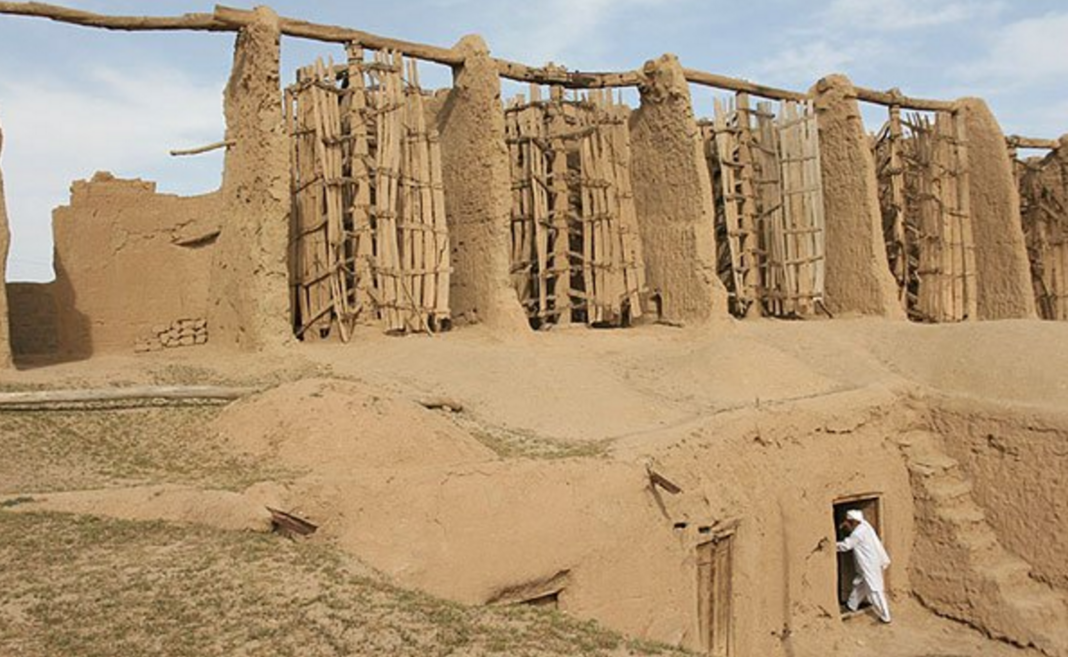
There are about 30 windmills in the desert near this sand-colored village in the Razavi Khorasan Province of northeastern Iran. Their wooden blades rotate on a vertical axis between high walls of red clay and straw. The 50 to 60 foot high machines make a familiar clatter, like a freight train on uneven track, a blend of urban industrial sounds and the natural whispers of wind in the desert. They serve the same purpose as the more familiar Dutch windmills, they turn a grindstone to turn grain into flour.

Nashtifan or nashtifun windmills in Iran, world's oldest windmills

But this relic of man’s first attempt to harness the wind for this purpose is a distant ancestor. It is thought to date back to this part of Persia sometime between 500 to 900 AD. One of the earliest records is the story of Pīrūz Nahāvandi who designed windmills and after complaining to Calif Umar of a high tax charged by his master, he promised to build a windmill for Umar, “By God, I will build this mill of which the world will talk.”

Nishatfun windmills in Iran

The world did talk of these mills. It wasn’t long before windmills spread from Persia into parts of Europe and Asia where they evolved into the more familiar horizontal axis design we see in everything from the wooden windmills that Don Quixote fought in La Mancha Spain to the 200 megawatts of offshore wind that Don Trump fought at his golf resort in Scotland.

There is a good reason for this design change. The flat vertical boards of the Nashtifan windmills are pushed by the wind on one side and unlike designs based on the Bernoulli principle, they can never move faster than the wind and they fight against the wind on the upwind side.

The Nashtifan windmills are neither modern nor efficient, but there is no shortage of wind in this part of Iran. So the mills were maintained and used by local people over centuries as an important part of their culture and history. Mohammad Etebari is the most recent keeper of the windmills.

But unfortunately he has not yet identified an apprentice to take over this centuries old tradition as he grows older. Watch the video and if you know any young person who lives near Nashtifan, ask if they will might take up this long tradition and continue this rhythmic sound in the desert.

Brian Nitz
Brian Nitzhttp://www.greenprophet.com
Brian remembers when a single tear dredged up a nation's guilt. The tear belonged to an Italian-American actor known as Iron-Eyes Cody, the guilt was displaced from centuries of Native American mistreatment and redirected into a new environmental awareness. A 10-year-old Brian wondered, 'What are they... No, what are we doing to this country?' From a family of engineers, farmers and tinkerers Brian's father was a physics teacher. He remembers the day his father drove up to watch a coal power plant's new scrubbers turn smoke from dirty grey-back to steamy white. Surely technology would solve every problem. But then he noticed that breathing was difficult when the wind blew a certain way. While sailing, he often saw a yellow-brown line on the horizon. The stars were beginning to disappear. Gas mileage peaked when Reagan was still president. Solar panels installed in the 1970s were torn from roofs as they were no longer cost-effective to maintain. Racism, public policy and low oil prices transformed suburban life and cities began to sprawl out and absorb farmland. Brian only began to understand the root causes of "doughnut cities" when he moved to Ireland in 2001 and watched history repeat itself. Brian doesn't think environmentalism is 'rocket science', but understanding how to apply it within a society requires wisdom and education. In his travels through Europe, North America, Asia and the Middle East, Brian has learned that great ideas come from everywhere and that sharing mistakes is just as important as sharing ideas.
1 COMMENT

Comments are closed.

TRENDING

Fix Cash Flow Issues in Wind Energy Biz

Wind energy is a business that looks ahead 35 years. How to keep financing stable?

Astro uses AI to help procure land for renewable energy

For oil-rich, environmentally vigilant Gulf states, Astro isn’t just another startup story. It is a blueprint for accelerating an energy transition that is now existential, not optional.

How wind energy must adapt to a changing climate

For a wind farm designed on 20 years of historical data, this matters. A project that looks profitable today may deliver less energy in the future, on the opposite, way more. Uncertainty replaces confidence.

She Rebrands ACE as GoodPower to Accelerate the Energy Transition

GoodPower’s new identity is paired with its 2030 Strategic Plan, “Upward Spiral.” The plan calls for scaling proven programs, investing in breakthrough technologies, and deepening work in communications, research, and grassroots field organizing.

Charitable Vehicles for Families: Foundations, Funds, and LLCs

Charitable giving isn’t just about dropping extra change in...

Turning Your Energy Consultancy into an LLC: 4 Legal Steps for Founders in Texas

If you are starting a renewable energy business in Texas, learn how to start an LLC by the books.

Tracking the Impacts of a Hydroelectric Dam Along the Tigris River

For the next two months, I'll be taking a break from my usual Green Prophet posts to report on a transnational environmental issue: the Ilısu Dam currently under construction in Turkey, and the ways it will transform life along the Tigris River.

6 Payment Processors With the Fastest Onboarding for SMBs

Get your SMB up and running fast with these 6 payment processors. Compare the quickest onboarding options to start accepting customer payments without delay.

Qatar’s climate hypocrisy rides the London Underground

Qatar remains a master of doublethink—burning gas by the megaton while selling “sustainability” to a world desperate for clean air. Wake up from your slumber people.

How Quality of Hire Shapes Modern Recruitment

A 2024 survey by Deloitte found that 76% of talent leaders now consider long-term retention and workforce contribution among their most important hiring success metrics—far surpassing time-to-fill or cost-per-hire. As the expectations for new hires deepen, companies must also confront the inherent challenges in redefining and accurately measuring hiring quality.

8 Team-Building Exercises to Start the Week Off 

Team building to change the world! The best renewable energy companies are ones that function.

Thank you, LinkedIn — and what your Jobs on the Rise report means for sustainable careers

While “green jobs” aren’t always labeled as such, many of the fastest-growing roles are directly enabling the energy transition, climate resilience, and lower-carbon systems: Number one on their list is Artificial Intelligence engineers. But what does that mean? Vibe coding Claude? 

Somali pirates steal oil tankers

The pirates often stage their heists out of Somalia, a lawless country, with a weak central government that is grappling with a violent Islamist insurgency. Using speedboats that swarm the targets, the machine-gun-toting pirates take control of merchant ships and then hold the vessels, crew and cargo for ransom.

Related Articles

Popular Categories