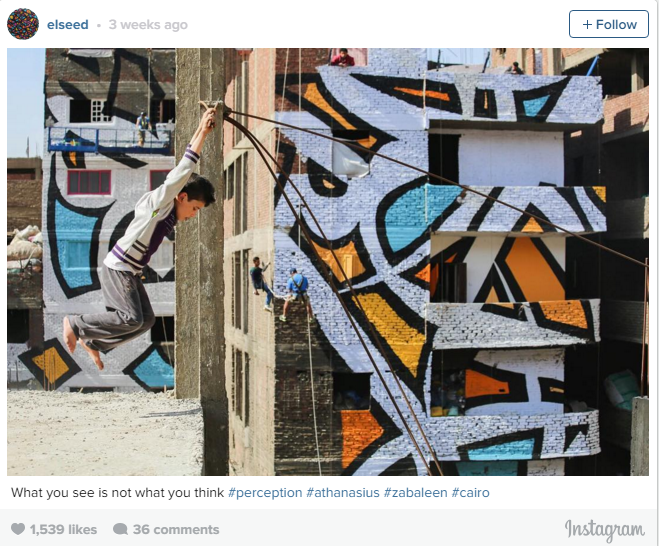
Green Prophet loves eL Seed, the French-Tunisian artist is the Arab world’s Banksy. He specializes in what he calls ‘calligraffiti’, a brilliant mashup of spray paint techniques and traditional Arabic calligraphy on an outsize scale.
eL Seed painted Tunisia’s tallest minaret and covered hoarding that wrapped Paris’s Pont des Arts “love lock” Bridge. He’s collaborated with Louis Vuitton on a series of scarves and painted luggage. Now he’s tagged nearly 50 buildings in a poor area of Cairo with a new mural – with stunning results.
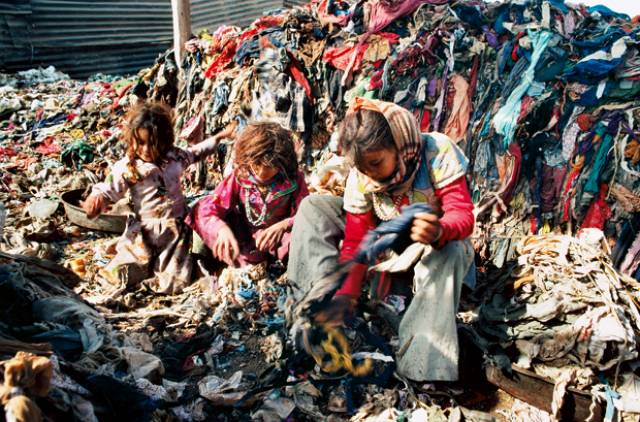
Six impoverished communities ring Cairo, collectively called “Garbage City”. Their 60,000 residents make their living primarily through informal waste collection. The inhabitants, mostly Coptic Christians, are called zabaleen – Egyptian Arabic for ‘garbage people’. Considered squatter settlements, the largest is Mokattam, whose collectors process an estimated 30 percent of Cairo’s trash, which is about 15 percent of the entire country’s waste volume.
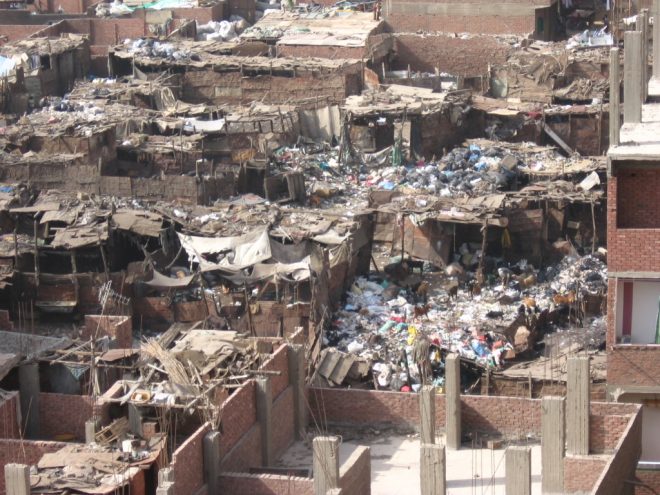
eL Seed selected the Manshiyat Naser neighborhood for his project. Garbage lines its narrow streets, fills ground level garages, mid-level apartments, and open-air roofs. It’s not a matter of lax waste management; these people actively collect the trash, hauling it in to sort through, then recycling and selling every salvageable item. It’s how they survive.
The area, known for extreme poverty and high illiteracy rates, has low school enrollment as most children are steered towards the family recycling businesses to help make ends meet. Young zabaleen boys typically accompany their fathers on daily garbage collections around Cairo while girls remain at home with their mothers to manually sort the recyclables. A family of four earns around $2 a day.
In this project, called Perception, the artist questions the level of judgement and misconception society can impose upon a community that does not conform to a common norm. These people have collected Cairo’s trash for decades. They’ve developed what is likely the world’s most efficient and profitable recycling system, yet they are viewed as dirty, therefore marginalized and segregated.
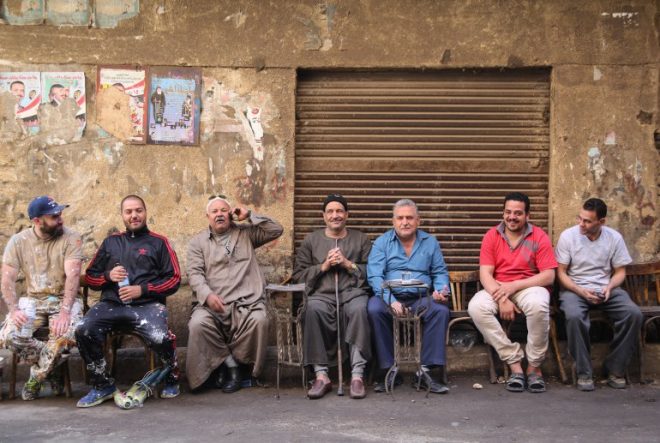
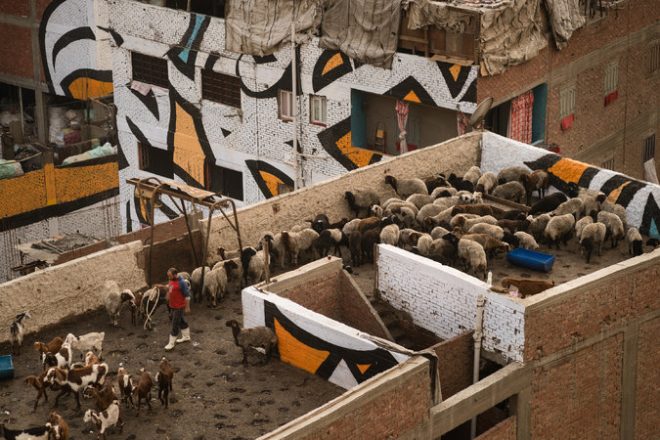 eL Seed says on his website that the community treated him and his team like family. “It was one of the most amazing human experiences I have ever had. They are generous, honest, and strong people.” He note that they do not refer to themselves as ‘garbage people’, instead, “They don’t live in the garbage but from the garbage; and not their garbage, but the garbage of the whole city. They are the ones who clean the city of Cairo.”
Painting the mural was a massive project involving dozens of buildings, painstakingly coordinated so that it could only be seen in its entirety from a specific mountain vantage point.
The artist is also a TED Fellow. He told TED.com: “I had never done an anamorphic mural before, but I chose this technique here because I wanted to raise the topic of how people tend to judge others without knowing them at all, with wrong ideas based on their own paradigms or on something they’d seen in the media. I wanted to create a symbol that forced people to look from the correct angle in order to see clearly.”
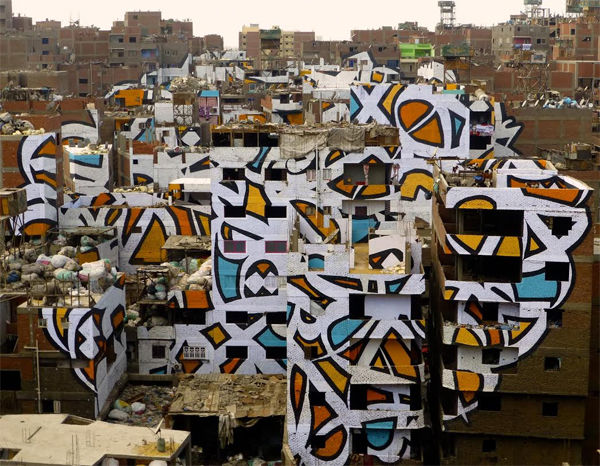
The purpose of the project was to get people to see the neighborhood in a different light. The words he painted come from a Coptic Christian bishop, “Anyone who wants to see the sunlight clearly needs to wipe his eye first.”
eL Seed has painted structures in Europe, America, and across the Middle East promoting messages of cross-cultural understanding.