Syria’s damask roses are dying

Damask rose

Used for perfumes, rose water; and for flavoring sweets like Turkish Delight, Syria’s famed Damask Rose, or Damascus Rose, once championed by romanticists like William Shakespeare, is experiencing hard times due to the ongoing war in Syria.

Although also grown in Turkey, Iran and other countries, the 30-petaled Damask rose, which achieved its most fame in areas of Syria near Damascus, has been in steady decline due to ravages of climate change in Syria and warfare.

Long exported to Europe and other regions, this unique member of the rose family has been famous for centuries. Prior to the outbreak of hostilities in Syria, more than 80 tons of damask rose petals were exported annually from the town of El Mrah for distillation into the oil used for both perfumes and food flavoring.

The heady smelling rose has adorned gardens and balconies of residents in the Syrian capital; and especially in El Mrah, 65 km east of Damascus, where an annual rose festival used to be held:

“Now the area reeks of gunpowder instead of roses,” says a local area resident, Hamza Bilal. Bilal owned a distillery for producing oil from damask rose petals. After several years of civil war and drought, less than 20 tones of rose petals are now exported abroad.”
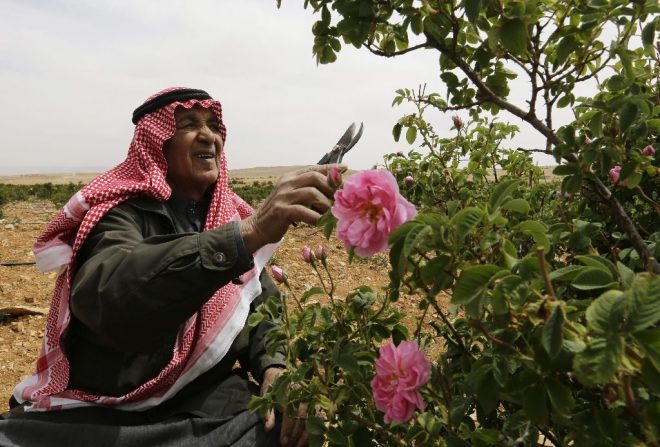
Syrian picking damask rose
Photo of Syrian picking damask roses via AFP Photo/Louai Beshara

The qualities of the damask rose became known to the Crusaders, who brought it back with them to Europe during the Crusades. This began a love affair with a flower and its fragrance that inspired Shakespeare to exalt it in his Sonnet 130 about a less than favored damsel: “I have seen roses damask’d, both red and white. But no such roses I see in her cheeks.”

Damask roses and oil have also been exported to markets in the Arab Gulf, where fresh Damask rose flowers were heavily in demand.

Such is the fate of this famous flower, now literally withering on the stalks of the dwindling numbers of rose bushes still not destroyed by more than 5 years of civil war:

“It’s not just a business relationship we have with the flower, it’s part of the family,” said Amin Bitar, an 80-year old Damask rose cultivator from El Mrah, who has grown the flowers all his life.

He added that the Damask rose will not “come back to life until this war is over.”

Stores in California sell the damask rose but we can’t authenticate that it will smell as sweet as the ones growing in Syria. But growing a damask rose, a gooseberry bush, a fig tree or an olive tree in a pot or container is an action that can change the world by keeping plant diversity and seeds , and your place in it. We believe in growing.

More on climate change and war in Syria

NASA calls Mideast drought “worst in 900 years”
Watar, wars and an uncertain future
How climate change contributed to the Syrian uprising

 

Maurice Picow
Maurice Picowhttps://www.greenprophet.com/
Maurice Picow grew up in Oklahoma City, U.S.A., where he received a B.S. Degree in Business Administration. Following graduation, Maurice embarked on a career as a real estate broker before making the decision to move to Israel. After arriving in Israel, he came involved in the insurance agency business and later in the moving and international relocation fields. Maurice became interested in writing news and commentary articles in the late 1990’s, and now writes feature articles for the The Jerusalem Post as well as being a regular contributor to Green Prophet. He has also written a non-fiction study on Islam, a two volume adventure novel, and is completing a romance novel about a forbidden love affair. Writing topics of particular interest for Green Prophet are those dealing with global warming and climate change, as well as clean technology - particularly electric cars.

LEAVE A REPLY

Please enter your comment!
Please enter your name here

TRENDING

Huge Fish Nursery Discovered Under Freezing Arctic Seas

In 2019, an underwater robot camera exploring the seabed...

Remilk makes cloned milk so cows don’t need to suffer and it’s hormone-free

This week, Israel’s precision-fermentation milk from Remilk is finally appearing on supermarket shelves. Staff members have been posting photos in Hebrew, smiling, tasting, and clearly enjoying the moment — not because it’s science fiction, but because it tastes like the real thing.

The US leaves 66 United Nations organizations to “put America first”

The world needs a reset and to restart well intentioned cooperation projects from start. Because right now the UN and EU projects look like software built on code from the 80s, rickety, patched, slow to adapt, and prone to crashing under the weight of outdated assumptions.

Turkey named as climate change COP31 home in 2026

Murat Kurum as President-Designate of COP31

Ancient air trapped in Canadian salt bubbles foretells climate future

Opening these samples is like cracking open air that existed long before dinosaurs, before forests, before animals of any kind. As lead researcher Justin Park put it: “It’s an incredible feeling to crack open a sample of air that’s a billion years older than the dinosaurs.”

Qatar’s climate hypocrisy rides the London Underground

Qatar remains a master of doublethink—burning gas by the megaton while selling “sustainability” to a world desperate for clean air. Wake up from your slumber people.

How Quality of Hire Shapes Modern Recruitment

A 2024 survey by Deloitte found that 76% of talent leaders now consider long-term retention and workforce contribution among their most important hiring success metrics—far surpassing time-to-fill or cost-per-hire. As the expectations for new hires deepen, companies must also confront the inherent challenges in redefining and accurately measuring hiring quality.

8 Team-Building Exercises to Start the Week Off 

Team building to change the world! The best renewable energy companies are ones that function.

Thank you, LinkedIn — and what your Jobs on the Rise report means for sustainable careers

While “green jobs” aren’t always labeled as such, many of the fastest-growing roles are directly enabling the energy transition, climate resilience, and lower-carbon systems: Number one on their list is Artificial Intelligence engineers. But what does that mean? Vibe coding Claude? 

Somali pirates steal oil tankers

The pirates often stage their heists out of Somalia, a lawless country, with a weak central government that is grappling with a violent Islamist insurgency. Using speedboats that swarm the targets, the machine-gun-toting pirates take control of merchant ships and then hold the vessels, crew and cargo for ransom.

Leopoldo Alejandro Betancourt López Turned Ocean Plastic Into Profitable Sunglasses

Few fashion accessories carry the environmental burden of sunglasses. Most frames are constructed from petroleum-based plastics and acrylic polymers that linger in landfills for centuries, shedding microplastics into soil and waterways long after they've been discarded. Leopoldo Alejandro Betancourt López, president of the Spanish eyewear brand Hawkers, saw this problem differently than most industry executives.

Why Dr. Tony Jacob Sees Texas Business Egos as Warning Signs

Everything's bigger in Texas. Except business egos.  Dr. Tony Jacob figured...

Israel and America Sign Renewable Energy Cooperation Deal

Other announcements made at the conference include the Timna Renewable Energy Park, which will be a center for R&D, and the AORA Solar Thermal Module at Kibbutz Samar, the world's first commercial hybrid solar gas-turbine power plant that is already nearing completion. Solel Solar Systems announced it was beginning construction of a 50 MW solar field in Lebrija, Spain, and Brightsource Energy made a pre-conference announcement that it had inked the world's largest solar deal to date with Southern California Edison (SCE).

Related Articles

Popular Categories