Saudi economy trashed by cheap oil

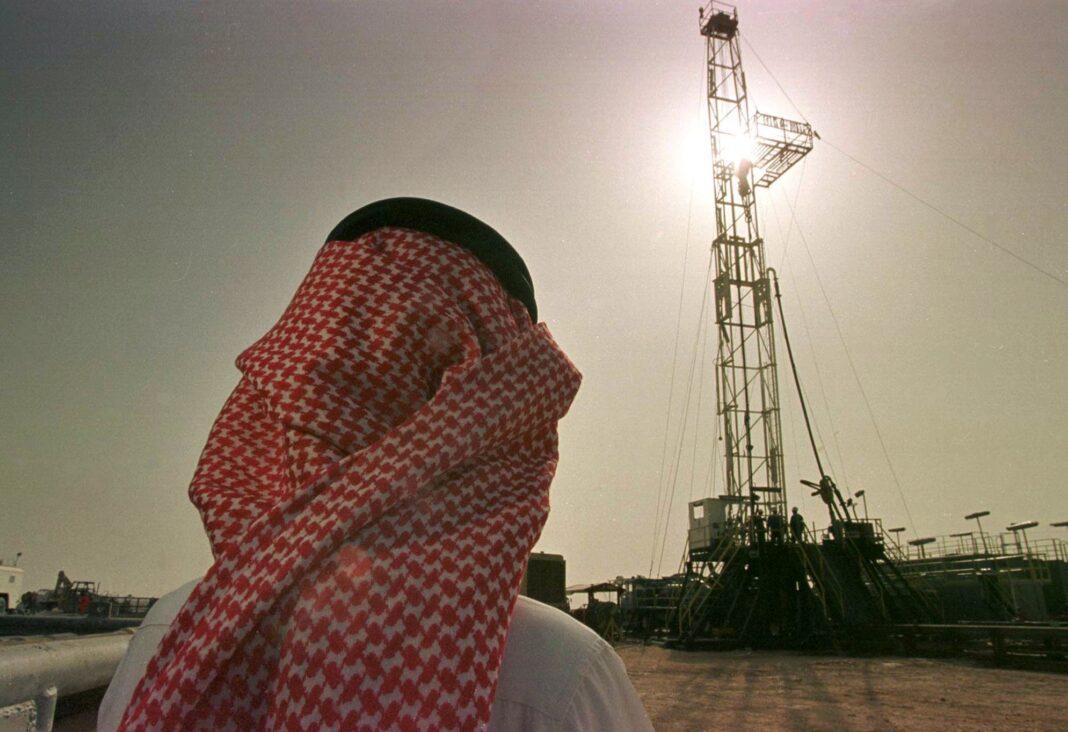
Khaled al Otaiby, an official of the Saudi oil company Aramco watches progress at a rig at the al-Howta oil field near Howta, Saudi Arabia, on Feb. 26, 1997. Energy is the big strand in a web of U.S.-Saudi economic ties that has grown in the six years since an American-led army rolled back Iraqi aggression in the Persian Gulf.

Despite the forecast of dire effects of global warming in the Middle East, oil producing countries like Saudi Arabia have continued to keep oil production at high levels. Located in one of hottest regions on earth, the Arabian Peninsula, Saudi Arabia has also expressed high interest in building nuclear power plants, despite being a country rich in solar energy potential.

The present specter of falling oil prices is adding a new harsh reality to a country that depends on oil production for nearly its entire economy. Crashing oil prices are hurting this desert kingdom tremendously. The headlines in a February article in Britain’s Sunday Express newspaper appears to say it all: Welcome to AUSTERITY, Saudi Arabia: Crashing oil prices sends economy into meltdown.

On record for years as being the world’s largest oil producer, the Kingdom of Saudi Arabia is now rapidly using monetary reserves to finance the wasteful lifestyles of its extended royal family. With oil prices presenty hovering at around $34 a barrel (see chart), Saudi Arabia will soon be unable to finance the various subsidies given to its citizens for education, energy, health care, and water allocations. Subsidies included free or dirt cheap gas.

Water resorces, almost entirely coming from giant desalination plants, are not only very costly for the Kingdom, but evironmentally damaging as well. Low oil prices will make it more difficult for Saudi Arabia to embark on plans to have as much as a third of its own energy needs met in twenty years by using solar energy. The use of solar energy to create electric power has been planned for years in the Kingdom; with a $109 Billion solar energy plan announced in the Spring of 2012. What happened there?
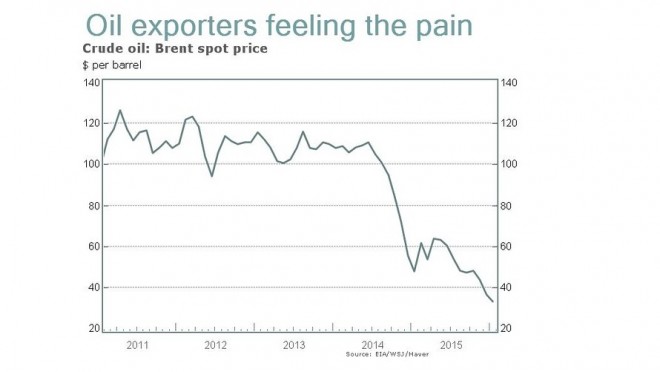
Brent crude prices 2011 50 end 2015

Low oil prices will force the Kingdom introduce massive austerity programs. These include reduction or cancellation of previously mentioned subsidies, drastic scale-backs of construction and infrastructure programs; and certain, painful belt-tightening in the Saudi royal family itself.

Without sufficient oil revenues to keep its economy afloat, there simply are not other means to provide needed foreign currency to keep the country going. Even sand, once another income source for the Kingdom, due to its use in the construction industry, is less available now.

In adddtion to Saudi Arabia, other oil income-dependent countries, including Russia, Azerbaijan, Venezuela, and the United Arab Emirates are also suffering economically from low oil prices. The situation is not forcasted to improve in the near future. Masood Ahmed, head of the Middle East department for the Sunday Express, was quoted in regards to the Saudi economy: “This (oil price collapse) will have to be part of a multi-year adjustment process.”

We hope it doesn’t end in conflict, an all too common story here in the Middle East.

Read more on oil:
Saudi Arabia dumps oil in time for U.S. election season
Solar rich Saudis running after nukes
The wrath of global warming and the Middle East
Saudi Arabia’s Desalinaton Market a $50 Billion opportunity

Photo of Saudi Oil Well by Green Tech Media 

Maurice Picow
Maurice Picowhttps://www.greenprophet.com/
Maurice Picow grew up in Oklahoma City, U.S.A., where he received a B.S. Degree in Business Administration. Following graduation, Maurice embarked on a career as a real estate broker before making the decision to move to Israel. After arriving in Israel, he came involved in the insurance agency business and later in the moving and international relocation fields. Maurice became interested in writing news and commentary articles in the late 1990’s, and now writes feature articles for the The Jerusalem Post as well as being a regular contributor to Green Prophet. He has also written a non-fiction study on Islam, a two volume adventure novel, and is completing a romance novel about a forbidden love affair. Writing topics of particular interest for Green Prophet are those dealing with global warming and climate change, as well as clean technology - particularly electric cars.

TRENDING

SolCold wants to cool buildings using sunlight

For centuries people living in hot climates have tried...

What are AWG air-water generators, and why they aren’t a golden-bullet solution (yet)

Atmospheric water generators (AWGs) sound like magic: machines that can pull drinking water out of air. The idea is mentioned in the Bible, where the elders would pray for water collected as dew on plants and the catch on turning this into a machine is in the physics. To turn invisible vapor into liquid, you must remove heat, especially the latent heat of condensation.

Jordan’s $6 Billion Aqaba–Amman Desalination Project from the Red Sea Moves Forward

In 2025, the Jordanian government signed agreements with a consortium led by Meridiam and SUEZ, alongside VINCI Construction and Orascom Construction. Under a 30-year concession agreement, the consortium will design, build, finance, operate, and maintain the system before transferring it back to the Jordanian government. The total investment is estimated at approximately $6 billion USD.

Saudi Arabia cancels the Asian games at Neom’s Trojena

Neom, a bombastic collection of futuristic cities and resorts, has flopped as Saudi oil prices roll back reality. The Saudi plan of hosting the 2029 Asian games to be held at Trojena, a ski report in the desert, has been cancelled. 

Xcimer is the Denver-based startup that could put Saudi Arabia out of business

An American company can collapse OPEC if they can prove their approach to unlimited energy works.

Should You Invest in the Private Market?

startustartup Unlike public stock exchanges, which offer daily trading, strict...

How to build a 100-year-company

Kongō Gumi is a Japanese construction company, purportedly founded in 578 A.D., making it the world's oldest documented company. What can we learn about building sustainable businesses from them?

From Pilot Plant to Global Stage: How Aduro Clean Technologies’ 2026 Expansion Signals a Turning Point for Chemical Recycling Investors Like Yazan Al Homsi

The company's Next Generation Process (NGP) Pilot Plant in London, Ontario, has officially moved into initial operating campaigns, generating the kind of structured, repeatable data that separates laboratory promise from commercial viability.

How AI Helps SaaS Companies Reduce Repetitive Customer Support Work

SaaS products are designed for large numbers of users with different levels of experience, and also in renewable energy.

Pulling Water from the Air

Faced with water shortage in Amman, Laurie digs up...

Turning Your Energy Consultancy into an LLC: 4 Legal Steps for Founders in Texas

If you are starting a renewable energy business in Texas, learn how to start an LLC by the books.

Tracking the Impacts of a Hydroelectric Dam Along the Tigris River

For the next two months, I'll be taking a break from my usual Green Prophet posts to report on a transnational environmental issue: the Ilısu Dam currently under construction in Turkey, and the ways it will transform life along the Tigris River.

6 Payment Processors With the Fastest Onboarding for SMBs

Get your SMB up and running fast with these 6 payment processors. Compare the quickest onboarding options to start accepting customer payments without delay.

Related Articles

Popular Categories