Cool innovation shocks salt from sea water

MIT-fracking-pond_0

Water, water everywhere but not a drop to drink!

Desalinating sea water is a costly and energy consuming way of providing fresh water in many parts of world. Though methods such as Graphene-Nanotechnology makes desalination more efficient, the end result is still problematic due to clogging of separation filters.

Returning heavily saline brine residue back to the sea makes seawater even more saline.

Rich countries and states like California, Saudi Arabia, Qatar and even Israel don’t care about cost of desalination to the national energy bill or to greenhouse gas emissions. We have said before and we will say again, desalination is not efficient and should only be used in a last-case scenario.

New research promises a more energy way to desalinate?
Mideast Israel Palestinians Water Source

A much more efficient way of separating salt from sea or brackish water by literally shocking the salt from the water is being developed by a research team at the Massachusetts Institute of Technology (MIT). Invented by an MIT research team, the system uses an electrically driven shockwave within a stream of flowing water that literally pushes salty water to one side of the flow and fresh water to the other.

This allows easy separation of the two streams without needing a filtration membrane.  The team leader, Professor Martin Bazant, a professor of chemical engineering and mathematics, says that the electrolysis process is a “fundamentally new and different separation system that forms a membrane-less separation of ions and particles.”

The new electrical shocking system works without using a traditional desalination system of reverse osmosis  or conventional electrodialysis, “This process looks similar to electrodialysis, but it’s fundamentally different,” says Bazant.

Besides the high costs involved, one of the biggest problems of conventional desalination is the clogging or fouling — a buildup of filtered material; or to degradation due to water pressure.

This often occurs with conventional membrane-based desalination, including conventional electrodialysis: “With our system, the charged salt particles, or ions, “just move to one side,” says Bazant.

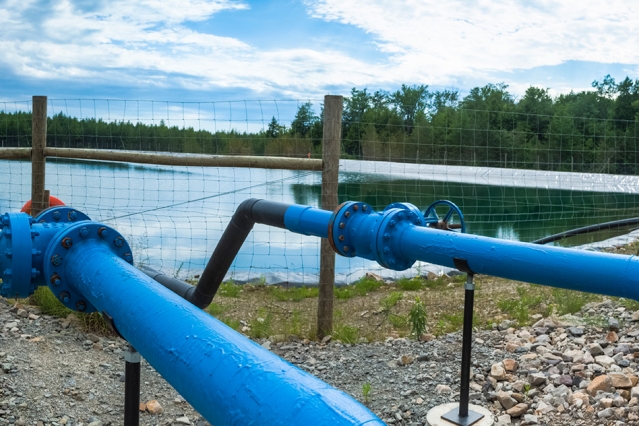
One of the more promising uses of the electrical shocking system is removing salt and other impurities from brackish water; including cleaning of large amounts of wastewater generated by hydraulic fracturing, or fracking.
saudi-arabia-desalination-jubail-500x352

Since the electro shocking process does not require the large infrastructure needed by conventional desalination, it can be used to clean saline waste water extracted by oil and gas wells: “The electric fields created by this process are pretty high, so we may be able to kill the bacteria in the water,” says Sven Schlumpberger, a graduate student also working on the project.

The electro shocking process being worked on by Professor Bazant and his colleagues is still in the developmental process; so it may be a while until it is actually put into use on a commercial scale. As a viable alternative to conventional desalination methods, it does appear to be promising.

What to do with the salt that “moves off to one side” willstill be an issue that will have to be dealt with, however.

Dive into our resources on desalination:

Graphene nanotechnology makes desalination 100 times more efficient
Cyprus gets new desalination plant with Mekorot Israel’s know-how
Going Green ends with Water from the Sea

Photo of fracking water pool, by MIT News: 

Maurice Picow
Maurice Picowhttps://www.greenprophet.com/
Maurice Picow grew up in Oklahoma City, U.S.A., where he received a B.S. Degree in Business Administration. Following graduation, Maurice embarked on a career as a real estate broker before making the decision to move to Israel. After arriving in Israel, he came involved in the insurance agency business and later in the moving and international relocation fields. Maurice became interested in writing news and commentary articles in the late 1990’s, and now writes feature articles for the The Jerusalem Post as well as being a regular contributor to Green Prophet. He has also written a non-fiction study on Islam, a two volume adventure novel, and is completing a romance novel about a forbidden love affair. Writing topics of particular interest for Green Prophet are those dealing with global warming and climate change, as well as clean technology - particularly electric cars.
2 COMMENTS
  1. Interesting concept. could you please help me to complete one project. its about desalination process n salt manufacturing and the process causes to the environment

  2. Thats an interesting concept, and should work alright on the small scale. the “shocking” refers only to the “shockwave”, not to the voltage required. Aquarious microbes need very little potential to kill.

Comments are closed.

TRENDING

SolCold wants to cool buildings using sunlight

For centuries people living in hot climates have tried...

Jordan’s $6 Billion Aqaba–Amman Desalination Project from the Red Sea Moves Forward

In 2025, the Jordanian government signed agreements with a consortium led by Meridiam and SUEZ, alongside VINCI Construction and Orascom Construction. Under a 30-year concession agreement, the consortium will design, build, finance, operate, and maintain the system before transferring it back to the Jordanian government. The total investment is estimated at approximately $6 billion USD.

The Saudi Startup Turning Desalination’s Toxic Waste Into Its Own Disinfectant

For millennia, the Middle East's water crisis seemed an immutable fact of geography — a region defined as much by what it lacked as by what lay beneath its sands. Today, a convergence of plummeting solar costs, advancing membrane technology, and hard-won engineering expertise is rewriting that story.

EU Ports Still Power Russia’s Arctic Gas Exports Despite Phase-Out Pledge

The findings suggest that rather than declining, Europe’s reliance on Yamal LNG intensified in 2025. Yamal cargoes accounted for 14.3% of the EU’s total LNG imports, equivalent to roughly one in every seven LNG ships arriving at European terminals.The findings suggest that rather than declining, Europe’s reliance on Yamal LNG intensified in 2025. Yamal cargoes accounted for 14.3% of the EU’s total LNG imports, equivalent to roughly one in every seven LNG ships arriving at European terminals.

10 Proven Israeli Technologies to Help Somaliland Build Food, Water, and Energy Security

Israel’s water and agricultural technologies didn’t emerge from ideal conditions. They were developed under pressure: low rainfall, saline water, political isolation, lack of energy resources, and the constant need to feed a growing population with limited land. Over the years, I’ve written about many of these companies not as miracle-makers, but as problem-solvers. That’s what makes them relevant to places like Somaliland. Israel was the first country in the world to recognize Somaliland as an independent state although Ethiopia has been treating the nation as such for decades.

Should You Invest in the Private Market?

startustartup Unlike public stock exchanges, which offer daily trading, strict...

How to build a 100-year-company

Kongō Gumi is a Japanese construction company, purportedly founded in 578 A.D., making it the world's oldest documented company. What can we learn about building sustainable businesses from them?

From Pilot Plant to Global Stage: How Aduro Clean Technologies’ 2026 Expansion Signals a Turning Point for Chemical Recycling Investors Like Yazan Al Homsi

The company's Next Generation Process (NGP) Pilot Plant in London, Ontario, has officially moved into initial operating campaigns, generating the kind of structured, repeatable data that separates laboratory promise from commercial viability.

How AI Helps SaaS Companies Reduce Repetitive Customer Support Work

SaaS products are designed for large numbers of users with different levels of experience, and also in renewable energy.

Pulling Water from the Air

Faced with water shortage in Amman, Laurie digs up...

Turning Your Energy Consultancy into an LLC: 4 Legal Steps for Founders in Texas

If you are starting a renewable energy business in Texas, learn how to start an LLC by the books.

Tracking the Impacts of a Hydroelectric Dam Along the Tigris River

For the next two months, I'll be taking a break from my usual Green Prophet posts to report on a transnational environmental issue: the Ilısu Dam currently under construction in Turkey, and the ways it will transform life along the Tigris River.

6 Payment Processors With the Fastest Onboarding for SMBs

Get your SMB up and running fast with these 6 payment processors. Compare the quickest onboarding options to start accepting customer payments without delay.

Related Articles

Popular Categories