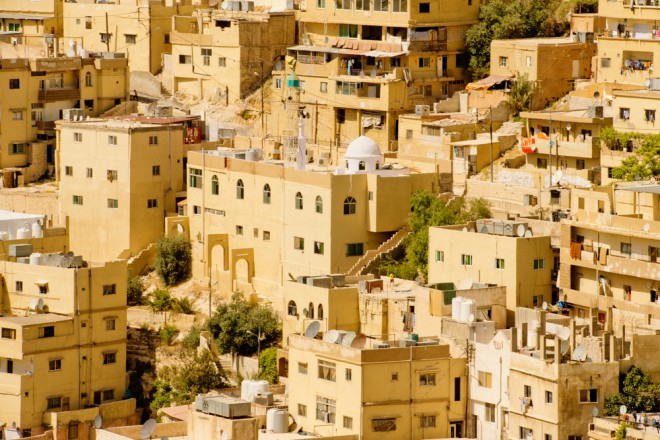
The Greater Amman Municipality (GAM) this week announced expansion of its “tidy-roofs” campaign, which kicked off last June to tackle residential buildings deemed unsightly by city officials. Back then, Raed Haddadin, director of GAM’s building control department, told the Jordan Times that the goal was to make the buildings “look more beautiful than before”. Good news for people with hilltop views, and the local bird population, but far better if the city followed universal career guidance and started in on the ground floor.
“Through field visits made by GAM teams and also by the mayor, we found that many rooftops are messy,” Haddadin told The Jordan Times over the phone in June. Violators were given until the end of the holy month of Ramadan to clean up, after which they would be issued warnings, and a GAM team would conduct the clean up, with the building owner paying expenses.
Amman is a hilly town, blanketed by concrete and limestone-clad buildings, mostly flat-roofed. Water tanks and satellite dishes sit on those roofs and, as a result of progressive 2013 city regulations, solar thermal hot water heaters are showing up too. But these are not the offending artifacts.
Municipal waste removal is spotty in the capital city of over one million people, with just one drop-off for recyclables – a waste center that doesn’t yet accept glass. Disposal of large items such as furniture and appliances makes for the funniest/saddest anecdotes. I’ve seen old couches shoved out windows from upper level apartments in Jabel Wedbieh, sailing over lower level balconies and gardens, heading towards empty lots in the wadi (valley) below. I’ve watched refrigerators free-fall down exterior stairways to land in sidewalk cemeteries of discarded kitchenware in embassy-packed Jabel Amman. No neighborhood is immune to the sea of plastic pollution and cigarette butts. A hackneyed joke says that plastic market bags, waving from trees, are the national bird.
Let’s switch gears for a moment. This month I received a 400 JD ($564 USD) electric bill, a sum that represents 125 percent of an average Ammanian’s disposable monthly salary. It’s been exceptionally hot this summer, and extreme dust storms have made it impossible to open windows. In my modest top-floor apartment, we gather in a family room, running one air conditioning split unit to save energy and cut costs. So this latest power bill was as eye-watering as the grit-filled air blowing up from Saudi.
The engineer husband pulled out his tools and methodically checked the power demand for every appliance in the house. Nothing askew. He looked to see if a neighbor might be tapping our power lines. No problem there either. The near-constant sunlight streaming through our windows is mostly indirect, and the airflow through the rooms is steady and strong. So why are the rooms so damned hot, especially at night?
It’s the roof. The flat expanse of uninsulated concrete, absorbing sunlight all day and radiating it into our rooms at night. It’s the hippie-dippy passive solar design I studied as an architecture student, ideal for climatic zones where chill exterior temperatures make a nocturnal boost of heat welcome, but not in a Middle Eastern summer.
I ventured up to our rooftop. Sure enough, the landlord has it loaded up with a broken toilet and bathroom sink, a pile of rotted wood, and a stack of chipped ceramic tiles. There are coffee cups and prayer mats discarded by long-ago work crews. There’s a pizza box and empty Russian vodka bottles. Unsightly? You betcha. But is that really Amman’s biggest problem with rooftops?
GAM explains that the tidy-roof campaign includes an awareness-raising program for the city’s youngest citizens that begins after the Eid Al Adha holiday, which starts on Wednesday and wraps up Sunday. Sustainability education is always a winning proposition, but in this water-starved kingdom that imports nearly all of its energy, clearing rooftop trash is not a top-ten priority and voluntary environmentalism is not a solution.
Amman needs better building codes, updated to adopt international best practices for insulation and energy-efficient building systems, and the kingdom must mandate compliance for all new construction. It needs city-wide management of organic and recyclable waste. It needs to ban free issue of non-disposable plastics. All of these are already adopted by many nations in the Arab world, with proven benefits to the economy and the environment.
Is there any practical reason these aren’t in play in Jordan?
Image from Anton_Ivanov / Shutterstock.com