

The fighting in Gaza has forced farmers and herders to abandon their lands and has paralysed fishing activities, bringing local food production to a halt and severely affecting livelihoods, the United Nation’s FAO warned last week.
Recovery in the agriculture sector, once hostilities cease, will require significant external assistance over the long term. And this is where we see opportunities for alternative agriculture systems for smallholder farmers and families. Aquaponics and hydroponics can be done on rooftops, and it is especially meaningful in areas where water is severely limited.
The FAO estimates that the recent fighting has resulted in substantial direct damage to Gaza’s 17,000 hectares of croplands as well as much of its agricultural infrastructure, including greenhouses, irrigation systems, animal farms, fodder stocks and fishing boats.
According to the latest update Gaza has lost half of its population of poultry birds (broilers and layers) either due to direct hits on their shelters or lack of water, feed or care resulting from access restrictions.
Around 64,000 head of small ruminants are in need of animal feed and water in order to avoid further animal deaths and the additional erosion of herders’ productive assets.
Meanwhile losses by Gaza’s fishing sector so far are estimated at 234.6 tonnes over the period 9 July – 10 August –equivalent to 9.3 percent of local fishers’ yearly catch.
“Up to now, ongoing military operations have prevented detailed assessments of damages to agriculture from being completed,” said Ciro Fiorillo, head of FAO’s office in the West Bank and Gaza Strip.
The Gaza Strip imports most of what it eats — however locally produced food represents an important source of nutritious and affordable food, and some 28,600 people in Gaza rely on farming (19,000 people), livestock raising (6,000) and fishing (3,600) for their livelihoods.
“Under the most recent ceasefire many farmers and herders are now able to access their lands, however resumption of food production faces serious obstacles given the damages sustained and shortages of water, electricity, inputs and financial resources, as well as ongoing uncertainty regarding the possible resumption of military activities”, said Fiorillo.
Volatile food prices
While they have never lacked variety, in part from active smuggling tunnels to Egypt, food prices in Gaza have fluctuated considerably compared with before hostilities began, registering significant increases for certain products such as eggs and many vegetables.
Upward spikes have ranged from a 40 percent increase in the price of eggs to a 42 percent increase for potatoes to a 179 percent spike in the price of tomatoes. Tomatoes, even fish can be grown with ease on rooftops and small plots of land using aquaponics and hydroponics.
With local food production halted and food imports curtailed, virtually the entire population of Gaza (about 1.8 million people) is currently reliant on food aid. But it doesn’t have to be so. Companies like flux are developing tools to make it super easy for people to grow their own food and plants on water, without soil.
Emergency fodder for animals
As soon as a permanent ceasefire is established FAO, with support from Canada, will distribute fodder to feed 55 000 small ruminants throughout Gaza for 45 days. The Organization is also positioned to distribute 4 000, 1-cubic metre water tanks to help herders water their animals.
“We have a programme that supports the resilience of agriculture-based livelihoods of Gaza fishermen, herders and farmers,” said Abdessalam Ould Ahmed, FAO Regional Representative for the Near East and North Africa. “We need to get this back on track as soon as hostilities cease, to promote not just survival of Gaza’s people but their self-reliant development.”
Again we emphasize the need for Gazans to take the future into their own hands and start rooftop and backyard farming. This approach can ease the current crisis and help people be self-reliant no matter the political circumstance.
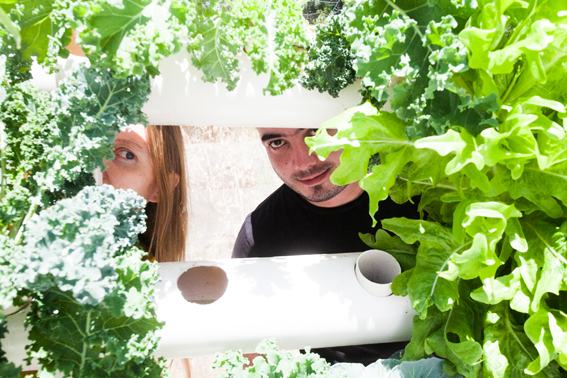
Above image via flux


High-tech, completely controlled system of hydroponics is mostly for industrial ventures, but not for ordinary people. Low cost hydroponics in open air is the way to popularize hydroponics in developing countries in the tropics. We are trying to control water circulation and aeration (10 minutes circulation every hour for 10 h a day), and management of salt index, pH (buffering), nutrient supply, and ambient and circulating water temperatures. Is there a guide on nutrient management for growing plants in open air hydroponics? How do we manage the different components dissolved oxygen in circulating water, water temperature, salt index, and buffering in water culture? Any technical help in these areas will be welcome. Email: [email protected]
[…] to grow food, just plenty of aerated water, and a nutrient solution. Some research bodies like the Food and Agriculture Organization at the United Nations argue that it is the world’s only alternative to conventional farming. Not as a replacement, […]
Hey,
I am a Berlin-based freelancer (some of my work here) working with a colleague in New York on a feature about hydroponics plants, and how the methods and usage are moving on following the legalisation of marijuana across the world.
There are several aspects that I am looking into, and would love to hear your thoughts on:
– Hydroponics as a tool against hunger in deprived areas
– Why hydroponics has not taken off as a mainstream agricultural method
– Its use against the monopolising of agriculture by a handful of mulitnationals
– Its potential to cut the cost of fresh food for developing nations
If these are topics you would like to speak to me about, I am available to chat most times of day via phone, +49 17661 459988, Skype – my handle: seanwilliams85 – or email. Your help in any way would be greatly appreciated and I look forward to hearing from you soon.
Best regards,
Sean Williams