Greet, meet, and eat with African asylum seekers in Israel

africa-refugee-israel-food
If you live in south Tel Aviv in the Shapiro neighborhood by the central bus station you might come in contact with an African migrant or refugee. Unless you live side by side with them, it’s doubtful that you’ll get a chance to talk to one of the tens of thousands of men, and sometimes women, who fled or migrated to Israel from countries like Eritrea and Sudan, in hope of a better life. But eating with them? That’s a different story.

On a Monday night in Jaffa a few months ago, TV was passé: Israelis and African migrants and refugees opened their ears and hearts to one another at a local restaurant which shut its kitchen down to the public and opened it up to let the Africans do the cooking.
africa-refugee-israelafrica-refugee-israel-eat

Sitting at my table was Dawit Damuz, a 30-something migrant from Senafe, Eritrea, a city close to the Ethiopian border. He has been in Israel since 2004. He told us that his life was made hell by the army who tortured him and other men that did not conform to army sanctions. There were strange practices called “helicoptering” which tortured men by hanging them from their legs. Men in the army simply go missing, there are extrajudicial killings, and incommunicado detentions.

Only four official religions can be practiced in the country, Damuz explained, and anyone who is meeting in groups larger than five people at a time are punished.
africa-refugee-israel-eating

Now in Israel Damuz has become a local leader among the asylum seekers in Tel Aviv who are facing deportation by the authorities. While they claim refugee rights, some Israelis and their politicians say it is the burden of countries through which they passed to absorb the migrants.

If there is any doubt about the problems the Africans may face, according to Human Rights Watch, “Torture, arbitrary detention, and severe restrictions on freedom of expression, association, and religious freedom remain routine in Eritrea.”

But even if for small moments, politics could be brushed aside at the second Cook, Eat & Meet in Jaffa. Every day Israelis were invited to meet some of the faces of the African refugees who share their city.

Amnesty International organizes such events to show locals in some cities the plight of asylum seekers and refugees. Two new immigrants to Israel, one from the UK and one from America organized this event in Jaffa.

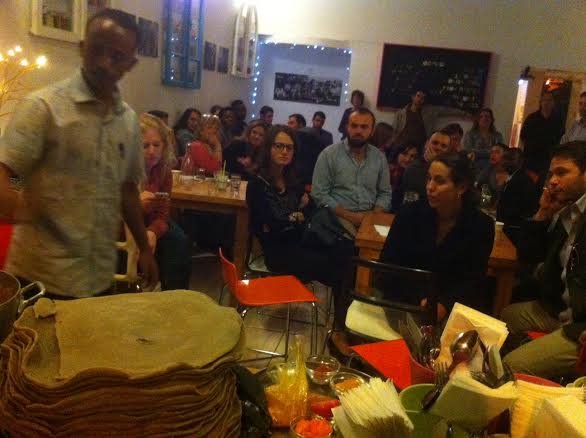
Earlier on the Israelis in the group, about 30 or 40 people, were chopping vegetables and sipping on a beer, tea or a glass of water. We sat around tables of about eight and talked with an asylum seeker.

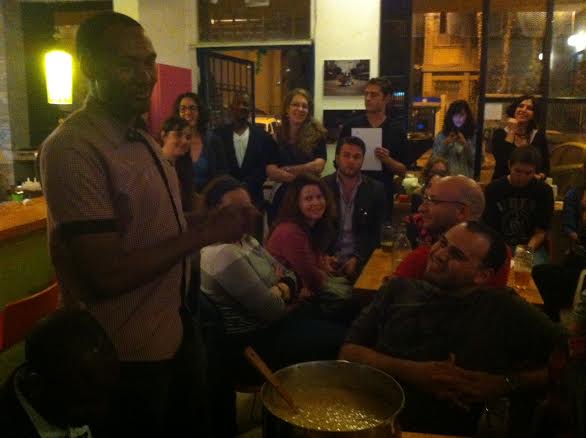
We drank a Central African Republic warm pudding drink called popoto made with rice and peanut butter. The recipe was shared and as we sipped it seemed like every Israeli with roots elsewhere said it reminded them of a drink from “home”. For me it tasted like the local Arabian sahlab, a thick drink sprinked with peanuts made to warm your insides on cold winter nights in Israel.

And throughout the night African migrants and refugees shared their stories of home, obligatory army service, the lack of freedom of speech –– and food.

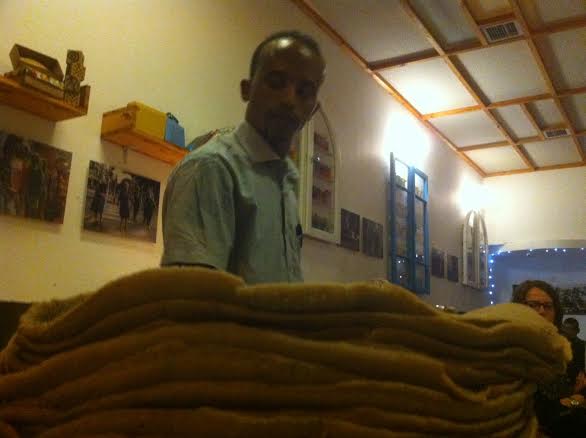
A stack of injera bread, with a hint of molasses and a bit sandy to the bite (from the desert?), waited by the service window as three readied pots of simple food, like alicha, with vegetables and lentils released smells not familiar to the Arabian city of Jaffa.

There were journalists, PR professionals, those from the startup community, and activists eager to “taste” the life and times of those less lucky in Israel. It was a time for people to get personal as we sat around round tables letting the Africans explain their life and times before Israel.

That night my home city of Jaffa, sometimes troubled, sometimes violent, but always interesting, seemed to be transformed. Whether it was the good will, and positive energy inside the Tarnagol Restaurant (that hosted this encounter) which transferred this vibe I cannot say.

All I can say is that the event brought some new life and hope to everyone there. We learned a few recipes that connected Israel directly to Africa, even if only by way of an imaginary border.

For upcoming events like this one, email [email protected]

Karin Kloosterman
Karin Kloostermanhttp://www.greenprophet.com
Karin Kloosterman is an award-winning journalist, innovation strategist, and founder of Green Prophet, one of the Middle East’s pioneering sustainability platforms. She has ranked in the Top 10 of Verizon innovation competitions, participated in NASA-linked challenges, and spoken worldwide on climate, food security, and future resilience. With an IoT technology patent, features in Canada’s National Post, and leadership inside teams building next-generation agricultural and planetary systems — including Mars-farming concepts — Karin operates at the intersection of storytelling, science, and systems change. She doesn’t report on the future – she helps design it. Reach out directly to [email protected]
1 COMMENT

LEAVE A REPLY

Please enter your comment!
Please enter your name here

TRENDING

Farm To Table Israel Connects People To The Land

Farm To Table Israel is transforming the traditional dining experience into a hands-on journey.

Plant trees in cities, for your heart

It seems like a no-brainer, but sometimes you need to give evidence to city councillors: A new multi-institutional study led by UC Davis Health suggests that not all green space is created equal. Living in urban neighborhoods with more visible trees is associated with a 4% lower incidence of cardiovascular disease, while areas dominated by grass or low shrubs may be linked to higher cardiovascular risk.

Mandi, Fragrant Yemenite Chicken With Golden Rice

This is a luxurious recipe that requires a taste...

Dark chocolate benefits means slowing aging: make Italian hot chocolate with this recipe

Eating dark chocolate can keep you looking young. Make your own healthy hot chocolate mix

Simple Qatayef recipe makes fabulous nut-filled pancakes

Qatayef - also spelled katayif or qatya’if - is traditionally eaten at Ramadan (get our Ramadan vegetarian ideas here), but it’s a treat anytime. In fact, it’s a treat that’s gone through history. A recipe for qatayif appears in a tenth century Arabic cookbook by the writer Ibn Sayyar al-Warraq, who compiled recipes going back to the eighth and ninth centuries. People have been eating qatayif for a very long time.

Qatar’s climate hypocrisy rides the London Underground

Qatar remains a master of doublethink—burning gas by the megaton while selling “sustainability” to a world desperate for clean air. Wake up from your slumber people.

How Quality of Hire Shapes Modern Recruitment

A 2024 survey by Deloitte found that 76% of talent leaders now consider long-term retention and workforce contribution among their most important hiring success metrics—far surpassing time-to-fill or cost-per-hire. As the expectations for new hires deepen, companies must also confront the inherent challenges in redefining and accurately measuring hiring quality.

8 Team-Building Exercises to Start the Week Off 

Team building to change the world! The best renewable energy companies are ones that function.

Thank you, LinkedIn — and what your Jobs on the Rise report means for sustainable careers

While “green jobs” aren’t always labeled as such, many of the fastest-growing roles are directly enabling the energy transition, climate resilience, and lower-carbon systems: Number one on their list is Artificial Intelligence engineers. But what does that mean? Vibe coding Claude? 

Somali pirates steal oil tankers

The pirates often stage their heists out of Somalia, a lawless country, with a weak central government that is grappling with a violent Islamist insurgency. Using speedboats that swarm the targets, the machine-gun-toting pirates take control of merchant ships and then hold the vessels, crew and cargo for ransom.

Leopoldo Alejandro Betancourt López Turned Ocean Plastic Into Profitable Sunglasses

Few fashion accessories carry the environmental burden of sunglasses. Most frames are constructed from petroleum-based plastics and acrylic polymers that linger in landfills for centuries, shedding microplastics into soil and waterways long after they've been discarded. Leopoldo Alejandro Betancourt López, president of the Spanish eyewear brand Hawkers, saw this problem differently than most industry executives.

Why Dr. Tony Jacob Sees Texas Business Egos as Warning Signs

Everything's bigger in Texas. Except business egos.  Dr. Tony Jacob figured...

Israel and America Sign Renewable Energy Cooperation Deal

Other announcements made at the conference include the Timna Renewable Energy Park, which will be a center for R&D, and the AORA Solar Thermal Module at Kibbutz Samar, the world's first commercial hybrid solar gas-turbine power plant that is already nearing completion. Solel Solar Systems announced it was beginning construction of a 50 MW solar field in Lebrija, Spain, and Brightsource Energy made a pre-conference announcement that it had inked the world's largest solar deal to date with Southern California Edison (SCE).

Related Articles

Popular Categories