Arab Gulf recycles paper, plastic, and cars!

UAE first car recycling plant

The United Arab Emirates (UAE) does everything big, including recycling, and this week they’ve officially opened their first plant dedicated to recycling cars! An estimated 11,000 UAE vehicles get scrapped every month.

Some simply reach their shelf-life, others are abandoned at airport parking lots and city back streets by debt-ridden expatriates and native boys who no longer can pay for their luxury toys.

Now all that automotive litter will be put to better use: “This is the only facility today that can deal with end-of-life vehicles in the country. We encourage insurance companies, dealers and government departments to use this service,” said Najib Faris, chief commercial officer of Bee’ah, the plant operator.

Dumped cars will be manually dismantled, then sliced and diced to allow valuable metals to be salvaged, and plastics, tires, upholstery, cables and mechanical parts to be recycled or refurbished within the Bee’ah compound.  Previously, old clunkers were sold to scrap dealers, who stripped off spare parts and sold the car carcasses on the international market.

Workers separate cables, which are sent to electronic waste traders, and foam cushions that can be recycled locally. Window glass is pulverized and used for landfill cover. The company aims to sell engines and transmissions to international companies that refurbish them.

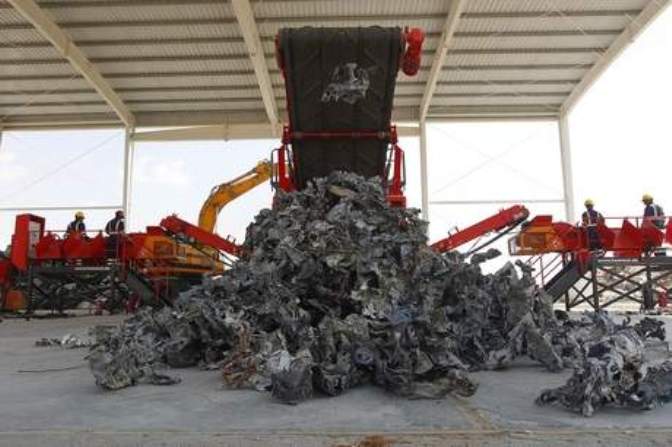
The facility began trial operations in October and has already processed about 350 old cars.  Its capacity is much greater;  Darker El Rabaya, director of waste processing at Bee’ah, told The National that its “shredder” (the equipment for processing car bodies) has a capacity of 60 vehicles an hour.

“Recycling consumes a lot less energy and a lot less water than producing virgin materials,” said Faris. It also diverts waste from landfills.

While the facility is now technically ready, a key issue for the next few months is to ensure a steady supply. As long as car dumping remains an Emirati epidemic, that ought not be a problem.

We’ve heard that some Emiratis prefer to just abandon unwanted cars, even Mercedes, Jags and BMWs at the airport, rather than get them scrapped. This initiative could change that.

Image of the Bee’ah “shredder” from The National

1 COMMENT

LEAVE A REPLY

Please enter your comment!
Please enter your name here

TRENDING

Urban miner Sortera raises $45 million USD to pull aluminum from the scrap pile

Sortera Technologies, founded in 2020 by Nalin Kumar and Manuel Garcia, is emerging as a major U.S. circular-industry player. Led by CEO Michael Siemer, the company uses AI and advanced sensors to turn scrap metal into high-value aluminum alloys. Its new ~$45 million funding round signals investor appetite for industrial decarbonisation—where emissions cuts come not from PR-friendly solar installs, but from upgrading the materials that power EVs, solar frames, and construction.

Waste Reform from the Ground Up: How Trash Balers Are Helping Cities Rethink Sustainability

If you’ve ever watched a recycling truck weaving through city streets, you’ve seen the problem firsthand. Most of what we call “recycling” still depends on long-distance transportation and centralized sorting facilities. Those systems are energy-intensive and prone to contamination — the dreaded mix of wet food, plastic wrap, and paper that renders recyclables useless.

Scientists Crack the Code for Low-Cost, Low-Carbon Plastic Recycling

While enzymatic recycling offers hope for managing existing plastic waste, scientists and environmental advocates agree it must be paired with the development of bio-based plastics—materials made from renewable biological sources like corn starch, sugarcane, or algae. Unlike conventional plastics derived from fossil fuels, bio-based alternatives can dramatically reduce carbon emissions at the production stage and are often compatible with closed-loop recycling.

Steven Bethell Joins Board of SMART at Historic Conference in Dubai, highlighting the importance of textile reuse and responsible recycling

SMART is a leading trade association representing the interests of the for-profit used clothing, wiping materials, and fiber recycling industries. The organization works to promote the environmental, economic, and social benefits of textile reuse and recycling while setting high industry standards.

Trump’s Gaza should use hemp concrete, solar power and smart grids

For Gaza to move beyond short-term recovery and embrace long-term resilience, sustainable technologies must be at the heart of US President Trump's reconstruction efforts.

6 Payment Processors With the Fastest Onboarding for SMBs

Get your SMB up and running fast with these 6 payment processors. Compare the quickest onboarding options to start accepting customer payments without delay.

Qatar’s climate hypocrisy rides the London Underground

Qatar remains a master of doublethink—burning gas by the megaton while selling “sustainability” to a world desperate for clean air. Wake up from your slumber people.

How Quality of Hire Shapes Modern Recruitment

A 2024 survey by Deloitte found that 76% of talent leaders now consider long-term retention and workforce contribution among their most important hiring success metrics—far surpassing time-to-fill or cost-per-hire. As the expectations for new hires deepen, companies must also confront the inherent challenges in redefining and accurately measuring hiring quality.

8 Team-Building Exercises to Start the Week Off 

Team building to change the world! The best renewable energy companies are ones that function.

Thank you, LinkedIn — and what your Jobs on the Rise report means for sustainable careers

While “green jobs” aren’t always labeled as such, many of the fastest-growing roles are directly enabling the energy transition, climate resilience, and lower-carbon systems: Number one on their list is Artificial Intelligence engineers. But what does that mean? Vibe coding Claude? 

Somali pirates steal oil tankers

The pirates often stage their heists out of Somalia, a lawless country, with a weak central government that is grappling with a violent Islamist insurgency. Using speedboats that swarm the targets, the machine-gun-toting pirates take control of merchant ships and then hold the vessels, crew and cargo for ransom.

Leopoldo Alejandro Betancourt López Turned Ocean Plastic Into Profitable Sunglasses

Few fashion accessories carry the environmental burden of sunglasses. Most frames are constructed from petroleum-based plastics and acrylic polymers that linger in landfills for centuries, shedding microplastics into soil and waterways long after they've been discarded. Leopoldo Alejandro Betancourt López, president of the Spanish eyewear brand Hawkers, saw this problem differently than most industry executives.

Why Dr. Tony Jacob Sees Texas Business Egos as Warning Signs

Everything's bigger in Texas. Except business egos.  Dr. Tony Jacob figured...

Related Articles

Popular Categories