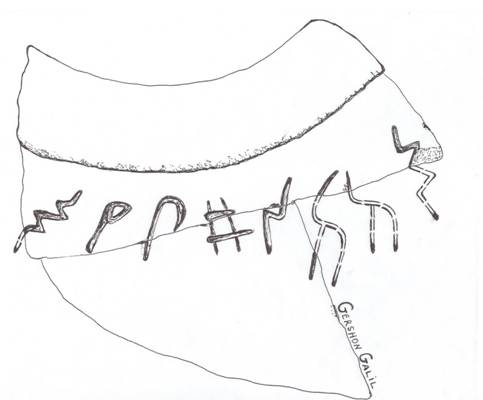
Oldest Hebrew inscription from Jerusalem deciphered: “the wine was cheap”

cheap wine hebrew inscription

Archeologists have deciphered what they believe to be the oldest Hebrew texts originating from the Holy City of Jerusalem: “the wine was cheap”, is the meaning of the basic inscription, illustrated above. It is also believed that the wine was made for the “riffraff”, the hard workers in the region, and for soldiers. 

Wine is used in Jewish traditional ceremonies, like on the Sabbath, when blessings for the holy day of rest are made on the wine. Jewish people in general tend not to be over-drinkers, but the inscription on the pot shows that even 3,000 years ago there was an appreciation of good wine.

By marking the pot as “cheap” wine it is suggested that the wine was designated for the riffraff, the workers in the region.

Related: Ancient pauper’s wine press uncovered

The text was found on a rim of a pot found in 2012 by Eilat Mazar and her team, during an archaeological excavation on behalf of the Institute of Archaeology of the Hebrew University in Jerusalem. The text on it was deciphered by Professor Gershon Galil, from the Department of Biblical Studies and Jewish History at the University of Haifa, in Israel.

He pointed out that it indicates writing abilities as well as the existence of an administration which collects taxes, prepare storage places and jars, and takes care of the workers in Jerusalem, as early as the second half of the 10th century BC, probably in the reign of King Solomon.

To be exact, the pot didn’t really say that the wine was cheap. That was our interpretation. This is what was written, word for word according to the translation: From  right to left the above reads as follows: 

“[…]m  [yy]n  ḫlq  m[…]”, namely: “[in the … year], wine of inferior quality, (send) from GN”.

The inscription is divided into three categories: (a) a date formula; (b) classification of the wine; and (c) provenance.

Prof. Galil said that the form yyn (“wine”) indicates that the language used in this inscription is Hebrew, written in the southern dialect: in Ugaritic, Old Canaanite, Phoenician, Ammonite, and even in Israelite Hebrew wine was always written with only one yod.

But in (southern) Hebrew the form is always yyn (Epigraphic Hebrew [Lachish, Arad and more], Biblical Hebrew [without any exception], Ben Sira, Qumran, and even in the Rabbinic sources).

Prof. Galil published his findings in the Strata Bulletin of the Anglo-Israel Archaeological Society.

“The new inscription is written in the late Cannanite script, in (southern) Hebrew, and should be dated to the second half of the 10th century BC. It is therefore the oldest Hebrew inscription ever found in Jerusalem, and it is about two hundred and fifty years older than other inscriptions known from Jerusalem,” he writes.

In those days King Solomon completed his monumental building projects in Jerusalem, including the Temple and the palace. Solomon was the king who inhabited the Ophel and he was the one who built the wall of Jerusalem which united its three main quarters: the Temple Mount, the Ophel and the city of David,” said Prof. Galil.

Prof. Galil also said that the new inscription indicates that large quantities of inferior wine were used in Jerusalem:

“This cheap wine was not served on Solomon’s table, nor used in the Temple. So it is reasonable to suppose that it was served to the hard workers that were engaged in the large scale building projects in Jerusalem, and maybe also to the soldiers who served there.

“The logistics needed were probably concentrated in the Ophel. Inferior wine was also served to the Cypriot mercenaries in Arad, and in later periods to workers and soldiers in the Hellenistic and Roman periods.”


Karin Kloosterman
Karin Kloostermanhttp://www.greenprophet.com
Karin Kloosterman is an award-winning journalist, innovation strategist, and founder of Green Prophet, one of the Middle East’s pioneering sustainability platforms. She has ranked in the Top 10 of Verizon innovation competitions, participated in NASA-linked challenges, and spoken worldwide on climate, food security, and future resilience. With an IoT technology patent, features in Canada’s National Post, and leadership inside teams building next-generation agricultural and planetary systems — including Mars-farming concepts — Karin operates at the intersection of storytelling, science, and systems change. She doesn’t report on the future – she helps design it. Reach out directly to [email protected]
2 COMMENTS
  1. Workers are not “riff-raff.” You might want to revise your article accordingly. Also, unless you are a “riff-raff” journalist you might want to stick to the substance of the inscription rather than a silly and biased interpretation thereof.

Comments are closed.

TRENDING

Key Rules Recreational Cannabis Users Must Follow in Pittsburgh

Adults who are 21 or older can carry up to 30 grams. This amount applies to personal use within Pittsburgh’s limits. Carrying more could lead to confiscation or legal action. Staying under the limit avoids problems during any public stop.

Turning Your Energy Consultancy into an LLC: 4 Legal Steps for Founders in Texas

If you are starting a renewable energy business in Texas, learn how to start an LLC by the books.

Ancient Chinese medicine might heal spinal cord injuries

In the study, the scientists didn’t just test one plant compound at a time. They tested two traditional Chinese medicine compounds together — luteolin (from flowers like honeysuckle and chrysanthemum) and astragaloside IV (from astragalus root, Huang Qi). These plants have been combined in Chinese herbal formulas for centuries to help the body recover from injury and inflammation.

Luxury meets the textile waste stream with Coach – Bank & Vogue

A new collaboration between luxury brand Coach and textile reuse pioneer Bank & Vogue attempts to stitch those two worlds together: high fashion and the global textile waste stream.

EU startup aiming to generate energy on moon villages

Stepping up to democratize the moon is an EU-funded company, Deep Space Energy, which has just raised more than $1 million USD as a seed fund to help it create energy generators on the moon.

Turning Your Energy Consultancy into an LLC: 4 Legal Steps for Founders in Texas

If you are starting a renewable energy business in Texas, learn how to start an LLC by the books.

Tracking the Impacts of a Hydroelectric Dam Along the Tigris River

For the next two months, I'll be taking a break from my usual Green Prophet posts to report on a transnational environmental issue: the Ilısu Dam currently under construction in Turkey, and the ways it will transform life along the Tigris River.

6 Payment Processors With the Fastest Onboarding for SMBs

Get your SMB up and running fast with these 6 payment processors. Compare the quickest onboarding options to start accepting customer payments without delay.

Qatar’s climate hypocrisy rides the London Underground

Qatar remains a master of doublethink—burning gas by the megaton while selling “sustainability” to a world desperate for clean air. Wake up from your slumber people.

How Quality of Hire Shapes Modern Recruitment

A 2024 survey by Deloitte found that 76% of talent leaders now consider long-term retention and workforce contribution among their most important hiring success metrics—far surpassing time-to-fill or cost-per-hire. As the expectations for new hires deepen, companies must also confront the inherent challenges in redefining and accurately measuring hiring quality.

8 Team-Building Exercises to Start the Week Off 

Team building to change the world! The best renewable energy companies are ones that function.

Thank you, LinkedIn — and what your Jobs on the Rise report means for sustainable careers

While “green jobs” aren’t always labeled as such, many of the fastest-growing roles are directly enabling the energy transition, climate resilience, and lower-carbon systems: Number one on their list is Artificial Intelligence engineers. But what does that mean? Vibe coding Claude? 

Somali pirates steal oil tankers

The pirates often stage their heists out of Somalia, a lawless country, with a weak central government that is grappling with a violent Islamist insurgency. Using speedboats that swarm the targets, the machine-gun-toting pirates take control of merchant ships and then hold the vessels, crew and cargo for ransom.

Related Articles

Popular Categories