

Tunisia was the first Arab country to talk about environment policy. Green Prophet attends a local conference on water and pollution and stunningly sees how there is no framework for Tunisia to make environmental change and progress. Read our report.
The following article was meant to review topics covered at the International Symposium on Emerging Pollutants in Irrigation Waters which, for the first time in Tunisia, brought together scientific communities around the Mediterranean Sea Basin and the Arab countries to discuss research findings and explore further opportunities of collaboration on mitigating practices in emerging pollutants in irrigation water.
With water scarcity becoming an impending issue for the MENA region and the post revolution effects of reduced controls on water quality (as well as trash), topics related to reusing and recycling water while ensuring water quality are key for this region.
But as I sat around the table with various Tunisian conference participants, ranging from researchers and professors specializing in chemical pollution to environmental specialists at various municipalities, questions regarding the content of the symposium could not help but be shirked and answers would insistently diverge into politics.
If I cannot keep my interviewees to the topic, I thought, there must be a reason. The reason is that Tunisia is far from realistically being able to implement advanced solutions to its environmental issues before reconstructing its basic environmental codes of conduct, which have degraded to pre-1990’s levels.
When asking Borhane Mahjoub, professor at the Institute of Agricultural Sciences, University of Sousse, and one of the organizers at the symposium, which of the discussed technologies could be seen as being used in Tunisia to purify irrigation water he refused to give me an answer, “We are far from realistically being able to apply any of the methods and research discussed at the conference.”
Following such a point blank answer, a succession of topics spilled out onto the table and it was clear that if the current Tunisian government does not reinstate environmental governance soon, the next generations of Tunisians will suffer massively – not only in terms of health but wealth too, polluted seas, rivers and soils are certainly not an attractive fate for its Tourism industry.
To briefly summarize the long and convoluted discussion that followed; The Tunisian environmental legislation, one of the best in the Middle East North Africa region in the 1990’s, has not been renewed ever since.
Furthermore, environmental regulation has been largely dropped from its current political agenda and a comprehensive environmental code is largely nonexistent. To exemplify the regression of the importance of environmental governance: In 1991 Tunisia was the first Arab state to create a Ministry of Environment, after the 2011 Jasmine revolution, the Ministry of the Environment was reinstated as a subgroup of the Ministry of Infrastructure (not even Agriculture!).
Tunisia is characterized by a large quantity of small domestic industries which dot the country and a few large international industries. Domestic industries are suffering from a post-revolution dire economy and without a government, a watchdog, which has an interest in regulating the environment, industries will not think twice from reducing its short term costs by polluting waterways and soils.
The southern region of Tunisia has been experiencing drastic environmental impacts particularly; pollution from its textile industry and water scarcity from its phosphate mining in the Gafsa region.
As I was pointed out, Tunisia is not only suffering from a post revolution but also from a current political agenda which is focused on a single topic: religion.
All other issues ranging from education, health, environment and public services are largely being left astray. So, on the one hand, the political will on implementing basic environmental policies on issues such as waste management, renewable energy, water treatment and recycling are missing in post-revolution Tunisia.
On the other hand, I am told there is a cultural component: “environmental factors are still not of primary concern for the majority of Tunisian citizens too,” this is not because environmental health is a luxury and so citizens do not have the time and money for this, but because the idea of “eco-citizenship” is missing.
Environmental sensibilisation has barely been part of any of the previous and current governments’ strategies and so current generations, who have had to depend less directly than previous generations on its environment, have lost touch with the importance of an environmental wealth.
Environmental sensibilization, through education, and starting from kindergarden, is an impending public policy. Likewise, although Tunisia has a strong civil society, like other MENA countries, it still lacks a strong eco-civil society and so the environment is likely to suffer deeply.
The moral of the story is quite simple. How can we speak about research and advanced technologies in Tunisia if there is limited political will and civil engagement in the environmental sector? To get back on track, Tunisia needs to update its environmental legislation, design and implement a comprehensive environmental code and invest in eco-citizenship.
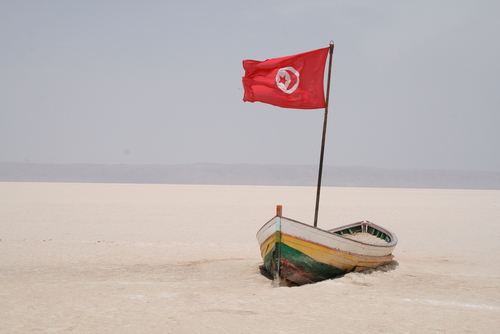
Image of boat in salt desert from Shutterstock




Dear Ms Pappagallo, could you please send me your e-mail. I need to know more about this article.
Best