Abu Dhabi energy pylons confuse perceptions of “land” use

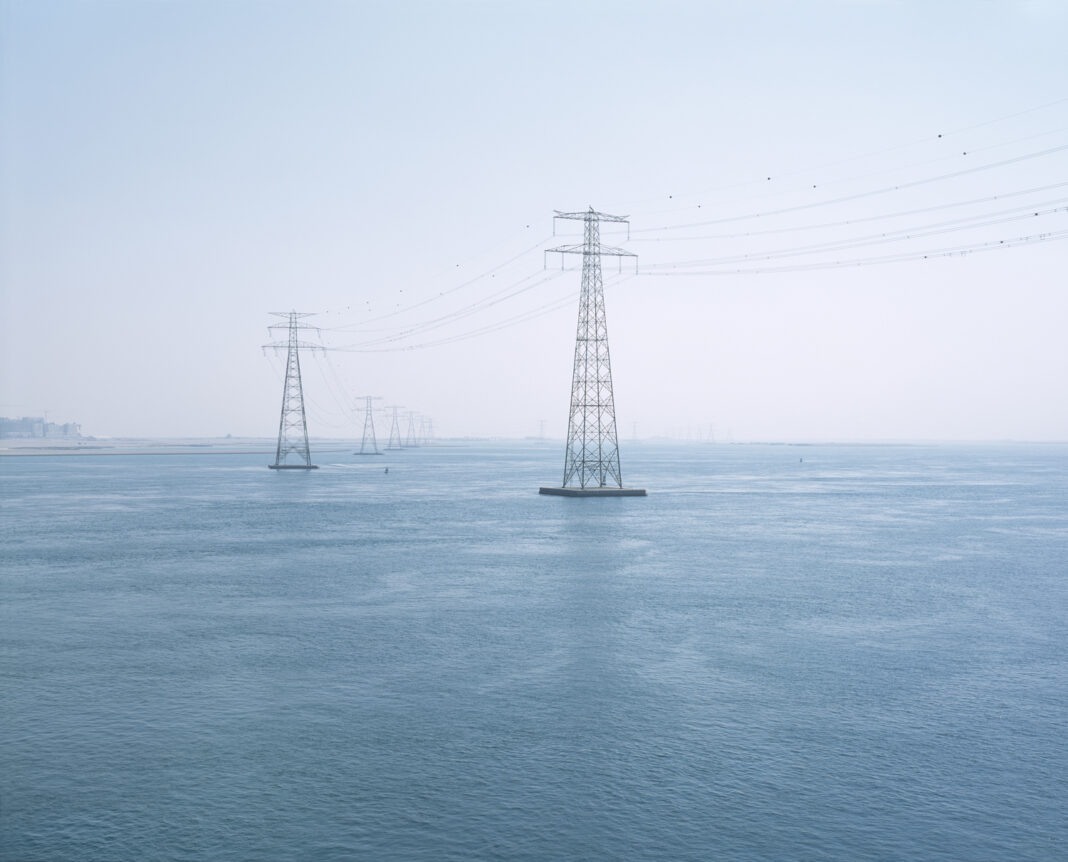
Abu Dhabi, pylons, thirst for energy,  environmental photography, urban development, Richard Allenby-PrattAn awe-inspiring sight, as one departs Abu Dhabi towards Saadiyat and Yas Islands, these pylons seems to disappear into the distant sea. But we are actually looking inland and they are delivering energy to, rather than from, the city center.

As a relatively infrequent visitor, the confusion of islands and waterways in this area ( 24°30’58.91″N  54°24’19.77″E) and the network of fast highways, reclaimed land, and new developments make instinctive navigation challenging, to say the least.

Pylons tend to be the scourge of scenic photographers. They stand so aggressively in the landscape, these most obvious and ubiquitous symbols of our relentless thirst for energy.

As a young photographer my tendency was to romanticise the landscape and avoid ugly intrusions, like pylons, in my compositions. Many was the occasion when I would elect not to waste film on an otherwise beautiful scene because it was marred by incongruous metal intrusions.

With the tools we have available today I doubtless would have taken the pictures anyway and removed the pylons afterwards on my computer. What a sad deception it would have been though!

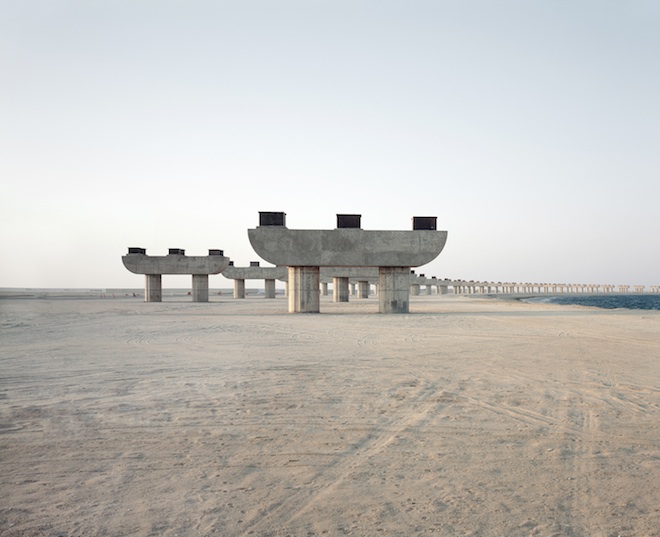
Note from the editor: this photograph is part of a series called “Consumption” that seeks to document consumerism’s impact on the environment. From resource extraction and commodity production all the way down the supply chain to retail stores and waste processing facilities, Richard artfully examines what nature has come to mean in a world that depends on buying stuff.

Richard Allenby Pratt
Richard is a British photographer living and working in Dubai, UAE. His concerns about the sustainability of the way we live and our economic systems only really became urgent after the birth of his son in 2008. As a landscape photographer he found the obvious way to express these concerns was by making photographs of the places impacted on by human activity, and particularly those places that best display the terrifying scale of our consumption. His basic method is to study google earth and then visit the most intriguing and inexplicable places thereby discovered.
4 COMMENTS

Comments are closed.

TRENDING

SolCold wants to cool buildings using sunlight

For centuries people living in hot climates have tried...

EU Ports Still Power Russia’s Arctic Gas Exports Despite Phase-Out Pledge

The findings suggest that rather than declining, Europe’s reliance on Yamal LNG intensified in 2025. Yamal cargoes accounted for 14.3% of the EU’s total LNG imports, equivalent to roughly one in every seven LNG ships arriving at European terminals.The findings suggest that rather than declining, Europe’s reliance on Yamal LNG intensified in 2025. Yamal cargoes accounted for 14.3% of the EU’s total LNG imports, equivalent to roughly one in every seven LNG ships arriving at European terminals.

Ecomondo 2025: Italy’s Green Expo Powers Global Circular Innovation

Each November, a quiet city on Italy’s Adriatic coast becomes the epicenter of the world’s circular economy conversation. What began in 1997 as a local waste management trade show has grown into Ecomondo, a global forum for environmental innovation, resource regeneration, and ecological transition.

Helion Energy, AI, and the New Cold Fusion War With China

Helion’s model plays to America's old strength: innovation through agility, not top-down megaprojects. Instead of waiting for 2050, Helion’s compact reactors aim to deliver electricity in a matter of years—and not just for cities, but for data centers, isolated industries, military bases, even disaster zones. Their current prototype, Polaris, is scheduled to fire in 2025. If Helion succeeds, it won’t just disrupt global energy. It could redraw the world map.

Trump’s “Shower Liberation” Proposal: A Disastrous Step Back or a New Path to Efficiency?

New findings revealed that at any given flow rate, higher-pressure showers were associated with lower water consumption. While low-flow showers delivered less water than high-flow-rate showers, high-pressure showers used less water overall because they were turned off sooner.

Should You Invest in the Private Market?

startustartup Unlike public stock exchanges, which offer daily trading, strict...

How to build a 100-year-company

Kongō Gumi is a Japanese construction company, purportedly founded in 578 A.D., making it the world's oldest documented company. What can we learn about building sustainable businesses from them?

From Pilot Plant to Global Stage: How Aduro Clean Technologies’ 2026 Expansion Signals a Turning Point for Chemical Recycling Investors Like Yazan Al Homsi

The company's Next Generation Process (NGP) Pilot Plant in London, Ontario, has officially moved into initial operating campaigns, generating the kind of structured, repeatable data that separates laboratory promise from commercial viability.

How AI Helps SaaS Companies Reduce Repetitive Customer Support Work

SaaS products are designed for large numbers of users with different levels of experience, and also in renewable energy.

Pulling Water from the Air

Faced with water shortage in Amman, Laurie digs up...

Turning Your Energy Consultancy into an LLC: 4 Legal Steps for Founders in Texas

If you are starting a renewable energy business in Texas, learn how to start an LLC by the books.

Tracking the Impacts of a Hydroelectric Dam Along the Tigris River

For the next two months, I'll be taking a break from my usual Green Prophet posts to report on a transnational environmental issue: the Ilısu Dam currently under construction in Turkey, and the ways it will transform life along the Tigris River.

6 Payment Processors With the Fastest Onboarding for SMBs

Get your SMB up and running fast with these 6 payment processors. Compare the quickest onboarding options to start accepting customer payments without delay.

Related Articles

Popular Categories