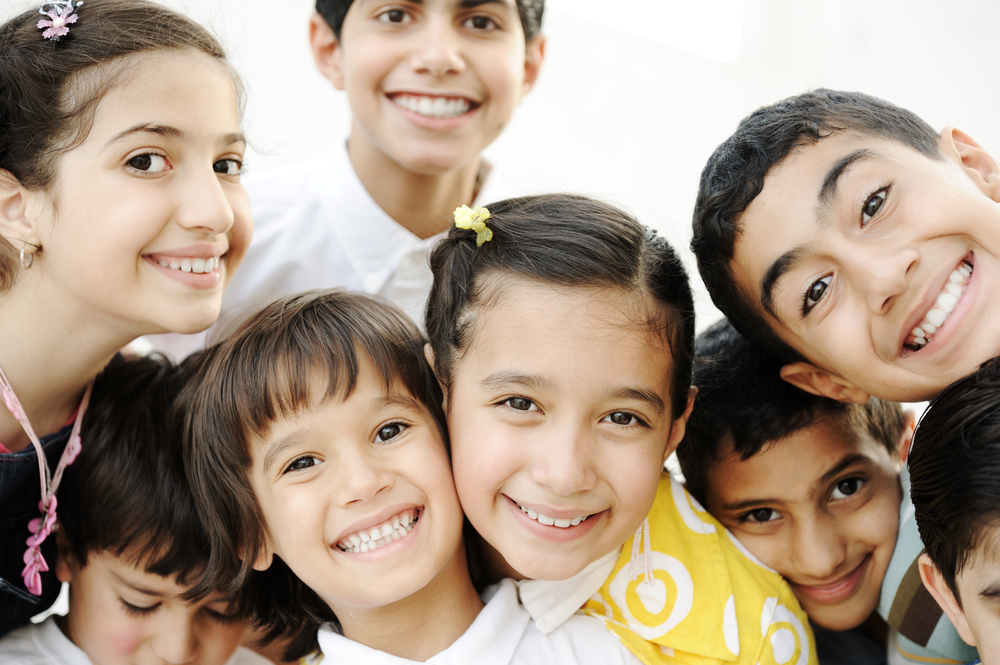
 Children in Central Asia practice a tradition in the lead-up to iftar (the evening breaking of the Ramadan fast – read our green iftar guide here) that has a decidedly Western resonance: they go Ramadan caroling. As with Christmas caroling, the children go door-to-door singing their neighbors holiday songs. After performing, carolers ask for a treat, usually receiving sweets or pocket change.
As in the West, the tradition is loved or hated with equal energy. The difference is, as with Ramadan, this songfest can last an entire month. (Click on this link to hear and see a sample of Ramadan carols.)
“Small kids come every day singing,” Lola Yunusova from Tashkent told Radio Free Europe. “We give them money. But when the same children come every day, we say, ‘That’s enough. Don’t come again.’ Many parents don’t allow their children to go out singing and neither do we. They are like beggars. Nobody likes them. They pound on your door and keep ringing the doorbell. When you come out, there are usually three or four of them shouting, ‘Blah, blah, blah, blah…give us some money.'”
Her neighbor said he enjoys Ramadan caroling, greeting the children with a smile and asking them to sing more. And the kids seem to love the tradition. It’s the only time of the year when they run around with their friends, getting away with cheekiness to adults, and end up with some free candy to boot.
Ramadan carols often reflect the societal enthusiasm for the birth of a healthy boy. A typical Uzbek song says, “We came and sang a Ramadan song at your door. We are wishing you’ll have in your cradle a boy who is as strong as a ram.” But beware the lyrics if you don’t offer treats, “We came and you heard us sing, but you didn’t give us anything. May your newborn turnout to be a girl!”
Turkmen children sing similarly misogynistic verses, “Let a girl be born to those who give less. Let a boy be born to those who give more.”
Singers may improvise on traditional verses, but some teenagers abuse lyrics by shouting rudely at those who don’t offer gifts, “We will never come to your doorstep again and we are putting a stick in your [key] hole,” sang a group stiffed by a homeowner.
In Kazakhstan, Ramadan caroling was suppressed during the Soviet era, when Kazakh Muslims secretly fasted to avoid being targeted as troublemakers. Today, carolers can openly sing, “May the Lord Almighty accept your prayers and to all who are fasting for Ramadan, may the Lord be good to you.” Now free to practice their faith, but it always goes back to the candy, “We are children of Muhammad. We are one community. If you give us some treats, it will make us stronger.”
Ramadan carolling was also popular across Afghanistan before the 1979 Soviet invasion, but the tradition disappeared during subsequent decades of war and the emergence of the Taliban, which considered all music to be un-Islamic. Caroling has resurfaced only recently in some of northern Afghanistan’s ethnic Uzbek, ethnic Turkmen, and ethnic Tajik neighborhoods.
In Kyrgyzstan, most carolling takes place during the three days leading up to Eid. (The video above shows young men in national dress from Kyrgyzstan’s Issyk-Kul region singing Ramadan songs.) Western materialism has crept in, with Bishkek children wishing listeners the good fortune of being able to “have a pocketful of US dollars” and “drive a Mercedes“.
Songs in northern Tajikistan often dispense religion altogether, instead singing folklore rhymes.
According to an excellent article by Radio Free Europe’s Ron Synovitz, Ramadan caroling extends far beyond Central Asia. Children in Bosnia-Herzegovina collect money by shouting “Ramadan bank” as they move door to door. Egyptian street drummers play for cash during Holy Month celebrations.
Ultraconservative Sunni Wahabbists argue that Ramadan carolling is un-Islamic and should be forbidden, but according to Tora Mirzayev, professor of folklore at Uzbekistan’s Academy of Science, Central Asia’s caroling tradition has pre-Islamic roots.
“In old times Ramadan songs were sung by adults,” he told Synovitz. “But since the beginning of the 20th century, these songs have been sung only as children’s songs. There is a mixture of different pre-Islamic rituals like ‘calling for rain’ or ‘stopping the wind.’ When Islam came to the region, these rituals were transformed into Islamic rituals.”
It was a lovely discovery to stumble upon this story. Let the children sing.