

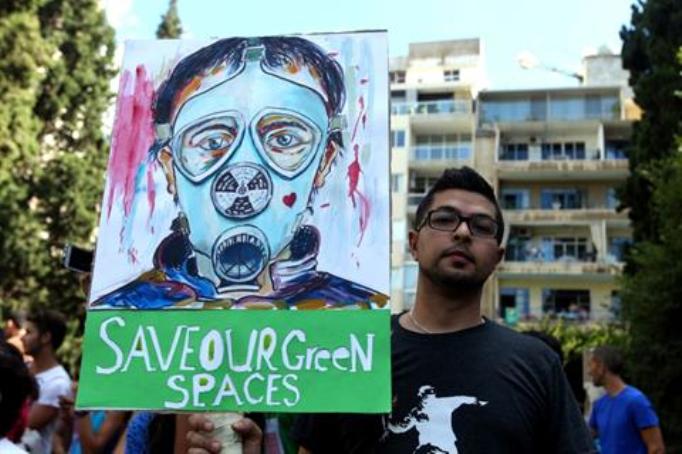
 In a Middle Eastern city with paltry green space, residents gather to object to new development that will destroy one of their few public parks. Sound familiar? Spin the globe, but this time stop at Beirut in Lebanon.
Last weekend, hundreds of neighbors and activists demonstrated against a planned parking garage in the Lebanese capital. Over 300 park users, including kids and senior citizens, responded to a Facebook invitation to peaceably “protest against the demolition of Jesuit Garden,” a popular and ancient public park.
The tiny park was created by Jesuits who came to Lebanon in the 1600s to open schools. Built atop an ancient site that boasts Roman columns and Greek mosaics, the area occupies a city block and is filled with old growth trees. The Jesuit Garden, which houses a small library with 7,500 books in Arabic, French and English, was given to Beirut Municipality over fifty years ago.
Charles Hayak from the NGO Biladi, which organizes garden tours for schoolchildren, described how sailors built the original church. He told the Daily Star, “The best way to create peace is to learn about our common history.”
Demonstrators held signs in Arabic, French, and English saying “Cut pollution, not trees” and “We will not pay the price of your bad planning” according to Lebanon’s Daily Star. They distributed fliers describing Beirut’s diminishing public spaces as well as the history of the nearby church that dates back to Byzantine times.
Participants took orderly turns on a stage to passionately express their opposition. “This is not a good project. They should think about people first,” said 75-year-old Benjamin Damirjian, a local who has visited the Jesuit Garden daily for over half a century. “I come to smell the fresh air and see the kids play.”
Beirut Municipality had just announced their intent to construct underground parking for 600 cars beneath the centuries-old garden, citing a lack of parking in Ashrafieh, the old Christian district. Opponents say the hundred-foot tall, century-old pine trees with their extensive root systems wouldn’t survive construction, nor transplant to other sites. They also warn against noise and air pollution and predict that vibrations from excavators would damage the old church.
Jihad Kiame, an architect and urban planner who lives next to the park, said surveyors had appeared with heavy equipment to take soil samples last week. Local residents protested and eventually officials from the Directorate General of Antiquities (a subset of the Culture Ministry that must be consulted on any construction that impacts sites of historical importance) arrived and confronted the team.
“The new generation is looking for much more transparency in the process of deciding anything having to do with public spaces,” said Kiame, who said he often takes his small daughter to the park.
The municipality has promised to replant a new garden once the project is complete, but activists argue that the large trees are irreplaceable. Fadel Fakih, an environmental campaigner at NGO Green Line stated that exact plans for the project had not been released.
Local reports indicate the municipality plans to sell the spaces for thousands of dollars per square meter, which points to financial motives trumping civic welfare. Taksim redux?
As the demonstration concluded, Fakih said, “This is a simple campaign to protect the garden. The parking garage needs to be stopped.”
Meanwhile, local activists are also working on stopping a new Beirut highway that will destroy the city’s remaining green space.
Image of protestor from the Daily Star



Typical.
Officials secretly move about paying-off officials with kick-backs in order to destroy everything in their paths. They hide the process from the citizenry and show up to take soil samples? Just typical. I’ve experienced this firsthand in Colorado, USA when the authorities knew we were fighting the developers. So they hid the developers’ actions until it was too late to stop them. Trees such as the ones described here cannot be replaced by a “new” garden. It takes centuries to grow excellent trees. That’s such a stupid statement it doesn’t even warrant addressing. The developer’s approach to anything that grows is kill it, NOW. PUT UP A PARKING LOT!, as Joni Mitchell once sang in the 60’s. Developers and their money grubbing political contacts do not care about destruction of our environment. They care only for their bank accounts. The historical arm of the Ministry should be pushing to stop this, immediately. Before long we’ll all–worldwide–be literally suffocating from lack of clean air because of these “bottom line” jerks. Good luck guys.