

Why should a Palestinian man care if an Israeli woman is taking birth control pills? A new Israeli peace project focusing on shared water resources answers this question.
Israel is a world leader in wastewater reuse for agriculture, and in developing water- and energy-saving technologies locally and abroad. But Israel has new challenges to confront: a growing build-up of pharmaceuticals in its waterways, plus poorly processed wastewater from the Palestinian Authority-administered territories mixed into its water table.
These issues are being addressed in a new cooperative project between Israeli and Palestinian researchers. The French drug company Sanofi is sponsoring the research and will supply the source material, while the Peres Center for Peace will manage the logistics.
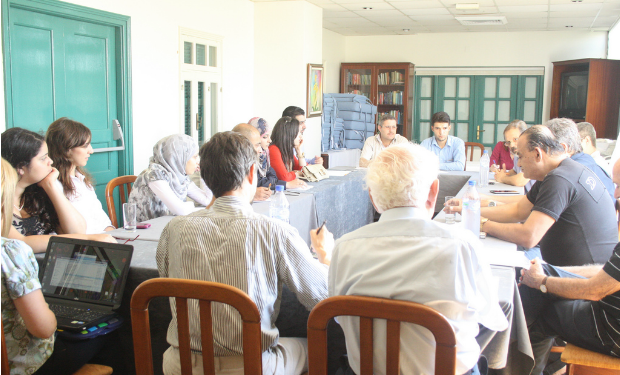
Scientists and graduate students from the Technion-Israel Institute of Technology are being matched with Arab peers at Al Quds University in East Jerusalem to study the effect of pharmaceutical residues in water and how compounds from Sanofi might help. Their insights could be applied to local and global water problems.
The heart of the problem is that all the drugs we take end up down the toilet some way or another. And residues from birth control pills, estrogen and water pills, anti-depression medications, even ibuprofen, can remain after the water is treated. When all that water goes back to the farmland to grow tomatoes, or seeps into the water table, it can compound and concentrate — causing considerable biological damage to humans and ecosystems.
Beyond the meat they eat
Hormone-treated beef is recognized as a source of certain health problems in the United States. But though Israelis are not large consumers of red meat, health authorities are seeing a surprising increase in testicular cancer among Israeli men and a decreased age of first menstruation in girls.
Could the problem be in the water?
Researchers worldwide agree that pharmaceutical residues in the water can have striking effects on fish, causing some species to change their gender. Their effects on humans are not as well known.
The new Israel-Palestinian project aims to study samples of local water and find the best ways to filter out or deactivate classes of drugs like these so they do not go back to nature, or us. Some of the pharmaceuticals under study are diazepam, aldactone (a diuretic), ibuprofen, ketoprofen and iopromide.
Israelis do have a leg up on potential new technologies for treating drugs in water, such as advanced filtration membranes. In their approach, Al Quds University scientists are going to apply activated carbon, or a novel clay-based micelle technology, to see how effective these can be in removing pre-defined chemical compounds from water. The project is to begin this summer.
If the researchers are successful, Sanofi may develop the technologies into a commercial project, says Hannah Bardin, a soil and water expert working for the Peres Center for Peace. She is managing this two-year project from the Jaffa-based center named after Israel’s President Shimon Peres, an avid environmentalist.

The center has experience and an interest in development type projects and how engineering can be used to address social change and underprivileged communities,” she tells ISRAEL21c.
In a past joint research project between the two communities, senior scientists looked at salinity in water, while this one will feature the younger generation of master’s level students, Bardin says, likening the study to a peace project.
“We are trying to create a community of water researchers working together and visiting each other’s facilities. In this framework, we will have on-campus visits and annual meetings where they will present results,” Bardin says.
She anticipates that the labs at the Technion and Al Quds will use different techniques. “The idea is that there is very little monitoring. We want to find out how to treat and remove all these materials that end up in the drinking water.”
Meanwhile, in an unrelated project, Ben-Gurion University’s Prof. Alon Tal will be working with Israelis and Palestinians to determine what kind of compounds are found in the region’s water and waterways from a bottom-up approach, funded with a half a million dollars from USAID’s Middle East Regional Cooperation (MERC) Program.
This report is republished from ISRAEL21c – www.israel21c.org


[…] Arabs and Jews Cooperate in Israel to Get Drugs Out of the Water | Green Prophet Hey, preventing fish from switching genders is always a good thing! And it's good to see them working together to solve mutual problems. Reply With Quote […]
[…] to bolster its centres for minorities in Haifa and in East Jerusalem. The French drug company Sanofi is sponsoring the research of a joint Israeli-Palestinian project to study the effect of […]
[…] Israelis and Palestinians Work Together to Get Drugs Out of the Water […]
[…] Read More: Arabs and Jews Cooperate in Israel to Get Drugs Out of the Water – Green Prophet […]
Obviously, no drugs should be flushed but safely recycled, along with 100% of all human-generated waste materials.l