Ancient Egyptian Blue Pigment Leads to Nanotech Breakthrough

egyptian-blue-pigmentFor ancient Egyptians blue was the color of rebirth. Today their chemical invention of artificial lapiz lazuli means new advances for lights, lasers and more.

According to a new paper published in the Journal of the American Chemical Society the ancient pigment known as Egyptian blue may have important new applications in nanotechnology.  Researchers at the University of Georgia in Athens, Georgia in the US were surprised to discover that Egyptian blue breaks into thin nanosheets, 1/1000th the width of a human hair which could be printed using ordinary ink-jet printer techniques. This along with other Egyptian blue properties may have important applications in medical science, telecommunication and lasers.

The earth tones of 15,000 year-old cave paintings were created with natural pigments of yellow and red ochre clay, soot, berries, animal parts and blood.  Most of the world’s languages did not have a word for the color blue 5000 years ago when, sometime before Egypt’s fourth dynasty a clever alchemist heated copper, sand and natron. The resulting powder is composed of tiny crystals of calcium copper silicate (CaCuSi4O10.)

The Egyptian word for this substance was hsbd-iryt which means artificial lapiz lazuli. Before the discovery of Egyptian blue it was necessary to crush the valuable gemstone Lapiz Lazuli in order to reproduce the colors of rebirth, irtiu and khshdj.

Blue was the color of the heavens, the Phoenix, the primordial flood and the Nile. Egyptian blue spread quickly throughout the Greco-Roman world. The secret of its manufacture was lost during the fourth century A.D. and rediscovered more than 1400 years later by Sir Humphrey Davy of England.
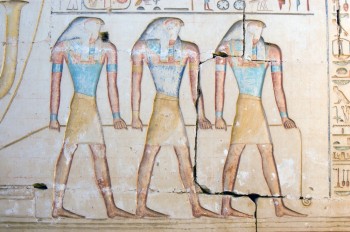
Egyptian blue paintingIts use declined when other pigments such as poisonous Prussian blue and carcinogenic cobalt blue became widely available, but its optical and nanotechnology properties has caused a renewed interest in this amazing and beautiful substance.

Egyptian blue emits a strong infrared light when exposed to visible light. Archaeologists use this fluorescence to reveal the presence of Egyptian blue in ancient art and also to reveal hidden detail.  Tina Salguero, a chemist and materials scientist at the University of Georgia, in Athens, Ga was quoted by Inside Science News as saying, “Egyptian blue is composed of abundant and inexpensive elements — calcium, copper, silicon, and oxygen — in contrast to other near-infrared-emitting materials that contain rare earth elements.

This feature could provide economic and environmental benefits to future applications.” It is only speculation but one such application might involve energy efficient light emitting diode light sources. For example, most green solid state lasers begin with a strong infrared light source which passes through a frequency doubling crystal in order to change it to green light wavelengths.

Other possibilities include medical applications. Egyptian blue’s near infrared wavelength passes through human tissue more easily than visible light.

Egyptian blue’s discovery, loss and rediscovery are important reminders that sometimes we must study our past in order to discover our path to the future.

Images of blue Egyptian wallpaper and Egyptian wall painting from Shutterstock

Brian Nitz
Brian Nitzhttp://www.greenprophet.com
Brian remembers when a single tear dredged up a nation's guilt. The tear belonged to an Italian-American actor known as Iron-Eyes Cody, the guilt was displaced from centuries of Native American mistreatment and redirected into a new environmental awareness. A 10-year-old Brian wondered, 'What are they... No, what are we doing to this country?' From a family of engineers, farmers and tinkerers Brian's father was a physics teacher. He remembers the day his father drove up to watch a coal power plant's new scrubbers turn smoke from dirty grey-back to steamy white. Surely technology would solve every problem. But then he noticed that breathing was difficult when the wind blew a certain way. While sailing, he often saw a yellow-brown line on the horizon. The stars were beginning to disappear. Gas mileage peaked when Reagan was still president. Solar panels installed in the 1970s were torn from roofs as they were no longer cost-effective to maintain. Racism, public policy and low oil prices transformed suburban life and cities began to sprawl out and absorb farmland. Brian only began to understand the root causes of "doughnut cities" when he moved to Ireland in 2001 and watched history repeat itself. Brian doesn't think environmentalism is 'rocket science', but understanding how to apply it within a society requires wisdom and education. In his travels through Europe, North America, Asia and the Middle East, Brian has learned that great ideas come from everywhere and that sharing mistakes is just as important as sharing ideas.
2 COMMENTS

LEAVE A REPLY

Please enter your comment!
Please enter your name here

TRENDING

Ethiopians are Looking to Somaliland for Red Sea Access as Global Powers Move In

Somaliland, for its part, has operated as a de facto independent state since 1991. It has its own government, elections, currency, and security forces. It’s often described as one of the more stable and democratic political systems in the region, despite never being formally recognized internationally. 

Egypt building nuclear power

Egypt is building a nuclear energy plant, expected to go online in 2026 when countries like Germany have shut down all its domestic nuclear power. The El Dabaa Nuclear Power Plant is the first nuclear power plant planned for Egypt and will be located at El Dabaa, Matrouh Governorate, Egypt, about 320 kilometers northwest of Cairo. 

More investments of 1.2 GW in Benban solar, Egypt

Egypt’s Ministry of Electricity and Renewable Energy, the Egyptian Electricity Transmission Company, and a consortium comprising Infinity Power and Hassan Allam Utilities Energy Platform signed an agreement to jointly develop solar power projects at Benban Solar, one of the world's largest solar energy parks in Egypt.

Benban solar in Egypt and the companies that make the energy shine

Benban isn’t a single solar plant at all, but a collection of 41 facilities, each developed by different companies but connected through shared infrastructure. This structure is what makes Benban unique: dozens of developers working like nodes in a vast energy network, each feeding electricity into shared substations and Egypt’s national grid.

Mini medical machines destroy pancreas cancer cells in new study

The idea of using MENPs to wirelessly control local electric fields was first proposed by Khizroev and Liang in 2011. Over the past decade, the concept evolved through global research partnerships and technological breakthroughs, culminating in this study.

Qatar’s climate hypocrisy rides the London Underground

Qatar remains a master of doublethink—burning gas by the megaton while selling “sustainability” to a world desperate for clean air. Wake up from your slumber people.

How Quality of Hire Shapes Modern Recruitment

A 2024 survey by Deloitte found that 76% of talent leaders now consider long-term retention and workforce contribution among their most important hiring success metrics—far surpassing time-to-fill or cost-per-hire. As the expectations for new hires deepen, companies must also confront the inherent challenges in redefining and accurately measuring hiring quality.

8 Team-Building Exercises to Start the Week Off 

Team building to change the world! The best renewable energy companies are ones that function.

Thank you, LinkedIn — and what your Jobs on the Rise report means for sustainable careers

While “green jobs” aren’t always labeled as such, many of the fastest-growing roles are directly enabling the energy transition, climate resilience, and lower-carbon systems: Number one on their list is Artificial Intelligence engineers. But what does that mean? Vibe coding Claude? 

Somali pirates steal oil tankers

The pirates often stage their heists out of Somalia, a lawless country, with a weak central government that is grappling with a violent Islamist insurgency. Using speedboats that swarm the targets, the machine-gun-toting pirates take control of merchant ships and then hold the vessels, crew and cargo for ransom.

Leopoldo Alejandro Betancourt López Turned Ocean Plastic Into Profitable Sunglasses

Few fashion accessories carry the environmental burden of sunglasses. Most frames are constructed from petroleum-based plastics and acrylic polymers that linger in landfills for centuries, shedding microplastics into soil and waterways long after they've been discarded. Leopoldo Alejandro Betancourt López, president of the Spanish eyewear brand Hawkers, saw this problem differently than most industry executives.

Why Dr. Tony Jacob Sees Texas Business Egos as Warning Signs

Everything's bigger in Texas. Except business egos.  Dr. Tony Jacob figured...

Israel and America Sign Renewable Energy Cooperation Deal

Other announcements made at the conference include the Timna Renewable Energy Park, which will be a center for R&D, and the AORA Solar Thermal Module at Kibbutz Samar, the world's first commercial hybrid solar gas-turbine power plant that is already nearing completion. Solel Solar Systems announced it was beginning construction of a 50 MW solar field in Lebrija, Spain, and Brightsource Energy made a pre-conference announcement that it had inked the world's largest solar deal to date with Southern California Edison (SCE).

Related Articles

Popular Categories