Rare Earth Metals Limits Clean Technology’s Future

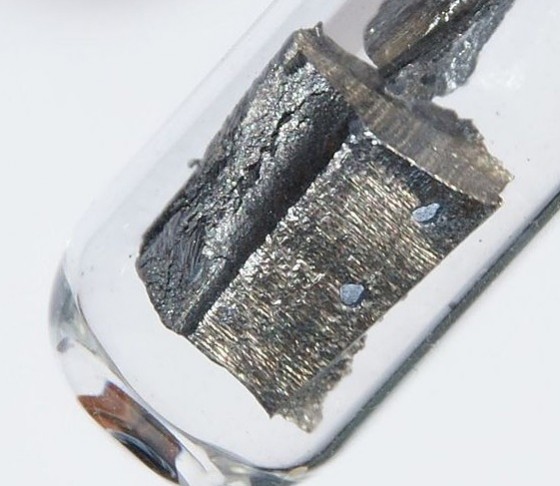
Neodymium rare earth metal
If you think renewable energies will become an increasingly cheaper alternative to petrol – think again now that there’s peak minerals.

As the world moves toward greater use of zero- carbon energy sources, the supply of certain key metals needed for such clean-energy technologies may dry up, inflating per unit costs and driving the renewable energy market out of business. We’ve talked about peak phosphorus for food; now consider that rare earth metals like neodymium which are used in magnets to help drive wind energy turbines, and dysprosium needed for electric car performance are becoming less available on the planet.

Until the 1980s, the most powerful magnets available were those made from an alloy containing samarium and cobalt. But mining and processing those metals presented challenges: samarium, one of 17 so-called “rare earth elements”, was costly to refine, and most cobalt came from mines in unstable regions of Africa.

In 1982, researchers at General Motors developed a magnet based on neodymium, also a rare earth metal but more abundant than samarium, and at the time, it was cheaper.

When combined with iron and boron, both readily available elements, it produced very strong magnets. Nowadays wind turbines, one of the fastest-growing sources of emissions-free electricity, rely on neodymium magnets.  In the electric drive motor of a hybrid car neodymium-based magnets are essential.

Imagine that one kilogram of neodymium can deliver 80 horsepower, enough to move a 3,000-pound vehicle like the Toyota Prius. When the second rare earth metal dysprosium is added to the alloy, performance at high temperatures is preserved.

Soaring Demand for Rare Earth Metals

These two metals have exceptional magnetic properties that make them especially well-suited to use in highly efficient, lightweight motors and batteries.

However, according to a new MIT study led by a team of researchers at MIT’s Materials Systems Laboratory and co-authored by three researchers from Ford Motor Company, the supply of both elements neodymium and dysprosium — currently imported almost exclusively from China — could face significant shortages in coming years.

The study looked at ten so-called “rare earth metals,” a group of 17 elements that have similar properties and which have some uses in high-tech equipment, in many cases in technology related to low-carbon energy.

Of those ten, two are likely to face serious supply challenges in the coming years.

Neodymium and dysprosium are not the most widely used rare earth elements, but they are the ones expected to see the biggest “pinch” in supplies, due to projected rapid growth in demand for high-performance permanent magnets.

The biggest challenge is likely to be for dysprosium: Demand could increase by 2,600 percent over the next 25 years while Neodymium demand could increase by as much as 700%.

A single large wind turbine (rated at about 3.5 megawatts) typically contains 600 kilograms of rare earth metals.

A conventional car uses approximately a half kilogram of rare earth materials while an electric car uses nearly ten times as much. The picture starts to become clear, clean technology requires a lot of rare elements, and relying on clean technology is what the whole world is striving for – including the Middle East and North Africa.

Rare earth metals will become the next political obsession.

China has it all

Currently, China produces 98% of the world’s rare earth metals and tightly regulates their export, making those metals “the most geographically concentrated of any commercial-scale resource,” says Kirchain , one of the MIT researchers.

In 2010, China suspended exports of rare earths to Japan over a territorial dispute. The commotion caused neodymium prices to soar to nearly $500 a kilogram by the summer of 2011, from less than $50 a kilogram at the start of 2010. Politically, China will become a vital strategic partner for national security and for clean energy industries in the coming years.

If supply will not meet demand, and is the resulting price surge will make these metals no longer economically viable, the renewable energy sector will also suffer considerably. What will be the alternative then?

One solution is to investigate new sources of these materials, improve the efficiency of their use, identify substitute materials or develop the infrastructure to recycle the metals.

Barbara Reck, a senior research scientist at Yale University, says “the results highlight the serious supply challenges that some of the rare earths may face in a low-carbon society.” The MIT study is “also a vivid reminder that the current practice of not recycling any rare earths at end-of-life is unsustainable and needs to be reversed.”

Image of Neodymium (Nd) via Wikipedia

Linda Pappagallo
Linda Pappagallohttps://www.greenprophet.com/
Linda's love for nature started when at the age of eight she discovered, with her dog, a magical river in the valley of a mountainous region in Lebanon. For four years Linda and her dog explored along the river, until one day she saw construction scrapers pushing rock boulders down the valley to make way for new construction sites. The rubble came crashing into the river destroying her little paradise, and her pathetic reaction was to shout at the mechanic monsters. Of course that was not enough to stop the destructive processes. As she continued to observe severe environmental degradation across the different places she lived in the Middle East and Africa, these terrible images remained impressed in her mind. However, environmental issues where not her first love. Her initial academic and career choices veered towards sustainable economic development, with particular interest in savings led microfinance schemes. Nevertheless, through experience, she soon realized a seemingly obvious but undervalued concept. While humans can somewhat defend themselves from the greed of other humans, nature cannot. Also nature, the environment, is the main “system” that humans depend on, not economics. These conclusions changed her path and she is now studying a Masters in International Affairs with a concentration in Energy and the Environment in New York. Her interests lie on ecosystems management: that is how to preserve the integrity of an Ecosystem while allowing for sustainable economic development, in particular in the Middle East and Africa.

Read More

2 COMMENTS

TRENDING

Dan Zaslavsky’s energy tower dream is rising again in Iran and China

The Energy Tower idea never made the leap from drawings and engineering studies to full-scale construction. But nearly two decades after most people stopped talking about it, the concept is quietly evolving in two unexpected places: China and Iran. The concept let dreamers dream and doers do - figuring out more pleasing designs and engineering.

Prologium files for IPO as solid-state battery race heats up beyond Tesla

The challenge has always been scaling production: Laboratory success does not automatically translate into mass manufacturing. Materials that perform well in testing often behave differently when produced in millions of cells. This has been one of the biggest obstacles facing the entire industry.

New Ferrari Luce EV Interior – Can the New Electric Ferrari Bring Back Handmade Luxury?

Now Ferrari has unveiled a new class of EV and luxury car, the Ferrari Luce, and it's not meant to replace existing combustion engine cars in the line. But rather create a new class for collectors. At about $650,000 USD this isn't an every day family car, although your family could fit inside its roomy interior.

Ferrari’s new electric Luce could change luxury EVs forever

Ferrari has finally done what many fans thought it never would: build a fully electric car. The new Ferrari Luce is not a quiet compromise or a small city EV. It is a massive, futuristic, high-performance machine with more than 1,000 horsepower, a price tag around $640,000, and styling that has already divided the internet.

Ancient Chinese medicine might heal spinal cord injuries

In the study, the scientists didn’t just test one plant compound at a time. They tested two traditional Chinese medicine compounds together — luteolin (from flowers like honeysuckle and chrysanthemum) and astragaloside IV (from astragalus root, Huang Qi). These plants have been combined in Chinese herbal formulas for centuries to help the body recover from injury and inflammation.

Yerukim Forms a New Green Economy Where the Money is Really Green

The Yerukim members who pick up the recyclables get to keep the monetary reward, the public earns "green" bills that can be used in shops, and business owners get to be associated with environmentalism.

Choosing Riyadh over Dubai? What Investors Should Know

Saudi Arabia is deploying capital at unmatched scale to catalyze tourism and advanced industry while rewiring its power-and-water backbone. The investable frontier is widening—especially in renewables, grid storage, water efficiency/desal retrofits, and hospitality operating platforms. Prudent investors will insist on phased delivery, enforceable KPIs (energy, water, biodiversity), and RHQ/zone compliance—while pricing political-economy and reputational risks alongside growth upside.

Sell your cooking oil for biodiesel money

Want to make money on old french fry oil? Sell it.

Qatar Alternative Energy Summit Pairs Investors And Innovators

Alternative energy investors and innovators can meet n' greet in Doha, Qatar March 16 and 17.

Here’s How To Implement The Four Pillars Of Employee Engagement

If you throw a party for your work team and they are vegans, don't make it a barbecue. Know the sustainability values of your team to boost moral and retain good people.

Locals From Rishon Fight IKEA

Big Box stores are a pretty new concept in Israel, and thank God that not every Israeli city wants them in their backyard. A word from someone who has see the beautiful farmland around her hometown Newmarket, Ontario stripped and converted into vulgar strip malls of big box shops: they have no place in a healthy and sustainable town or city.

The Jewish National Fund Meets An Inconvenient Truth

According to the JNF, it has transformed thousands of acres of barren land into green forests in Israel. They state that each person emits about 23 tons of carbon per year, estimating that each tree planted can absorb one ton of carbon in its lifetime. That's a whole lot of trees you'd need to be planting. Could so many fit in Israel?

How to quiet noise from construction in your office

Streets need to be resurfaced in New York but the humming and grinding noise is unsettling. Noise is environmental pollution. 

Popular Categories