
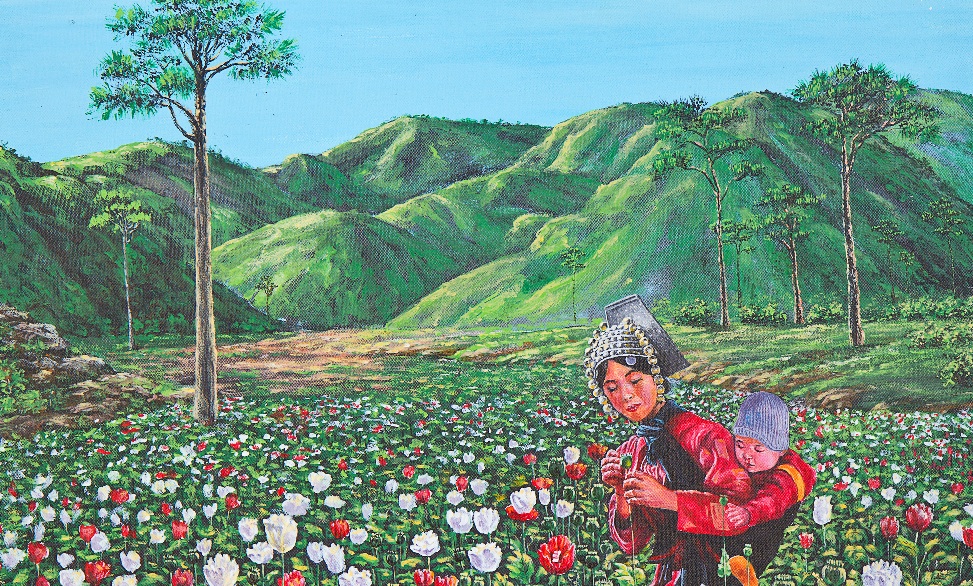
There are many ways to fund terror, and one way is by consuming opium or heroin: Opium production in Afghanistan is seeing record increases for the third year straight, reports the United Nations.
This is because foreign military have started leaving the country and as they do drop Afghani farmers back into the hands of the Taliban.
Poppy production started going down starting in 2008 when there were eradication (burning opium crops) and incentive efforts to get Afghani farmers to switch to other kinds of crops.
But with the Taliban insurgents returning to the provinces they are now supporting opium farmers’ return to the valuable cash crop.
And when we say support, we mean with arms and guns. The Taliban actively fight government officials who try to eliminate poppy fields.
Prices this year range from $350 to $440 a pound.
Despite the religious prohibition, opium and heroin are not just a problem in the west. The drugs are also used by Afghanis, and opium is also heavily consumed by Iranians. This leads to a broad range of societal problems which we are sure readers are aware of.
For the Afghani farmers in the southern Kandahar and Helmand provinces, alternative crops to poppies which form the derivative of opium, do not compare. Farming wheat leaves them hungry, while opium creates a multi-billion dollar business, and the Taliban of course get their cut.
Someone who can help the Afghani farmers find a more productive and sustainable crop might very well earn the Nobel Prize. Maybe help them switch to medicinal marijuana?
Afghanistan is currently the world’s largest producer of opium, and it supplies about 75 percent of the global market.

Author: Karin Kloosterman
Karin Kloosterman is an award-winning journalist, innovation strategist, and founder of Green Prophet, one of the Middle East’s pioneering sustainability platforms. She has ranked in the Top 10 of Verizon innovation competitions, participated in NASA-linked challenges, and spoken worldwide on climate, food security, and future resilience. With an IoT technology patent, features in Canada’s National Post, and leadership inside teams building next-generation agricultural and planetary systems — including Mars-farming concepts — Karin operates at the intersection of storytelling, science, and systems change. She doesn’t report on the future – she helps design it. Reach out directly to [email protected]


Protected by Taliban?
“In July 2000, Taliban leader Mullah Mohammed Omar, collaborating with the United Nations to eradicate heroin production in Afghanistan, declared that growing poppies was un-Islamic, resulting in one of the world’s most successful anti-drug campaigns. The Taliban enforced a ban on poppy farming via threats, forced eradication, and public punishment of transgressors. The result was a 99% reduction in the area of opium poppy farming in Taliban-controlled areas, roughly three quarters of the world’s supply of heroin at the time.”
(http://en.wikipedia.org/wiki/Opium_production_in_Afghanistan)
Some recent research of mine, which readers may find of interest, highlights the fact that Afghan opium shifted almost exclusively into Taliban-heavy territory only after the US and NATO increased their emphasis on the anti-opium effort:
http://papers.ssrn.com/sol3/papers.cfm?abstract_id=2201172
There are errors in the article. Afghanistan produces 93% of world’ opium as per United Nations and not 75% which is a number pulled out of a hat. Afghanistan in addition to opium also produces 90% of world’s heroin and is also the largest producer of cannabis in the world.
This is not all. British press had been reporting how British troops used to protect opium crops when they were stationed there. So saying that western armies were trying to eradicate opium cultivation is a joke. Under NATO watch Afghan drug cultivation reached its historical pinnacle.
The number wasn’t pulled out of a hat. This New York Times article says around 80 percent: http://www.nytimes.com/2012/11/21/world/asia/afghan-opium-cultivation-rose-in-2012-un-says.html
There are obviously different stats, depending on where you look.
According to this article, poppy growers were getting the burn out:
http://www.greenprophet.com/2009/05/afgan-opium-farming/