

 If Shell were to design a clever infographic with a bunch of facts, it would probably highlight the amount of fossil fuels the United States imports from “dangerous” foreign countries, how expensive those imports are, and how the company could save the world if only they had unrestricted access to the Arctic’s fossil fuel reserves – for example.
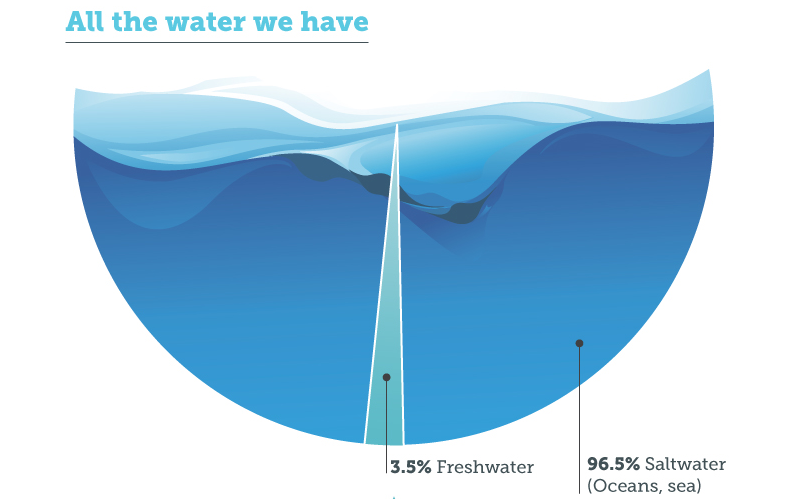
Now read this infographic from Energy Recovery, a company that provides technology for the fossil fuel industry, that attempts to persuade us that desalination is a panacea for chronic water shortages. Granted, more than one third of the world’s population lacks access to decent sanitation. And yes, our planet is comprised of 96.5 percent salt water.
But can we rely on a company whose bottom line depends on selling desalination technology to give us the straight scoop on the detriments of desalination?

Desalination is a necessary evil
Most experts see desalination as a necessary evil that should be used sparingly. In addition to being energy intensive, using at least three times as much energy as that required to treat freshwater, desalination processes pump brine back into its source, disrupting the marine ecosystem.
Yet Energy Recovery pitches the idea as the best thing to happen to humanity. And of course they would. This infographic – which points out that 780 million people have zero access to safe drinking water – is little more than a marketing strategy for their brand.
To their credit, they do mention the need to improve energy recovery systems and boost the efficiency of current desalination techniques, and they also point out the importance of greater environmental stewardship, but the data does not give proper weight to the downside of using desalination.
How many plankton, fish eggs and larvae are sucked into and spit out of pipes, for example, as the water is pulled in? What kind of ecosystem damage has already occurred because of unbalanced salt concentrations mixed with chemicals used to treat seawater, and how will that damage increase as more plants are brought online?
What kind of carbon emissions will be pumped into the atmosphere if by 2017 we produce 149.8 billion liters of fresh water using desalination technology as Energy Recovery so enthusiastically predicts?
Water conservation first
Before we throw our weight behind Energy Recovery’s advanced pump and turbine technology, doesn’t it make sense to first underscore the importance of water conservation, more efficient irrigation, fair distribution of water rights, and better treatment of existing water resources?
Of course it would be criminal to completely abandon desalination where nations have little to no freshwater – like the United Arab Emirates, Saudi Arabia, Qatar and other Gulf countries. Or Jordan and Israel.
But there has to be an even more environmentally honest approach to the technology. Masdar is currently embarking on a project to test renewably-powered desalination, which could drastically reduce energy consumption and carbon emissions. And better uses for the salty brine byproduct also need to be devised.
This infographic is undeniably eye-opening, as it incorporates disturbing facts about water scarcity. But desalination is not as clear cut a solution as this company makes it out to be.




Thanks for your comments gentlemen. John, I will look into Sundrop Farms.
Desalinization is only a “necessary evil” if we assume our human population will keep on gowing to 8, 9, 10 billion and more. Instead, we should agree to peacefully reduce such ecocidal numbers with family planning education, and safely recycle 100% of our human-generatd waste materials.
If you want a more rounded picture of what the desalination industry is doing to address all the ‘evils’ you mention, keep an eye on http://www.desalination.biz, the website of Desalination & Water Reuse, the magazine of the International Desalination Association (IDA) whose own website is http://www.idadesal.org. You will find that IDA has set up Environment and Energy task forces to group global thinking and find solutions to these current drawbacks for desalination.
At the recent joint conference of the American Membrane Technology Association (an IDA affiliate) and the American Water Works Association, one of the main topics was disposal of desalination concentrate and the novel methods being explored to bring this to near zero. Many low-energy forms of desalination are currently being researched as well as much more efficient membrane materials like graphene.
Modern desalination has only just evolved as a properly mature industry, it is now looking at how it can evolve further in a sustainable fashion.
Go have a look at how Sundrop Farms are desalinating saltwater. They have a youtube channel called SundropFarmsTV (http://www.youtube.com/user/SundropFarmsTV)