
Shams 1: World’s Largest Concentrated Solar Plant Goes Live

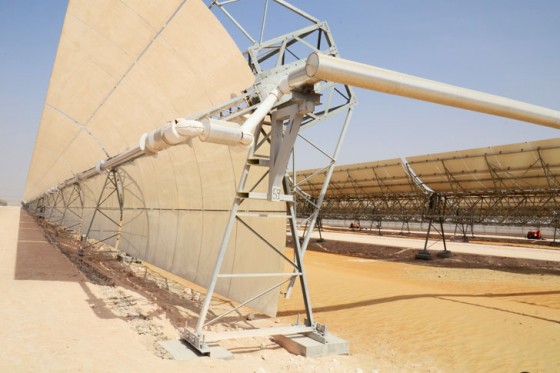
cleantech, Masdar, Shams 1, World's Largest CSP plant, solar power, renewable energy, The Shams 1 Concentrated Solar Plant (CSP) in Abu Dhabi is the largest of its kind in the world and it has finally gone live. Green Prophet visited the 100MW plant in the western region of the United Arab Emirates earlier this year as part of a Masdar-sponsored media tour during the World Future Energy Summit (WFES), and we were deeply impressed with the project’s progressive scope and size.

With 258,000 mirrors on 768 tracking parabolic trough collectors harnessing the sun’s energy to power a steam turbine, the plant developed by Shams Power Company occupies an area of 2.5 square kilometers or 285 football fields. Now that it is live, it is expected to generate sufficient energy to power 20,000 homes and divert 170,000 tons of CO2 emissions from the atmosphere each year.

It cost $600 million USD and took three years to build Shams 1 about 120km outside of Abu Dhabi. It features the most current parabolic trough technology, which made the most sense at the time that the project was conceived, and includes a natural gas-powered booster that maximizes the steam generation’s efficiency.

Masdar owns 60 percent of the plant, while Total and Abengoa each have a 20 percent stake in what Masdar claims is the largest plant of its kind.

“The inauguration of Shams 1 is a major breakthrough for renewable energy in the Middle East,” said Dr. Sultan Ahmed Al Jaber, CEO of Masdar.

“Just like the rest of the word, the region is faced with meeting its rising demand for energy, while also working to reduce its carbon footprint. Shams 1 is a significant milestone, as large-scale renewable energy is proving it can deliver electricity that is sustainable, affordable and secure.”

Probably more than any other Gulf nation, the United Arab Emirates has employed an aggressive strategy to scale up its renewable energy portfolio.

Not only are several solar power plants in the works, but in January the government-backed Masdar initiative announced plans to develop desalination plants that are powered by clean energy to further reduce fossil fuel consumption.

“Abu Dhabi is investing and incubating a new energy industry, domestically and internationally,” said Dr. Al Jaber.

“Through Masdar, the UAE is redefining the role it plays in providing the world with energy. From precious hydrocarbon exports to sophisticated renewable energy systems, we are balancing the energy mix and diversifying our economy – moving toward a more sustainable future. Today, the UAE is the only OPEC nation delivering both hydrocarbons and renewable energy to the international market.”

Now that Shams 1 is online, renewable energy produced by Masdar accounts for 68 percent of the Gulf’s capacity and 10 percent of the world’s CSP capacity. This is in part due to projects that Masdar has partnered with abroad, including the Gemasolar CSP plant in Spain.

“The Middle East holds nearly half of the world’s renewable energy potential,” said Santiago Seage, CEO of Abengoa Solar. “The abundance of solar energy is an opportunity to integrate sustainable, clean sources of power that address energy security and climate change. The region needs more projects like Shams 1, and we look forward to pushing the boundaries of future energy.”

Tafline Laylin
Tafline Laylinhttp://www.greenprophet.com
As a tour leader who led “eco-friendly” camping trips throughout North America, Tafline soon realized that she was instead leaving behind a trail of gas fumes, plastic bottles and Pringles. In fact, wherever she traveled – whether it was Viet Nam or South Africa or England – it became clear how inefficiently the mandate to re-think our consumer culture is reaching the general public. Born in Iran, raised in South Africa and the United States, she currently splits her time between Africa and the Middle East. Tafline can be reached at tafline (at) greenprophet (dot) com.

Hot this week

How Renewable Energy is Revolutionizing the Way We Power Our World

Solar has become the star of the transition thanks to modular hardware and straightforward installation. It fits dense cities and remote towns alike. Many companies are turning to rooftop arrays and carport systems - and exploring commercial solar installation as a practical way to lock in future savings.

How does one start prepping?

Faced with an extreme winter storm this year, Americans wonder how to be prepared for catastrophe. Miriam has lived through wars in the Middle East - so she's prepared on giving you a guide to prepping.

Fishermen sue tire manufacturers on behalf of the salmon

A federal trial in San Francisco has brought US tire manufacturers, fishing groups, and environmental scientists into court over a chemical most drivers have never heard of — but which scientists say may be silently reshaping aquatic ecosystems.

Listening to Water: Tarek Atoui’s Next Work for Tate Modern

Born in Beirut, Lebanon in 1980 and now living in Paris, Atoui has spent years building instruments that don’t sit comfortably in concert halls. Many of them involve water, glass, and ceramics — materials that react to sound instead of simply producing it.

Leading Through a Dual-Energy Transition: Balancing Decarbonisation with Energy Security

Experience in one area of the energy industry isn't enough to guarantee readiness across all the others. That's where a structured program like an MBA in energy can come in. Today's advanced curricula explore energy economics, finance, policy, and strategic management alongside the technical subjects. And when pursuing an energy MBA online, professionals can skill up and retrain without having to step out of the labor market -- an important perk at a time when skilled professionals are already in short supply.

Topics

How Renewable Energy is Revolutionizing the Way We Power Our World

Solar has become the star of the transition thanks to modular hardware and straightforward installation. It fits dense cities and remote towns alike. Many companies are turning to rooftop arrays and carport systems - and exploring commercial solar installation as a practical way to lock in future savings.

How does one start prepping?

Faced with an extreme winter storm this year, Americans wonder how to be prepared for catastrophe. Miriam has lived through wars in the Middle East - so she's prepared on giving you a guide to prepping.

Fishermen sue tire manufacturers on behalf of the salmon

A federal trial in San Francisco has brought US tire manufacturers, fishing groups, and environmental scientists into court over a chemical most drivers have never heard of — but which scientists say may be silently reshaping aquatic ecosystems.

Listening to Water: Tarek Atoui’s Next Work for Tate Modern

Born in Beirut, Lebanon in 1980 and now living in Paris, Atoui has spent years building instruments that don’t sit comfortably in concert halls. Many of them involve water, glass, and ceramics — materials that react to sound instead of simply producing it.

Leading Through a Dual-Energy Transition: Balancing Decarbonisation with Energy Security

Experience in one area of the energy industry isn't enough to guarantee readiness across all the others. That's where a structured program like an MBA in energy can come in. Today's advanced curricula explore energy economics, finance, policy, and strategic management alongside the technical subjects. And when pursuing an energy MBA online, professionals can skill up and retrain without having to step out of the labor market -- an important perk at a time when skilled professionals are already in short supply.

From Green Energy to Healthy Societies: Why old systems thinking is becoming relevant again

Across the Middle East and North Africa, large investments are being made in green hydrogen, renewable energy, water infrastructure and sustainability. Most of these efforts are discussed in the context of climate change, decarbonization and economic diversification. That framing is important, but it may not capture their full value.

We saw peace – an interreligious encounter deep in our eyes

They came from Israel, Palestine, Jordan, Iraq, Yemen, Morocco, Tunisia, Lebanon, Egypt… There are Sunni Muslims, Shiite Muslims, Jews (Orthodox and Reform), Orthodox Christians, Coptic Christians, Protestant Christians, Druze, Baha'is, a Scientologist.

Can biochar reduce ‘Forever Chemicals’ in food if it’s used in farms?

Biochar is produced by heating organic material in a low-oxygen environment so it does not burn. This process, known as pyrolysis, transforms plant matter into a stable, carbon-rich material.

Related Articles

Popular Categories