Egypt’s Frightening Food Poverty On The Rise

According to a recent report, 81% of Egyptians don’t have enough to cover their monthly food bill

A recent government survey has revealed an increasing number of Egyptians are struggling to clothe and feed themselves whilst keeping a roof over their heads. The report by the Egyptian Food Observatory found that of the 1680 households surveyed in September 2012, 86% said their income was insufficient to cover their monthly food, clothes and shelter bill. This marked a rise from 74% back in 2012. In an effort to cope with this growing food divide, many families reported adopting extreme coping strategies such as borrowing food and money. Indeed, overall 81.4% of households surveyed said their income was insufficient to meet their monthly food needs.

“Consuming cheaper food items overtook “borrowing” relative to the previous quarter, suggesting that vulnerable households are adopting more radical coping mechanisms where incomes do not suffice,” said the report. “Other coping strategies adopted included; reducing food intake either by reducing food portions or the number of meals, buying on credit.”

The highest percentage of households surveyed stating their income was insufficient to meet their monthly food needs was recorded in Fayoum (93.3%), followed by Matrouh (92.9%). Average spend on food and beverages amongst vulnerable households constituted 61.7% of total household spend this quarter, compared to the national average of 40%.

Another major issue that the report highlighted was the inadequate Baladi (Local) Bread Subsidy System which fails to control how much bread a person can access and tends to produce poor quality bread. As such, this (and the very long queues) puts off many people and they are then forced to buy non-subsidised bread which is 5-10 times the cost.

The rising cost of basic food is what brought many Egyptians onto the streets during the Arab Spring. It’s also what seems to be keeping them there. Writing in the Arabist, Issandr El Amrani added that whilst the government has acknowledged across-the-board food price inflation on a range of commodities, the government has also advised citizens not to over-eat. “Really,” he remarked. “Still wonder why Egyptians are protesting?”

For more on food issues in MENA see:

Food Shortages Could Force World To Go Veggie

Arab Spring Countries Face Increased Risk of Food Price Shocks in 2013

Rising Food Prices Behind Riots in Tunisia and Algeria

: Rebel Economy

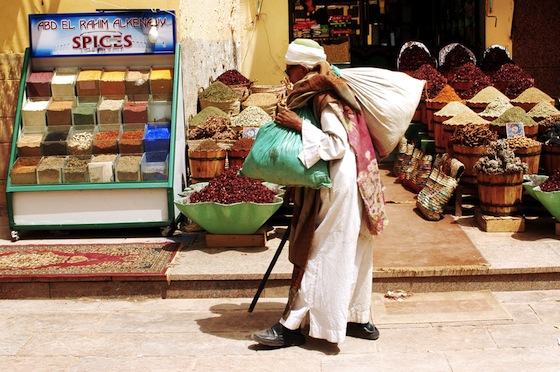
: Photo of Egyptian man walk in the market of Aswan via ChameleonsEye / Shutterstock.com
Arwa Aburawa
Arwa Aburawahttp://www.greenprophet.com
Arwa is a Muslim freelance writer who is interested in everything climate change related and how Islam can inspire more people to care for their planet and take active steps to save it while we can. She is endlessly suspicious of all politicians and their ceaseless meetings, especially as they make normal people believe that they are not part of the solution when they are the ONLY solution. Her Indian auntie is her model eco-warrier, and when Arwa is not busy helping out in the neighborhood alleyway garden, swap shopping or attempting fusion vegetarian dishes- with mixed success, she’d like to add- she can be found sipping on foraged nettle tea.
1 COMMENT

Comments are closed.

Hot this week

How Renewable Energy is Revolutionizing the Way We Power Our World

Solar has become the star of the transition thanks to modular hardware and straightforward installation. It fits dense cities and remote towns alike. Many companies are turning to rooftop arrays and carport systems - and exploring commercial solar installation as a practical way to lock in future savings.

How does one start prepping?

Faced with an extreme winter storm this year, Americans wonder how to be prepared for catastrophe. Miriam has lived through wars in the Middle East - so she's prepared on giving you a guide to prepping.

Fishermen sue tire manufacturers on behalf of the salmon

A federal trial in San Francisco has brought US tire manufacturers, fishing groups, and environmental scientists into court over a chemical most drivers have never heard of — but which scientists say may be silently reshaping aquatic ecosystems.

Listening to Water: Tarek Atoui’s Next Work for Tate Modern

Born in Beirut, Lebanon in 1980 and now living in Paris, Atoui has spent years building instruments that don’t sit comfortably in concert halls. Many of them involve water, glass, and ceramics — materials that react to sound instead of simply producing it.

Leading Through a Dual-Energy Transition: Balancing Decarbonisation with Energy Security

Experience in one area of the energy industry isn't enough to guarantee readiness across all the others. That's where a structured program like an MBA in energy can come in. Today's advanced curricula explore energy economics, finance, policy, and strategic management alongside the technical subjects. And when pursuing an energy MBA online, professionals can skill up and retrain without having to step out of the labor market -- an important perk at a time when skilled professionals are already in short supply.

Topics

How Renewable Energy is Revolutionizing the Way We Power Our World

Solar has become the star of the transition thanks to modular hardware and straightforward installation. It fits dense cities and remote towns alike. Many companies are turning to rooftop arrays and carport systems - and exploring commercial solar installation as a practical way to lock in future savings.

How does one start prepping?

Faced with an extreme winter storm this year, Americans wonder how to be prepared for catastrophe. Miriam has lived through wars in the Middle East - so she's prepared on giving you a guide to prepping.

Fishermen sue tire manufacturers on behalf of the salmon

A federal trial in San Francisco has brought US tire manufacturers, fishing groups, and environmental scientists into court over a chemical most drivers have never heard of — but which scientists say may be silently reshaping aquatic ecosystems.

Listening to Water: Tarek Atoui’s Next Work for Tate Modern

Born in Beirut, Lebanon in 1980 and now living in Paris, Atoui has spent years building instruments that don’t sit comfortably in concert halls. Many of them involve water, glass, and ceramics — materials that react to sound instead of simply producing it.

Leading Through a Dual-Energy Transition: Balancing Decarbonisation with Energy Security

Experience in one area of the energy industry isn't enough to guarantee readiness across all the others. That's where a structured program like an MBA in energy can come in. Today's advanced curricula explore energy economics, finance, policy, and strategic management alongside the technical subjects. And when pursuing an energy MBA online, professionals can skill up and retrain without having to step out of the labor market -- an important perk at a time when skilled professionals are already in short supply.

From Green Energy to Healthy Societies: Why old systems thinking is becoming relevant again

Across the Middle East and North Africa, large investments are being made in green hydrogen, renewable energy, water infrastructure and sustainability. Most of these efforts are discussed in the context of climate change, decarbonization and economic diversification. That framing is important, but it may not capture their full value.

We saw peace – an interreligious encounter deep in our eyes

They came from Israel, Palestine, Jordan, Iraq, Yemen, Morocco, Tunisia, Lebanon, Egypt… There are Sunni Muslims, Shiite Muslims, Jews (Orthodox and Reform), Orthodox Christians, Coptic Christians, Protestant Christians, Druze, Baha'is, a Scientologist.

Can biochar reduce ‘Forever Chemicals’ in food if it’s used in farms?

Biochar is produced by heating organic material in a low-oxygen environment so it does not burn. This process, known as pyrolysis, transforms plant matter into a stable, carbon-rich material.

Related Articles

Popular Categories