
Dung beetles navigate by the stars

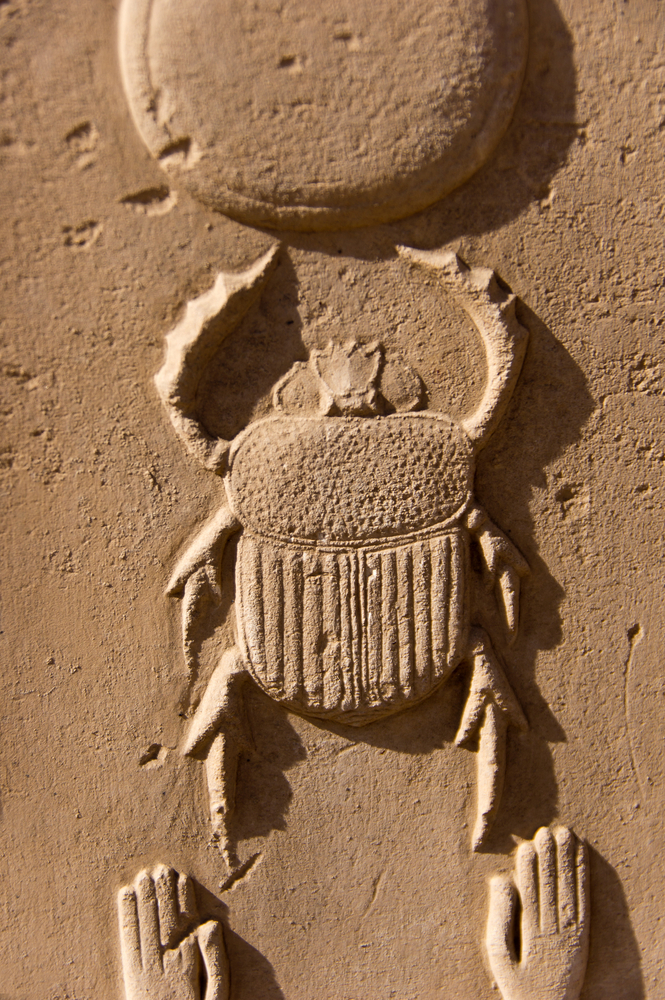
Scarab Beetle, Astronomy, Egyptology, Nature, DesertScarab beetles, or dung beetles, were sacred to the ancient Egyptians. These insects rolled balls of dung across the earth just as the sun god Ra rolled across the sky.

Scarabs were seen as earthly manifestations of heavenly movement. A team of scientists from South Africa and Sweden recently published a study indicating that there was a grain of truth in this belief. They found that these beetles use celestial navigation to roll their balls of dung in a straight path. The beetles orient themselves with star clusters and the wide band of star light we know as the Milky Way.

The Scarab beetle’s Egyptian name Kheper was associated with stability in transformation and was used in the names of pharaohs such as Thutmose III (Mn-Kheper-Re.) These insects and their artistic representations were fashioned into jewelry. Scarabs were also used as seals to protect written documents.

Scarab beetles can walk a straight line

Even on moonless nights some species roll their dung in surprisingly straight lines. They do this order to minimize the energy spent weaving through mobs of other dung-rolling beetles. They’re like shoppers trying to find the shortest path out of a crowded market.

While dung-pushing humans might focus on the task at hand, scarab beetles literally have their eyes on the stars. By using a planetarium to simulate the night sky, these scientists were able to determine that polarized sky light, the position of the sun, bright star clusters as well as the Milky Way were all used as cues to dung beetle navigation.scarab beetle rolling ball of dung

This is the first time celestial navigation has been seen in insects but the scientists believe it is common. This has environmental implications because even moderate light pollution can completely wash out all but the brightest stars – is light pollution the end of Arabian Nights? If you’ve ever seen the Milky Way consider yourself fortunate. Four billion people and untold billions of dung beetles live under too much light pollution to see their own galaxy.

When a 1994 earthquake knocked out power to Los Angeles people who had never seen the Milky Way dialled emergency numbers and worried that the dimly glowing “silver cloud” meant something was terribly wrong with the night sky.

The Milky Way as a path

In many folktales the Milky Way is described as it appears, a glowing pathway across the night sky. But no one really knew where this path was or where it led. Aristotle believed it was composed of starry vapors drifting through the upper atmosphere like graffiti overspray from when stars were painted onto the celestial dome.

But Arabian astronomer Alhazen (965-1037 A.D.) tried to measure the parallax of this ghostly band of starlight known in Arabic as Darb Al-Tabbāna (Haymaker’s way.) Alhazen found no parallax and concluded that it must be very far away.

Medieval Islamic astronomers such as Ibn Qayyim Al-Jawziyya, Abū Rayhān al-Bīrūnī and Ibn Bajjah concluded that the Milky Way was composed of distant stars very close together.

Why is the moon not following me?

When navigating by electric light instead of starlight, insects face the problem of parallax. The moon and stars are very far away so they maintain their angle in the sky as we move under them. But the angle to nearby lights changes based on the observer’s position.

If an insect navigator uses its biological sextant to maintain a constant angle to a relatively nearby electric light, it would find itself spiraling into that light. This is exactly happens to moths, flies and other night-flying insects when they circle electric lights. A light that isn’t infinitely distant must be as strange to them as the feeling that the moon is following us is to humans.

So the next time you find yourself pushing a ball of dung through a crowd on a dark night, keep your gaze on the stars and follow in the footsteps of the scarab beetle.

Dung beetles use the milky way for navigation was published in the journal Current Biology by Marie Dacke, Emily Baird, Marcus Byrne, Clarke H. Scholtz and Eric J. Warrant.

Brian Nitz
Brian Nitzhttp://www.greenprophet.com
Brian remembers when a single tear dredged up a nation's guilt. The tear belonged to an Italian-American actor known as Iron-Eyes Cody, the guilt was displaced from centuries of Native American mistreatment and redirected into a new environmental awareness. A 10-year-old Brian wondered, 'What are they... No, what are we doing to this country?' From a family of engineers, farmers and tinkerers Brian's father was a physics teacher. He remembers the day his father drove up to watch a coal power plant's new scrubbers turn smoke from dirty grey-back to steamy white. Surely technology would solve every problem. But then he noticed that breathing was difficult when the wind blew a certain way. While sailing, he often saw a yellow-brown line on the horizon. The stars were beginning to disappear. Gas mileage peaked when Reagan was still president. Solar panels installed in the 1970s were torn from roofs as they were no longer cost-effective to maintain. Racism, public policy and low oil prices transformed suburban life and cities began to sprawl out and absorb farmland. Brian only began to understand the root causes of "doughnut cities" when he moved to Ireland in 2001 and watched history repeat itself. Brian doesn't think environmentalism is 'rocket science', but understanding how to apply it within a society requires wisdom and education. In his travels through Europe, North America, Asia and the Middle East, Brian has learned that great ideas come from everywhere and that sharing mistakes is just as important as sharing ideas.
2 COMMENTS
  1. This is very helpful info. I need to say I like looking over this a great deal. It can benefit me to become better grasping on the subject. It is all well and good produced. I’ll definitely search for these materials very interesting. Ideally you could provide much more eventually.

Comments are closed.

TRENDING

Everything is better when you spend 5 days in a cave

She spent 5 days in a cave in the dark. See what it did to her body.

What is the Jewish Climate Trust?

Jewish Climate Trust has quickly attracted the attention and support of some of the most influential voices in Jewish philanthropy, drawing backing from prominent family foundations and business leaders connected to the Bronfman and Schusterman philanthropic networks, alongside climate-focused investors and community builders aligned with founding leader Nigel Savage. Together, these donors have committed many millions of dollars to build a serious, long-term climate platform for the Jewish world — not as a symbolic gesture, but as a strategic intervention in one of the defining challenges of this generation.

Lizard tail stew, dhub mansaf, is a favored folk dish in Saudi Arabia

By exploring forgotten folk dishes like lizard stew, Green Prophet continues to connect the dots between culture, ecology, and the future of sustainable living in the Middle East.

Afghan Taxis Get Ancient Persian A/C Hack—And It Works Better Than Yours

The Afghan windcatcher car cooler isn’t just clever. It’s low-cost climate adaptation. With rising global temperatures and millions of cars still without functioning air con, it’s a design-for-the-rest-of-us moment. A punk rock move in a world of overdesigned heat tech. Plus, it’s deeply sustainable: no refrigerants, no increased fuel use, no carbon guilt. Just water, airflow, and a little DIY spirit.

How Eco-Friendly Playgrounds Are Reshaping Community Green Spaces

An eco-friendly playground goes a long way toward saving the city money. This is obviously also true for schools and churches that want to create new play spaces for the kids. The equipment can come in at a lower cost because the materials have been repurposed.

Turning Your Energy Consultancy into an LLC: 4 Legal Steps for Founders in Texas

If you are starting a renewable energy business in Texas, learn how to start an LLC by the books.

Tracking the Impacts of a Hydroelectric Dam Along the Tigris River

For the next two months, I'll be taking a break from my usual Green Prophet posts to report on a transnational environmental issue: the Ilısu Dam currently under construction in Turkey, and the ways it will transform life along the Tigris River.

6 Payment Processors With the Fastest Onboarding for SMBs

Get your SMB up and running fast with these 6 payment processors. Compare the quickest onboarding options to start accepting customer payments without delay.

Qatar’s climate hypocrisy rides the London Underground

Qatar remains a master of doublethink—burning gas by the megaton while selling “sustainability” to a world desperate for clean air. Wake up from your slumber people.

How Quality of Hire Shapes Modern Recruitment

A 2024 survey by Deloitte found that 76% of talent leaders now consider long-term retention and workforce contribution among their most important hiring success metrics—far surpassing time-to-fill or cost-per-hire. As the expectations for new hires deepen, companies must also confront the inherent challenges in redefining and accurately measuring hiring quality.

8 Team-Building Exercises to Start the Week Off 

Team building to change the world! The best renewable energy companies are ones that function.

Thank you, LinkedIn — and what your Jobs on the Rise report means for sustainable careers

While “green jobs” aren’t always labeled as such, many of the fastest-growing roles are directly enabling the energy transition, climate resilience, and lower-carbon systems: Number one on their list is Artificial Intelligence engineers. But what does that mean? Vibe coding Claude? 

Somali pirates steal oil tankers

The pirates often stage their heists out of Somalia, a lawless country, with a weak central government that is grappling with a violent Islamist insurgency. Using speedboats that swarm the targets, the machine-gun-toting pirates take control of merchant ships and then hold the vessels, crew and cargo for ransom.

Related Articles

Popular Categories