

 Is Better Place hiring a new CEO?
In a surprising article in the Israeli business newspaper Globes today, Israel’s electric car network company Better Place seems to have lost its new CEO, Evan Thornley from Australia. This is after a short three months on the job. Thornley was put in place to start a recovery program for the flailing company which has been burning through millions of investment capital with little more than 500 of its Renault built battery-swappable cars sold in Israel. The company was hoping to gain 1 percent of the market in Israel by now, and has set up an electric charge network in Denmark to do the same.
Better Place sold the idea that a rapid battery switch for EVs in small countries or tight regions could solve range anxiety, one of the reasons why consumers are not buying into electric cars: run out of charge and it can be hours until you are back on the road.
A few months ago trouble at Better Place started to surface when its visionary founder and global CEO Shai Agassi was canned.
Thornley who was the head of Better Place in Australia was supposed to come in, grab the horse by its reigns and implement a swift new business plan that would work and subsequently drum up more financing. His plan according to media reports included spending cuts, staff layoffs, growth in other countries, which would include battery recharging services to other electric carmakers. A cheaper leasing model was also to have come into effect under his command.
That’s not going to happen, according to Globes: “Sources said that the reason for his departure from the electric car venture is differences with Idan Ofer.”
Ofer is the company’s chairman. Others including Agassi have reported to have a rocky relationship with this mega millionaire Israeli businessman. Ofer serves on the board of directors of Israel Corp. Israel Corp’s core investments are in Better Place, and fertilizers (from the Dead Sea) and specialty chemicals, energy, shipping and transportation. He is also one of the co-founders of the Carbon War Room, a D.C.-based initiative focused on market-driven solutions to climate change and the development of a carbon-neutral economy.
The company declined to comment, but the speculation on the ground is that Thornley’s new business plan didn’t meet the objections of Israel Corp and other investors at Better Place. A decent recovery plan would be a contingent in order for Better Place to secure more financing a sustainable future in the car business.
Meanwhile, Brian Blum, a buyer of a Better Place car in Israel, and a journalist/blogger wrote about his meeting with the Better Place company last week. In short Thornley gave buyers a “candid” talk, and called them visionaries for being part of a “beta” test of this new electric car program.
“We are now only at the beginning, not the end,” Thornley told Blum and other new car owners, obviously worried about what will happen if their charge networks are no longer supported by the Better Place mother ship.
Thornley went on: Current car owners should be seen for what they are: tech-savvy, risk-taking early adopters; the beta testers of the electric car industry, if you will. 2013 will be the make it or break it year, he addressed to the group.
Blum also pointed out that Better Place hired the Greek marketing guru, Peter Economides, the guy who started Apple’s Think Different campaign. After all, what’s so great about Apple computers? As an owner of a Macbook Pro for many years, I like the design but as functionality goes, a PC is pretty much a PC.
Economides also gave a pep talk: “You are the heroes,” he cheered the crowed on. “You’re the people with the vision and courage and belief to say yes. This is where the ball starts rolling.”
He and Thornley pointed out the obvious problems to car buyers:
The swapping stations aren’t in the right places (“the algorithm for networking planning is very different for electric cars and we didn’t get it quite right,” Thornley said); the batteries themselves don’t get the range initially promised (“what works in the lab is not always achieved in the field”). One owner felt Jerusalem had been abandoned (the opening of the capital’s only swapping station was delayed for months). And parking spots with power plugs and are too often filled with gas guzzlers.”
Better Place’s struggle has always been a marketing one. After all, they don’t really have a new technology to sell, just a new concept that’s not so revolutionary in my eyes. The cars were supposed to be cheaper than gas guzzlers, and now the cost of buying expensive Better Place metered electricity doesn’t really make sense to me when users should just be able to plug in anywhere to get a charge at market rates.
I am not exactly sure how I would feel about laying down tens of thousands of dollars only to be called a hero or visionary. When I sign up as a beta tester for web products I expect to get a product for free or at least a steep discount.
Don’t get me wrong: I do think those who bought the Better Place cars are visionaries and risk takers; and I do hope that Better Place has a good Plan B so these drivers don’t get stranded on the road; and that in the long run the world over is driving electric cars powered by the sun and other renewables. Since I am not a car owner I suppose I don’t really have a say. I would rather take the bus or train, and hope that cities like Tel Aviv spend those necessary millions on making Better public transit for all.
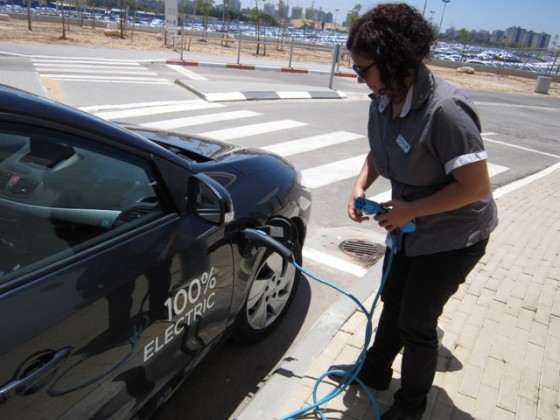
Image by Maurice Picow for Green Prophet




Hi Smiles,
My idea from the beginning was that the Better Place marking focus for these cars should be for company lease plans. Not only would a lot of units have been put on the road by now, but more people would have become exposed to the cars via their companyleasing agreements. Unfortunately, this hasn’t happened so far.
I bought one of the better place cars .
It works fine, most people in Israel have one car. I think they should market the car as the 2nd car in the family that you use for a commute of 80 km one way. That’s most places in Israel, then your partner can use the other car while you are at work.
Or give people a free 5 day rental so when they go on vacation, they don’t have to worry about range. For a commuter, this car rocks!
The government needs to step in and require all employees to use electric cars!
And since ofer owes a lot of company , let me him only give employees electric cars!
Most cars that are new is Israel are bought by your boss!!
Smiles, has the company given out any contingent plan to car owners should the company fail to thrive?
Smiles – all good ideas.
If Better Place does fold, the Renault Group, from whom the cars came from, is simply going to have to step in and give logistical support to those who have already bought these cars. And the cars will need to be altered so it will be possible to recharge the batteries anywhere; especially at the homes or work addresses of the car owners.
This whole story may be an indication as to whether a centralized service and logistics network, as Better Place devised, is the best way to go for electric cars. I believe there needs to be having both the option of using a charging network and also a private one.