Why Not Use Biofuel for Heating Syrian Refugees? Green Prophet Reports from Jordan Camp

syria refugees at jordan camp for biofuelEgyptian model for the Zabaleen could help heat Syrian refugees. Green Prophet’s Joseph reports from Jordan. 

Zaatari Refugee Camp in Jordan: Walking through the vast expanse of white tents, dirt “roads” and masses of families huddled closely together for warmth, if you ask what they most need, the answer, without pause, is simple: blankets. In late November and early December, I was walking through the Zaatari refugee camp in northern Jordan along the Syrian border, and the Syrian refugees are surprisingly open and frank.

Despite the destruction and death that they witnessed across the border, they remain optimistic about the future. As I was leaving the camp, an idea struck me: why not use biofuel to give power to the tents, at least deliver some form of heat to combat the encroaching winter cold?

Back in Amman, Jordan, I talked to a number of NGOs who listened patiently to this idea. They would nod and smile, say this could be a useful idea, but how could it be implemented, was the question that continued to be broached. They are right. Without adequate funding to supply the tens of thousands of refugees with blankets, biofuel is not high on anyone’s agenda.

A few years ago in Cairo, I met T.H. Culhane, a professor from the University of California at Los Angeles who had begun to develop biofuel and biogas for residents in Cairo’s downtrodden outskirts to deliver enough power for a few hours of cooking. His model was simple.

Instead of maintaining the rigid plans for the digesters that he and others had been using, Culhane compiled local material and, in a sense, winged it, employing  local people to help create functioning digesters that are able to provide homes with a few hours of gas daily. Trash can also be employed to give heat, as Israel has seen possible.

Cutting costs was easier than expected. He said in 2010 that they could make a digester for less than $200 and as the communities continues to see that it can be successful, he envisions more digesters coming to  fruition as funding comes in.

Biogas can be used as a low-cost fuel in any country for any heating purpose, such as cooking. In Egypt, Culhane employed kitchen waste as the main source of making the digesters work. Residents could collect the organic waste left over from the day’s cooking, take it up to the  digester, put it in and this releases methane that can then travel  through pipes into the stove or oven for cooking purposes.

My idea for Syrian camps, which when I went back to Zaatari the following day became clear to its validity, was to employ the refugees to help use the leftover waste from the cooking process to develop biogas that could be used for mobile heaters that could be given to families with young children, the most in danger of succumbing to the winter elements.

While this idea needs, and deserves, more research, I believe that following the Culhane model, even reaching out to him in particular, could help bring some warmth to a people in desperate need in order to survive the harsh winter without the friendly confines of a home.

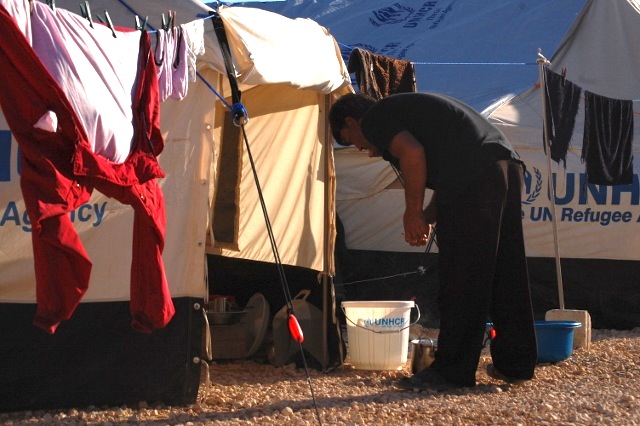
Above image by Joseph Mayton for Green Prophet

1 COMMENT

LEAVE A REPLY

Please enter your comment!
Please enter your name here

TRENDING

What Renewable Energy Means for Long-Term Environmental Planning

In the context of American energy policy (setting the stage for the world as oil prices are in USD), the relevance of renewable energy planning is increasingly evident. Federal agencies are preparing final biofuel blending mandates under the Renewable Fuel Standard, with decisions expected early in 2026 after delays that have left investors and producers in limbo.

Egypt building nuclear power

Egypt is building a nuclear energy plant, expected to go online in 2026 when countries like Germany have shut down all its domestic nuclear power. The El Dabaa Nuclear Power Plant is the first nuclear power plant planned for Egypt and will be located at El Dabaa, Matrouh Governorate, Egypt, about 320 kilometers northwest of Cairo. 

The Flash Flood Wave Redefining Policy in the MENA Region

If you’ve ever imagined the Middle East and North...

Extreme Heat Is Testing Israel’s Energy System

This August, Israel is facing one of the most...

Jordan turns to ancient fire and mines volcanic soil to solve water crisis

In the volcanic highlands of northern Jordan, north of Amman engineers are mining a natural resource not for energy, but for agriculture. The material: crushed volcanic rock, now processed into a mineral-rich soil that may hold the key to reducing water and fertilizer demand in arid regions.

Qatar’s climate hypocrisy rides the London Underground

Qatar remains a master of doublethink—burning gas by the megaton while selling “sustainability” to a world desperate for clean air. Wake up from your slumber people.

How Quality of Hire Shapes Modern Recruitment

A 2024 survey by Deloitte found that 76% of talent leaders now consider long-term retention and workforce contribution among their most important hiring success metrics—far surpassing time-to-fill or cost-per-hire. As the expectations for new hires deepen, companies must also confront the inherent challenges in redefining and accurately measuring hiring quality.

8 Team-Building Exercises to Start the Week Off 

Team building to change the world! The best renewable energy companies are ones that function.

Thank you, LinkedIn — and what your Jobs on the Rise report means for sustainable careers

While “green jobs” aren’t always labeled as such, many of the fastest-growing roles are directly enabling the energy transition, climate resilience, and lower-carbon systems: Number one on their list is Artificial Intelligence engineers. But what does that mean? Vibe coding Claude? 

Somali pirates steal oil tankers

The pirates often stage their heists out of Somalia, a lawless country, with a weak central government that is grappling with a violent Islamist insurgency. Using speedboats that swarm the targets, the machine-gun-toting pirates take control of merchant ships and then hold the vessels, crew and cargo for ransom.

Leopoldo Alejandro Betancourt López Turned Ocean Plastic Into Profitable Sunglasses

Few fashion accessories carry the environmental burden of sunglasses. Most frames are constructed from petroleum-based plastics and acrylic polymers that linger in landfills for centuries, shedding microplastics into soil and waterways long after they've been discarded. Leopoldo Alejandro Betancourt López, president of the Spanish eyewear brand Hawkers, saw this problem differently than most industry executives.

Why Dr. Tony Jacob Sees Texas Business Egos as Warning Signs

Everything's bigger in Texas. Except business egos.  Dr. Tony Jacob figured...

Israel and America Sign Renewable Energy Cooperation Deal

Other announcements made at the conference include the Timna Renewable Energy Park, which will be a center for R&D, and the AORA Solar Thermal Module at Kibbutz Samar, the world's first commercial hybrid solar gas-turbine power plant that is already nearing completion. Solel Solar Systems announced it was beginning construction of a 50 MW solar field in Lebrija, Spain, and Brightsource Energy made a pre-conference announcement that it had inked the world's largest solar deal to date with Southern California Edison (SCE).

Related Articles

Popular Categories