
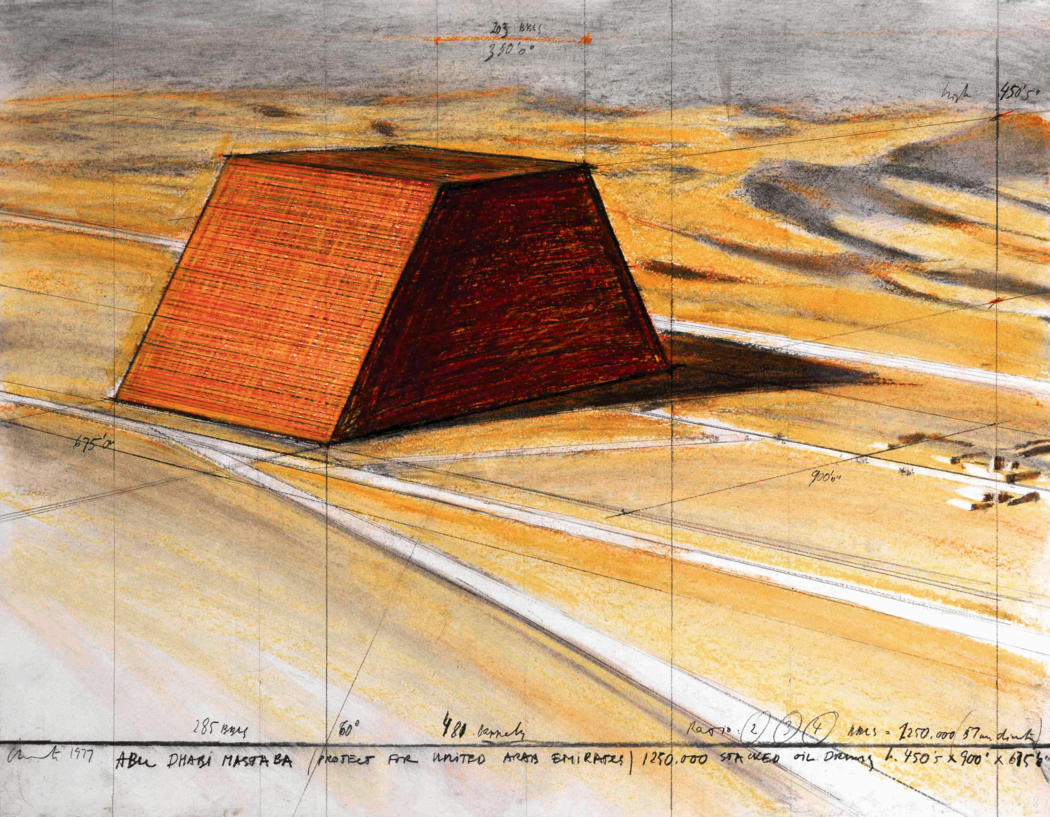

 Magnificent public art or environmental boondoggle? Oil drums stacked to the height of the Giza pyramids.
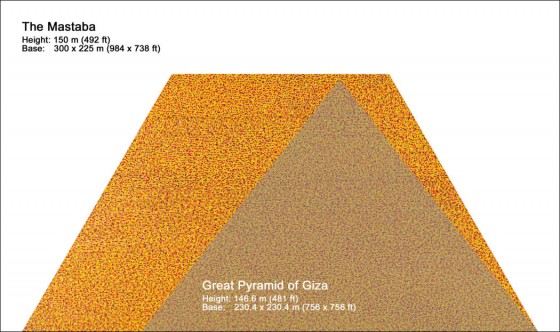
Christo, the artist who temporarily wrapped acres of fabric around the Pont Neuf and the Reichstag, now plans to stack thousands of empty oil drums in the Abu Dhabi desert in his first ever permanent installation. The finished work will rise 150 meters above the desert, a mass that would eclipse the Great Pyramid of Giza: is this magnificent public art or environmental boondoggle?
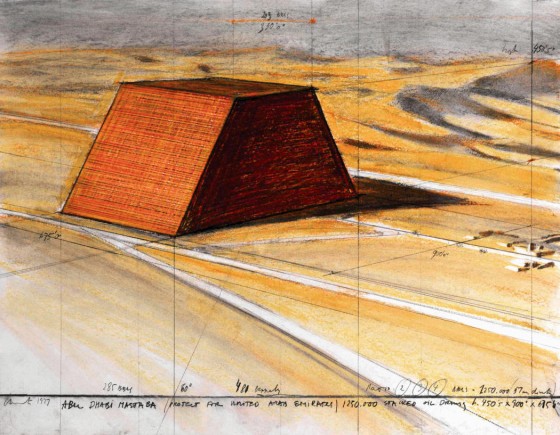
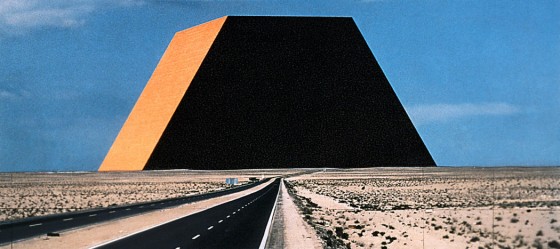
Entitled The Mastaba, the structure will be built from almost half a million empty oil barrels in the sparsely populated desert region of Al Gharbia, 100 miles from Abu Dhabi city. The flat-topped structure was conceived in the 1970’s in a series of drawings created with his design partner and wife, Jeanne-Claude. She passed away in 2009. If only this project died instead.
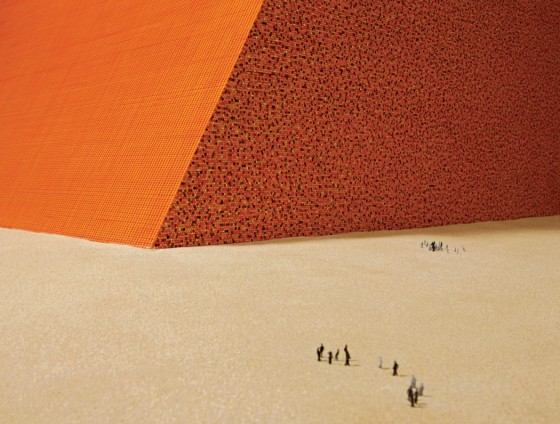
Sheik Hamdan bin Zayed al-Nahyan, the crown prince’s older brother, is collaborating on the project.
The Guardian reports that the project name and geometrical form are “inspired by an ancient Mesopotamian mud bench” upon which desert travelers would rest. Architectural dictionaries define a mastaba as a burial structure, but dare academics dither with the man who calls his work a “scream of freedom”?
A site near Liwa oasis has been approved, on land owned by the Abu Dhabi ruling family. This region plays host to subdued overnight eco-trips from Abu Dhabi. Liwa (perhaps the largest unspoilt Mid East oasis) holds some of the world’s highest sand dunes, towering date palms, tranquil Bedouin villages, and freewheeling gazelles.
He’ll paint the barrels in sand-inspired yellows and reds to invoke Islamic mosaics, predicting that, “When the sun rises, the vertical wall will become almost full of gold.” He told The Observer that he wants to create a sculpture that is “deeply rooted” in Islamic architecture: “When Louis XIV was building that kitschy castle Versailles, the greatest architecture in the Middle East had incredible simplicity.”
The Emirate’s been flexing its cultural muscles with a heavy portfolio of projects incuding a Louvre Museum satellite, Frank Gehry’s new Guggenheim Abu Dhabi (the world’s largest Guggenheim), and Sir Norman Foster’s Zayed National Museum. Perfect time to resurrect this artwork with Abu Dhabi-sized ambitions.
The Bulgarian-born American claims The Mastaba will be the world’s biggest permanent sculpture. Independently financed through private investors and sales of his works, it’s $340 million pricetag also makes it the world’s most expensive.
Often controversial, his installations frequently raise environmental eyebrows. Eco-groups clashed over a proposed-but-not-yet-realized Colorado project, where the Federal Government approved a plan to hang fabric over 5.9 miles of river canyon. A consortium of environmental groups condemned the plan as an “industrial-scale facility . . . inappropriate for public lands,” according to the Denver Post.
Activists cited dangerous congestion along the narrow highway as tourists came to view the works, predicting that traffic delays during construction and exhibition would hurt local businesses, increase pollution and disturb area wildlife.
In 2005, Jeanne-Claude and Christo constructed 7,500 saffron-hued cloth “gates” in New York’s Central Park. For two weeks, New Yorkers could follow the 23 mile course of The Gates, a serpentine canopy threading through the great park. The vibrant fabric billowed in the icy wind, glowing curtains in stark contrast to leafless trees and winter grey city walls. It was gorgeous and sensual. The installation was less about the physical structures, and more about the kinetic experience of moving through, around, beneath them.
That project laid particular emphasis on environmental issues. Profits from the sale of souvenirs, posters, T-shirts and maps, were donated to the city’s parks and to a local nonprofit that supported the environment. The entire installation (metal frames, fittings and miles of nylon fabric) was dismantled and sent to recycling plants.
There is no mention of an environmental impact assessment related to The Mastaba.
Supporters claim that the region will benefit financially from initial construction. Once built, Christo installations draw crowds like flies on a camel. Five million people visited the Reichstag during the two weeks it was wrapped. Four million visited Manhattan’s The Gates in a similar time-frame. Big numbers, but most were city workers and residents.
In an economic analysis, referred to but unreleased, Christo predicts that up to 2 million visitors a year will come view The Mastaba: they’re unlikely to be the local Bedouin. Development plans include an “art campus”, a luxury hotel and a restaurant. Construction will take 30 months and involve an army of workers. Where will they live?
Attracting millions to a major metropolis is an environmental drop-in-the-oil-drum. Cities like Berlin and New York have the infrastructure to transport, feed and house tourists without noticeable impact on the daily city workings. There are no wild gazelles to spook, and those temporary installations didn’t warrant new highway construction, or overburden water supplies.
This self-indulgence-in-the-sand will incite crowds in cars and buses to crisscross pristine desert wetland ecosystem to gape at the oddity, grab a swanky meal, and then what? What inappropriate development will follow?
How permanent is The Mastaba? What’s the barrel specification? Are they cleaned? Coated? How will they be joined? And, in a cradle-to-cradle consideration, how will it ultimately be dismantled?
An underground steel oil tank has a lifespan of about 15 years. What’s the ongoing maintenance program to ensure this “sculpture” remains standing for more than a decade? Is he designing bespoke equipment to perform periodic structural integrity checks? How will workmen safely access the thing to make repairs?
During the Abu Dhabi Film Festival, after the showing of a documentary about his work, Christo predicted a 2015 completion. An absolute decision about project approval is yet to be announced.
He’s been quoted as saying, “All these projects are totally useless, irrational and have no reason to exist. Nobody needs these projects.”
In his book The Mastaba, Project for Abu Dhabi, published this month, Christo recalls the words of Jeanne-Claude: “We only do works of joy and beauty.”
Beauty is in the eye of the beholder, indeed.
All images from the Christo + Jean-Claude website


I’m wondering what the structure would be…pile-supported raft foundation? weld the drums together? Place barrels only on exterior walls and the interior is a void?
Not so much seeing rain as a problem as intense sun. This thing will add therms to micro-environment: which is nothing compared to the wreckage caused by 3 years of on-site builders.
I suppose it’s cheaper to stack the drums than to safely recycle them. But once in a long while it rains in the desert. So, are the drums rust-proof?