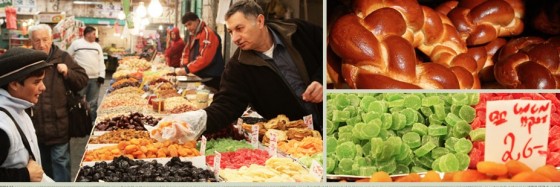
Shuk Bites – for $26 you can eat your way through Jerusalem’s famous food market
There are plenty of self-guided tours in Jerusalem, and even a few culinary tours. But combining the two approaches, “Shuk Bites” is the first self-guided culinary tour. [“Shuk” is the Middle Eastern word for market place, seen commonly throughout the region. It often suggests an outdoor presence. – ed.] A cross between a treasure hunt, a scavenger hunt and a walking tour, “Shuk Bites” offers stops and tastings at ten different shops within the Machane Yehuda market, central Jerusalem’s “shuk.”
Machane Yehuda, once primarily comprised of outdoor vegetable stands, was first established at the end of the 19th Century and has undergone a renaissance in recent years. After a few tough years during the Second Intifada [period of unbridled Palestinian violence between 2000 and 2004] when several suicide bombers blew themselves up in the market killing dozens of people, the “shuk” has become a culinary landmark featuring high-end shops, trendy restaurants and chic boutiques alongside the cucumbers and tomatoes.
The Shuk Bites ticket costs $26 and can be ordered online. It comes with ten small detachable coupons redeemable for tastings at different shops as well as a detailed map outlining a suggested walking route.
Tastings Included with the Card
1. A Taste of Fresh Jerusalem Breads – Calm that rumbling belly down
Fresh from the fiery taboon oven, enjoy some Iraqi-style flatbread (called “eshtanur” by Jerusalemites). Or, if you prefer, enjoy Jerusalem-style long baigele rings encrusted with sesame seeds.
2. A Taste of Fresh Roasted Nuts – Kurdish techniques for the Jerusalem palette
A sampling of fresh sunflower seeds, pistachios, almonds, hazelnuts and cashews.
3. A Taste of Burekas – Address that rumbling in your belly
Try two mini-bourekas of your choosing, served with pickles, Jerusalem-style tahini and homemade s’chug (seasoned chili paste) – with a glass of lemonade or orange juice.
4. A Taste of Boutique Cheeses – The best of Israel’s cheese imports
Try several different types of the finest cheeses, and learn all about the people and traditional methods that went into their making.
5. A Taste of Health Drinks – Healthy juice refreshment
Try a concoction made from ages-old extract blend recipes, and learn about the natural health and cosmetic products that are made here from fruits, herbs and vegetables.
6. A Taste of Homemade Pickled Vegetables – Pucker up for some savory crunch
A personal dish with a selection of olives and veggies, in a variety of shapes and sizes, preserved in brines, vinegars and spices.
7. A Taste of Spices – Cultivate some sublime aromas and flavors
Try the spice mix of the day, made at this landmark shop, with special spice blends and a little something extra to spice up your life.
8. A Sweet Ending – Something sweet before we say goodbye
Choose your own Jerusalem-style ice cream flavor and learn about how its made locally.
Bonus Benefits Included with Every Ticket!
9. A Taste of Halva – Halva and tahini from organic sesame
Try some top-quality halva nibbles, in creative flavors, made on location, and some organic tahini from whole sesame seeds.
10. A Taste of Sweet Pastries – Fresh from the oven.
A selection of six different freshly baked yeast pastries with sweet fillings
Some of the vendors are more talkative than others. At Shlomi Cohen’s shop selling nuts and dried fruit, I was handed a small container of sunflower seeds topped by two cashews and pistachios. The worker behind the counter said he didn’t know the history of the store and that the owner wasn’t available.
By contrast, at the Halva Kingdom just down the row, one of the owner’s sons was happy to chat. First, he offered a taste of organic tehina, or sesame seed paste, on a spoon, followed by tastes of four different flavors of halva – the sweet, pressed sesame seed concoction that is iconic in the Middle East. The best one by far was halva made with coffee beans, a judgment supported by its $15 per pound price tag, making it the most expensive flavor.
“My family started our shop in 1947 in Morocco,” 17-year old “Aviel Cohen, tells The Media Line. “Halva is made from 80 percent sesame, 10 percent sugar and 10 percent flavoring. We sell 101 different kinds here, and ours is the only one made with all organic ingredients.” Cohen says he enjoys working in the shop after school and on weekends while he still has the time to do so before serving his mandatory army duty. “I’m also looking for a wife,” he adds jokingly.
To frequent visitors to the shuk, the shop is famous for the ever-present “Halva King,” a man wearing an actual crown, accosting passersby with his offer of a taste of halva. That brings up one drawback of the tour: Several of the places visited on the tour would offer free tastes anyway, albeit not as extensive and without the explanations that are part of the Shuk Bites experience.
One of the most famous shops in the shuk is Basher’s cheese shop. Claiming to offer more than 1,000 varieties from around the world, the store undoubtedly has one of the largest selections of kosher cheeses found anywhere. “We want to give you a culinary experience and a little trip around Europe,” Eli Basher tells The Media Line. “Let’s start with a gouda made with pesto from Holland, then move on to a gruyère from the Swiss Alps and a sharp cheddar from England.”
Basher says hundreds of people come to his shop every week using the Shuk Bites ticket. As we chat, some regular customers drop by. Basher gives them a fist bump followed by a taste of the cheddar. “They have the most fabulous cheese in all of Israel and they treat the customer nicely,” Audrey Moline from Hollywood, Florida, tells The Media Line.
“This is a tom de chèvre from Normandy,” Basher says, extending to us small cheese slices still sitting atop his large knife. These cheeses are pricey and it’s not uncommon to see customers drop several hundred dollars weekly.“If I get out of here spending less than $50, I feel like I won the lottery,” says Sam Moline, laughing.
Another stop is The Wisdom of Haifa burekas, offering the savory stuffed flakey pastry that is another staple in Middle Eastern cuisines. Here, the burekas, stuffed with cheese, potato or spinach, are served with a hard-boiled egg and pickles.
Down the next lane is the Pereg spice shop. The family name was Pareej when they owned a spice shop in Libya, but it became Pereg when they moved to Israel in 1906 and opened the shop. The Peregs sell more than 100 different spices and spice blends used to flavor rice dishes and salads. Here, the taster is offered a small bowl with rice, lentils and a spiced quinoa, topped with a cup of almond milk.
It quickly became clear that Shuk Bites was a win-win for shop-owners and customers alike. “About half of the people who come on the Shuk Bites tour buy something,” Netanel Eliyahu, told The Media Line. “But whether they buy or not, it brings more people to the shuk and they learn new things.”
Image via Shuk Bites website
This story is reprinted courtesy of the Middle East News Source – the Media Line