
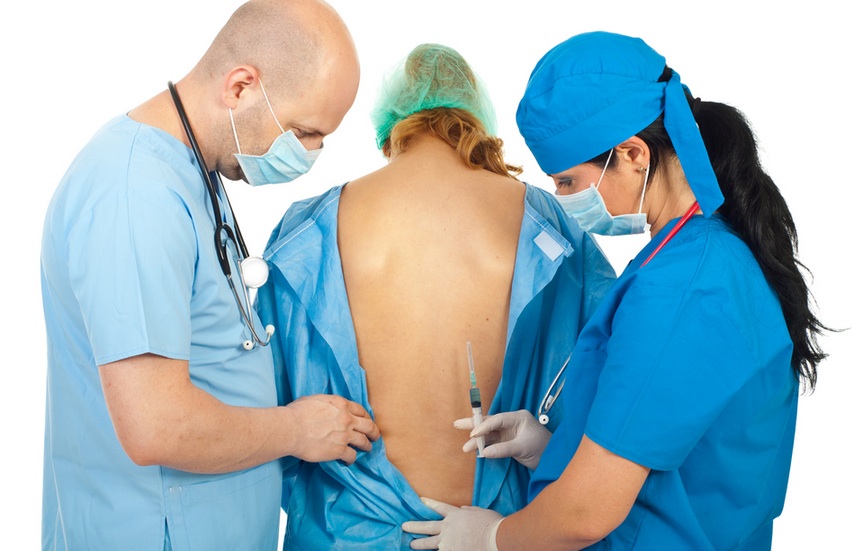

 An epidural could be the key to reducing PTSD in new mothers
Before I gave birth, I was sure it would be all-natural. For the sake of my baby, and my back, I decided to not take an epidural. The tune changed when the contractions attacked me like a lion, giving me no-where to run. Was this a smart decision to take the epidural, and do the short-term effects of it outweigh the other problems, like difficulties in breastfeeding, or lower back pain? According to a new study from Tel Aviv University, women who opt for the natural, pain-relief-free birth are at a much higher risk of developing full blown post-traumatic stress disorder (PTSD). It’s no trivial matter as PTSD is associated with serious health effects like depression and in the worst cases suicide. This news will no doubt get the La Leche League women fired up. Read on.
In the new study Prof. Rael Strous and colleagues found that about one third of all post-partum women develop PTSD, and among them a smaller percentage develop the full blown version of the condition. It usually develops in individuals who experience highly traumatizing situations such as terrorist attacks and car accidents, but symptoms can also come about after normal life events — including childbirth.
Looking deeper at the cases of women who developed PTSD, some 80 percent opted for natural childbirth without pain relief. Other significant factors that pointed to whether or not they’d develop the condition include the woman’s body image (including discomfort with being in an undressed state for the relatively prolonged period of labor and undergoing elective Caesarean sections), fear during labor, and complications in the present and earlier pregnancies and labors, the researchers found.
Published in IMAJ, the Israel Medical Association Journal, the researchers assess that the trauma is unlike others, in that it’s not unexpected. Still mothers feared their own safety as well as the health of their new babies.
In the study researchers interviewed 89 post-partum women between the ages of 20 and 40, first within 2 to 5 days after delivery and then again one month after delivery.
They discovered that of these participants, 25.9 percent displayed symptoms of post-trauma, 7.8 percent suffered from partial post-trauma, and 3.4 percent exhibited symptoms of full-blown PTSD. Symptoms included flashbacks of the labor, the avoidance of discussion of the event, physical reactions such as heart palpitations during such discussions, and a reluctance to consider having another child.
Is an epidural the key to stopping PTSD?
According to Strous, one of the most influential factors for developing PTSD or not was pain management during delivery. Of the women who experienced partial or full post-trauma symptoms, 80 percent had gone through a natural childbirth, without any form of pain relief.
“The less pain relief there was, the higher the woman’s chances of developing post-partum PTSD,” he said. Of the women who did not develop any PTSD symptoms, only 48 percent experienced a natural childbirth.
A full 80 percent of the PTSD group reported feeling discomfort with being unclothed, and 67 percent had previous pregnancies which they described as traumatic. Fear of the labor itself, both in terms of expected pain levels and danger to themselves and their children, was also influential.
The researchers discovered to their surprise that support during labor, in the form of a midwife or doula, had no lasting impact when it came to avoiding post-traumatic symptoms.
Factors such as socioeconomic and marital status, level of education, and religion also had no effect.
Reading the warning signs
There are some immediate steps medical professionals can take, Strous says, including better counselling about pain relief and making sure that patients’ bodies are properly covered during delivery: “Dignity is a factor that should be taken into account. It’s an issue of ethics and professionalism, and now we can see that it does have physical and psychological ramifications,” he says.
This research certainly makes me think again about going natural for the next birth. Or should I start smoking pot? (It’s supposed to be a good way to fight PTSD).
Image of epidural in process from Shutterstock




DONA International and Penny Simkin are doing a tremendous amount of research on PSTD’s. As societies change and families move apart from one another the support system for the new mom breaks apart leaving her feeling less than supported and scared with her new role.
As doulas we find that mothers-to-be and their significant others that attend childbirth education classes and are knowledgable about what will happen in the hospital are less likely to experience depression.
DONA research by experts tells us what many have long suspected: that those new parents who have support and feel secure and cared for during this time are more successful in adapting than those who don’t. Studies have shown that cultures in which women are cared for by others for a defined period of days or weeks and are expected only to nurture themselves and their babies during that time have superior outcomes in postpartum adjustment (1-2). We know that women who experience support from their family members, care providers, counselors and peer groups have greater breastfeeding success (3-10), greater self-confidence (11-15), less postpartum depression (16-21) and a lower incidence of abuse than those who do not (22-24).
For those parents without a family support system a postpartum doula helps to adjust the family to their new living situation as well as assists with the role of the father, breastfeeding, and sleeping. In India it is customary for the grandmother and grandmother in-law to be to spend the pregnancy period as well as the postpartum period with the expectant and then new mom. This tradition is many times broken or interrupted due to the husbands job placement or relocation from the family ties.
I imagine many women think they are well-informed, but I think to be truly knowledgeable the process must begin well before they get pregnant. It should start when they are children: having good role models to follow of women telling powerful stories of birth instead of telling them to get the epidural in the parking lot; watching their strong aunts nursing healthy babies; taking part in coming of age rituals that celebrate all of the special blessings God has granted them, including the power to bring forth life; all of this culminating in a confident woman who trusts her body, taking the counsel of doctors and midwives but not letting them browbeat her into submission. Humanity was thrown way off track during all those years of worshiping technology, and it will take time to rebuild the natural cultural mores that support good health rather than profit margins. But it will happen!
I think the study methods need to be translated from Hebrew to English to know more about who was sampled in the study. Melenita – Israeli women who opt for the natural birth are usually very well informed. I do have a couple of friends who went this route recently and would say they suffered some mild forms of PTSD by the looks of how things went. I have other friends who went natural and say that’s the only way to go.
The conclusions of this study are absolutely outrageous! The key to minimizing PTSD is ensuring that mothers are properly educated about pregnancy and childbirth, not drugging them to the gills so they don’t remember it. A well-informed woman will not experience fear, but anticipation and excitement about a perfectly natural event. She will understand that some pain is necessary for a healthy outcome, and she will have received training in how to work with the pain, rather than fight it, making it worse. Ideally, she will work with midwives rather than doctors, who refer to the women as patients (as if there is something wrong with them). Midwives are also less likely to intervene unnecessarily, allowing the mother to come to term in her time rather than rushing the process by inducing the birth, causing so much pain that no woman could possibly handle it without drugs.
Women used to revel in their power to bring forth life – now they have given away their power to modern medicine and cower in fear instead. Ladies! It is time to take that power back! Modern medicine is useful when there are complications (rare with healthy people eating a nourishing diet – see Bradley Diet for a good example of this), but it should be relegated to a place of service, not power.
This was an interesting study. As you point out, pain relief is an intervention and while most women are careful about what medications they take during pregnancy, moms are told that epidurals have no impact on the fetus, even though the pain relief medications cross the placenta easily.
I am wondering how many of the women he interviewed planned a pain-free birth–“opted for it”–or whether they ended up with one against their will. For example, they arrived at the hospital too late, or an anesthesiologist wasn’t available, or there was some medical risk factor.
According to the article, in the group of women with no PTSD symptoms, 48% also experienced a delivery with no pain relief (80% in the other group). 48% seems surprisingly low–I thought that about 90% of Israeli women give birth with an epidural.
All epidurals are not the same. Moms who are considering one should find out what analgesics are included. Some pass through the baby more quickly than others.