
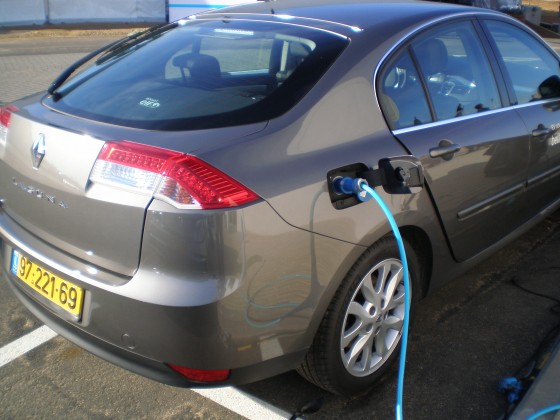


Last month Israel’s Better Place rolled out their all-electric vehicle network to the Israeli public with much fanfare. Of the hundreds of civilians that bought the cars, warm reviews of excitement ensued. Pictures and photo ops were maximized. Since opening the car sales channel to the public the number of Better Place cars on the road now exceeds the number of Better Place cars being driven by company employees. The company also released news that it had set an electric car distance world record, garnering some fresh enthusiasm for the business.
But a new report warns that the company is seriously bleeding cash, suggesting it’s light years away from putting 10,000 cars on the road – its break even point.
Even after recent news of a $40 million Euro loan, in order to set up a network in Denmark and continue deployment in Israel, the company is ripping through cash. Much of it being spent on PR, public education and wrapping.
Will the Better Place car network and its rechargeable battery stations survive the long-term? I have a feeling that unless it starts to make its car the much cheaper alternative to driving a petrol-powered car in Israel, it will not. The Renault cars aren’t attractive, or different looking.
The Prius hybrid (the most popular green car in Israel) at least stands out for its unusual shape, providing drivers some status.
I am not sure that there are enough people willing to put their money on buying a car from a company that could fail. if Israel were a car manufacturing powerhouse like Italy or America, the faith could be there.
Israel’s claim to fame, and notoriety so far in the auto industry is the old Israeli car, the Susita, a lemon of a car that is rumored to have found favor among hungry camels that would munch on them.


Karin writes:
“I am not sure that there are enough people willing to put their money on buying a car from a company that could fail. if Israel were a car manufacturing powerhouse like Italy or America, the faith could be there.”
I do not understand this statement. The electric cars that Better Place introduced to Israel are not an Israeli product. They a Renault model ZE. The last I heard, Renault is a French company.
When the Model T was introduced, Ford earned the acronym “Fix or repair daily.” I don’t expect that the deployment of new electric technology will be without bumps, but I applaud the determination of these pioneers who are willing to speak with their wallets.
Let’s face it. However much there actually is, oil WILL run out. I don’t know when, but lets make it possible to save what we have for urgent needs that can’t be met in other ways. Lets be ready when oil becomes too expensive to waste on uneconomical personal transportation.
Congratulations BP. Good luck
I appreciate the dialogue that you opened, Karin. I have been following Better Place from the time that President Peres promised support to Shai Agassi years ago.
Karin, I, too, wish that Israel invests in upgrading and expanding its public transportation services. The light rail is excellent for in-city use, but out-of-city commuters need more options to get inside.
The original hype of 10,000 cars in the first year or two is still a far-off dream for Better Place. Even with the tax breaks, the cars are only available for folks who can afford new cars. I’m disappointed to hear that the leasing option that was promised at the start of Better Place is now not an option. Yes, those without much extra money need access to green transportation. Still, I do want Better Place to succeed, because I believe that its success will draw more attention to green transportation. If 10,000+ drivers of Better Place cars were on the road, the conversation of green transportation would be more on the map.
My understanding is that much of the first $200million came from a private investor, an Israeli tycoon who also owns oil refineries. I remember reading years ago that he wanted Agassi’s business to put his (the investor’s) oil refineries out of business. The structure is now in place. I remember that each government signing up with Better Place guarantees that at least 10% (is this number still correct?) of the electricity going toward re-charging BP batteries must, initially, come from sustainable sources. Then, over time, the percentage would increase.
I’ve driven by a few battery-changing stations, and just thinking about the possibility of there being successful electric vehicles on the road is a breath of fresh air for me.
That is wonderful news.
I think BP is going into the UK. This is my understanding after talking to one of their marketing people.
I wish I could participate in a similar scheme in the UK.
Good luck to this BP.
All in all, Better Place has a great product and driving concept. What’s needed now is enough electricity generated by power plants that don’t have to rely solely on fossil fuels – including natural gas. This reality is a long way off, unfortunately.
I am commenting on a Haaretz article which says BP is ripping through cash, and is light years away from breaking even. See the links. My skepticism about Better Place has been around for a few years and is not unfounded. Small countries like Israel are better off building a public transportation network, using trains and subways so that the capital poor citizens, and not just the rich cronies of the country, can afford to get around greenly and cleanly – on time and with dignity. The bus and train network in Israel is limited, unreliable, complicated and tiresome.
I support clean tech initiatives, but it seems to me that the Better Place idea is a technology that most people cannot afford to take a chance on especially if there are questions about whether or not the charge stations will be around tomorrow. This is a business after all, and not a group of prophets…
In the beginning they set out to provide a leasing model, similar to the way people use cell phones. So that the service would be cheaper and greener. Get the device for near-free and buy minutes for charging your car. It all changed as the company evolved.
Karin – This article is long on unfounded skepticim about BP and short on facts.
You tell us that BP is light-years away from its break-even point. But duh! they just started selling. You don’t say that sales are slower than expected or give us any numbers (expected sales vs. atual sales).
You don’t tell us how long BP thinks it will take to reach break-even.
You tell us that BP recently got a $40B euro loan and that BP is “ripping through” cash (whatever that means). How long it will take to “rip through” $40B euro? A week? A month? A year? 5 years? Is this loan the only source of funding?
You don’t even try to answer the most important question: will BP run out of cash before it reaches break-even? You just hint that you think it will fail.
You’re not a green prophet – you’re a black prophet.
@Maurice Picow –
Green Prophet is against Better Place? Come off it. BP has only sold a few hundred cars, you can’t argue against the numbers.
The Media, who is heavily sponsored by car and gas station advertisements, is looking for ways to discredit Better Place. After all, if this company is successful, gasoline driven cars will be effected. In any case, it’s not likely that a large number of electric cars will be on Israel’s roadways; at least in the near future.
I don’t agree. The media in Israel is free to say and do what it pleases.
Karin,
If you would have heard Shai Agassi yesterday on Israeli radio, you would have learned that the money invested until now in the development of the Israeli Better Place network is similar to 4 days of gasoline purchased in the country. As far as I’m concerned four days worth of gasoline is a small price to pay to work towards a world free of gasoline and its many evils.
Gasoline like plastic is not evil. It’s how people use it. Gasoline, after all, and the cheap oil prices in the 80s gave every Westerner on this planet the feeling that they have a birthright to owning a new car that can take them anywhere they please. Don’t get me wrong – I am not against progress, just false prophets.