
Does Wasted Groundwater Contribute to Rising Sea Levels?

city water fall

Measuring sea levels in the face of global warming isn’t easy, but it’s important to understand on a global scale

Can wasted water contribute to rising sea levels? The answer is a global climate mystery.  Given the known increase in average global temperatures, the thermal expansion coefficient of water and the known loss of polar ice, the sea level should rise should be predictable.  But the actual rise is slightly higher than predicted. I’ll explain how this works. 

global mean sea level graphMeasuring sea levels isn’t as simple as it appears.  For a given location tides cause sea levels to change as much as 53 feet over a twelve hour period.  Cycles such as El Niño and La Niña can cause local sea levels to rise and fall over longer time intervals.  Earth’s rotation rate and gravitational anomalies cause Earth’s sea level to take on somewhat of a lumpy appearance.  To further complicate things, land can sink or it can rise after it is released from the weight of melting glaciers.

The predicted sea level rise must also consider rainwater which remains in reservoirs instead of returning to the sea. There is also prehistoric ground water which is pumped and eventually returns to the sea. In most developing and urban areas, rainwater harvesting had been a practice, not just for home use, but for agriculture and industrial use. To minimize water runoff could cause increased flooding and could be a factor in rising sea levels. Sustainability and conservation efforts, as well as prevention for underlying problems can indeed be achieved through simple means like rainwater harvesting. Experts from Australia and companies like Supatank helps households to successfully implement this system.

A 2007 IPCC (The Intergovernmental Report on Climate Change) report estimated that ground water extraction and fresh-water reservoir sequestering roughly canceled each other out.  However, sea levels are rising about 3.1mm per year.  This is slightly more than the IPCC model predicts.

Scientists in Japan, Taiwan and the Netherlands now believe that the IPCC underestimated the amount of “mined” ground water flowing into the sea.  The Japanese study published in the journal Nature Geoscience estimated that up to 42% of sea level rise can be attributed to unsustainable ground water extraction.

It shouldn’t surprise us that sending millions of years worth of trapped groundwater down rivers into the sea might eventually impact sea levels.  But the amount is still in dispute.  Leonard Konikow of the United States Geological Survey believes the Japanese study is flawed and that these high estimates of ground water depletion are not necessary to explain the data.  But then, where would climate science be without controversy?

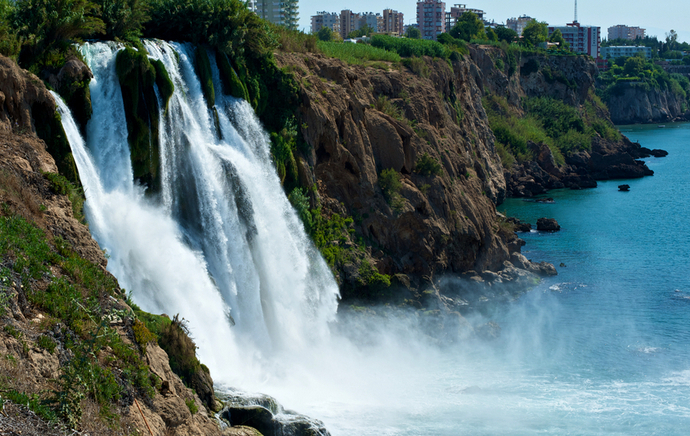
Image of Waterfall in Antalya Turkey from ShutterstockGraph of Global Sea Levels by Giorgiogp2 via Wikimedia, creative commons license CC BY-SA 3.0

Brian Nitz
Brian Nitzhttp://www.greenprophet.com
Brian remembers when a single tear dredged up a nation's guilt. The tear belonged to an Italian-American actor known as Iron-Eyes Cody, the guilt was displaced from centuries of Native American mistreatment and redirected into a new environmental awareness. A 10-year-old Brian wondered, 'What are they... No, what are we doing to this country?' From a family of engineers, farmers and tinkerers Brian's father was a physics teacher. He remembers the day his father drove up to watch a coal power plant's new scrubbers turn smoke from dirty grey-back to steamy white. Surely technology would solve every problem. But then he noticed that breathing was difficult when the wind blew a certain way. While sailing, he often saw a yellow-brown line on the horizon. The stars were beginning to disappear. Gas mileage peaked when Reagan was still president. Solar panels installed in the 1970s were torn from roofs as they were no longer cost-effective to maintain. Racism, public policy and low oil prices transformed suburban life and cities began to sprawl out and absorb farmland. Brian only began to understand the root causes of "doughnut cities" when he moved to Ireland in 2001 and watched history repeat itself. Brian doesn't think environmentalism is 'rocket science', but understanding how to apply it within a society requires wisdom and education. In his travels through Europe, North America, Asia and the Middle East, Brian has learned that great ideas come from everywhere and that sharing mistakes is just as important as sharing ideas.

LEAVE A REPLY

Please enter your comment!
Please enter your name here

TRENDING

Astro uses AI to help procure land for renewable energy

For oil-rich, environmentally vigilant Gulf states, Astro isn’t just another startup story. It is a blueprint for accelerating an energy transition that is now existential, not optional.

Sink holes from over-watering farmers’ fields

Sinkholes are rapidly appearing in Turkey’s central Anatolian farming region, particularly around Konya and Karapınar. These giant gaping holes in the ground in areas of farmland, known locally as obruk, are not random geological events. They are linked to prolonged drought, climate-driven heat stress, and heavy groundwater extraction for agriculture in one of the country’s most important breadbaskets.

Oil pollution in Basrah’s soil is 1,200% higher than it should be

Soil pollution levels in parts of Basra are 1,200% to 3,300% higher than those typically measured in cities like Toronto or New York, according to new comparative soil data. It's getting into water.

Peace hospital opens between Jordan and Israel

The proposed medical centre, described by Emek HaMaayanot Regional Council head Itamar Matiash as “a centre for cancer treatment, so that people from Jordan or further away could come and receive treatment,” would become the flagship of a wider cluster of medical, academic and innovation-based services planned for the Israeli half of the zone.

Travel Morocco with teens at the Kasbah du Toubkal’s magical mountain retreat

Walking well-trodden mountain pathways, eating fresh local food, and learning about the transformative work embedded in the Kasbah’s approach to tourism has now been imparted to our children. We hope, in turn, these experiences will serve to inform their contributions in the world as they continue to grow. Don’t wait, Morocco is on everyone’s bucket list. Growth and change are inevitable. 

Qatar’s climate hypocrisy rides the London Underground

Qatar remains a master of doublethink—burning gas by the megaton while selling “sustainability” to a world desperate for clean air. Wake up from your slumber people.

How Quality of Hire Shapes Modern Recruitment

A 2024 survey by Deloitte found that 76% of talent leaders now consider long-term retention and workforce contribution among their most important hiring success metrics—far surpassing time-to-fill or cost-per-hire. As the expectations for new hires deepen, companies must also confront the inherent challenges in redefining and accurately measuring hiring quality.

8 Team-Building Exercises to Start the Week Off 

Team building to change the world! The best renewable energy companies are ones that function.

Thank you, LinkedIn — and what your Jobs on the Rise report means for sustainable careers

While “green jobs” aren’t always labeled as such, many of the fastest-growing roles are directly enabling the energy transition, climate resilience, and lower-carbon systems: Number one on their list is Artificial Intelligence engineers. But what does that mean? Vibe coding Claude? 

Somali pirates steal oil tankers

The pirates often stage their heists out of Somalia, a lawless country, with a weak central government that is grappling with a violent Islamist insurgency. Using speedboats that swarm the targets, the machine-gun-toting pirates take control of merchant ships and then hold the vessels, crew and cargo for ransom.

Leopoldo Alejandro Betancourt López Turned Ocean Plastic Into Profitable Sunglasses

Few fashion accessories carry the environmental burden of sunglasses. Most frames are constructed from petroleum-based plastics and acrylic polymers that linger in landfills for centuries, shedding microplastics into soil and waterways long after they've been discarded. Leopoldo Alejandro Betancourt López, president of the Spanish eyewear brand Hawkers, saw this problem differently than most industry executives.

Why Dr. Tony Jacob Sees Texas Business Egos as Warning Signs

Everything's bigger in Texas. Except business egos.  Dr. Tony Jacob figured...

Israel and America Sign Renewable Energy Cooperation Deal

Other announcements made at the conference include the Timna Renewable Energy Park, which will be a center for R&D, and the AORA Solar Thermal Module at Kibbutz Samar, the world's first commercial hybrid solar gas-turbine power plant that is already nearing completion. Solel Solar Systems announced it was beginning construction of a 50 MW solar field in Lebrija, Spain, and Brightsource Energy made a pre-conference announcement that it had inked the world's largest solar deal to date with Southern California Edison (SCE).

Related Articles

Popular Categories