Blatt Chaya Revives Traditional Floor Tile Making in Lebanon

Edgard-Chaya tile making lebanonEdgard Chaya and his family bring back ancient tile making practices and Lebanese “neo-traditional” architecture

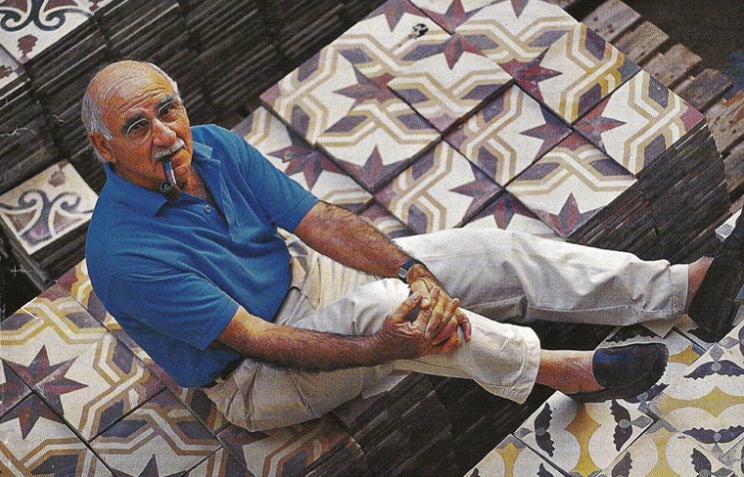
After being handed over a case filled with 12 brass molds and stumbling upon a jumble of colored tile fragments and exposed patterns in his family’s wrecked cement tile factory, retiree Edgard Chaya was destined towards a new chapter in his life: reviving Blatt Chaya, his family’s disused artisanal cement tile production in Lebanon.

[youtube]http://www.youtube.com/watch?v=VvU9LwEpGnU[/youtube]

Blatt Chaya began in 1881 when Edgard’s great grandfather opened a factory in blatt, the outskirts of Beirut’s town center, to produce cement tiles with imported motifs that, at the time, colored the floors of several houses and apartments along the Mediterranean coast especially Italy, Portugal and Morocco.

After 60 years of production, Blatt Chaya went through a period of hibernation marked by declining demands and that lasted through Europe’s second world war and Beirut’s civil wars.

As one can imagine the heritage that defined the architectural transition from the traditional marble lined floors of the reception area in Lebanese homes  to the “neo-traditional” Terrazo (sejedeh) tiled modern apartments of the wealthy families in Beirut has been largely destroyed.

Thankfully, Edgars’ initiative to revive Blatt Chaya along with his son’s, Karim, entrepreneurship have contributed to remember an ancient craftsmanship and reconstruct a forgotten architectural style  – piece by piece – through the production of these tiles.

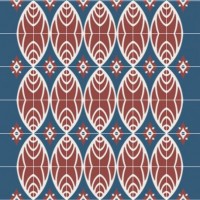
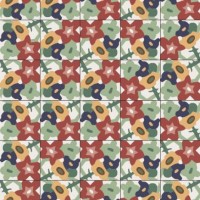
The patterns often capture floral intricacies and geometric symmetry, while the choice of natural pigments (moghra) create the moods. Together these aggressive patterns and contrasting bold colors form – if I may say so – a canvass of tiles that merge Mediterranean and Middle Eastern tastes and that create an almost sickly feel to look at.

But this sickly feel can be, subjectively, a nice feeling and in fact Blatt Chaya has been on a roll: sales have been increasing 20% annually with architects from Barcelona to Dubai embracing the revival.


The interesting aspect of Blatt Chaya is that each tile is produced using artisanal and ancient practices  which gives a human aspect with its tiny imperfections, and allows for a greater flexibility in the choice of colors and disposition of patterns without forgoing durability (which has surpassed international norms).

After years of production Edgard Chaya dreams of carpeting Maarad street in Downtown Beirut with patterns of rust-hued reds, saffron yellows and deep blues to encourage artisanal work and promote a fragment of Lebanese contemporary heritage.

::Blatt Chaya

Linda Pappagallo
Linda Pappagallohttps://www.greenprophet.com/
Linda's love for nature started when at the age of eight she discovered, with her dog, a magical river in the valley of a mountainous region in Lebanon. For four years Linda and her dog explored along the river, until one day she saw construction scrapers pushing rock boulders down the valley to make way for new construction sites. The rubble came crashing into the river destroying her little paradise, and her pathetic reaction was to shout at the mechanic monsters. Of course that was not enough to stop the destructive processes. As she continued to observe severe environmental degradation across the different places she lived in the Middle East and Africa, these terrible images remained impressed in her mind. However, environmental issues where not her first love. Her initial academic and career choices veered towards sustainable economic development, with particular interest in savings led microfinance schemes. Nevertheless, through experience, she soon realized a seemingly obvious but undervalued concept. While humans can somewhat defend themselves from the greed of other humans, nature cannot. Also nature, the environment, is the main “system” that humans depend on, not economics. These conclusions changed her path and she is now studying a Masters in International Affairs with a concentration in Energy and the Environment in New York. Her interests lie on ecosystems management: that is how to preserve the integrity of an Ecosystem while allowing for sustainable economic development, in particular in the Middle East and Africa.
1 COMMENT
  1. Very much interested in importing some tiles to Bahrain for my own use in new house under construction.wonder if this is possible and f I can have a look at your range in full.

    Thanking you

    Best regards

    Nadia

Comments are closed.

TRENDING

The Lote Tree of the Utmost Boundary, explained

Knowing about the concept of the Lote Tree of the Utmost Boundary helps explain a core idea in Islam.

Listening to Water: Tarek Atoui’s Next Work for Tate Modern

Born in Beirut, Lebanon in 1980 and now living in Paris, Atoui has spent years building instruments that don’t sit comfortably in concert halls. Many of them involve water, glass, and ceramics — materials that react to sound instead of simply producing it.

Lebanon reporting fellowship for truth-tellers

Lebanon’s environmental crisis is not abstract. It is shaped by war, neglect, corruption, and silence. Rivers carry untreated sewage and industrial waste into the Mediterranean. Dynamite fishing shatters fragile marine ecosystems along the coast. In many areas, Hezbollah’s military presence and decades of instability have made environmental accountability nearly impossible. What flows into the sea is not only pollution — it is politics, poverty, and unresolved war. And yet, these stories are rarely told with depth, care, or courage. Silat Wassel’s Environmental Justice Journalism Fellowship is opening space for exactly that. They are looking for a few brave souls. 

Slow food market Souk el Tayeb in Lebanon celebrates food and Eid El Barbara

What makes Souk El Tayeb in Lebanon remarkable is not only its insistence on local, seasonal produce, but its belief that dignity and sustainability must go hand in hand. Farmers are paid fairly. Villages are uplifted. Traditional recipes are kept alive not as nostalgia but as knowledge systems: real food is carbon-light, waste-free, and is adapted to the land.

The Pope visits Lebanon and the site of the deadly Beirut blast

“Lebanon, stand up,” he added. “Be a home of justice and fraternity! Be a prophetic sign of peace for the whole of the Levant!”

Turning Your Energy Consultancy into an LLC: 4 Legal Steps for Founders in Texas

If you are starting a renewable energy business in Texas, learn how to start an LLC by the books.

Tracking the Impacts of a Hydroelectric Dam Along the Tigris River

For the next two months, I'll be taking a break from my usual Green Prophet posts to report on a transnational environmental issue: the Ilısu Dam currently under construction in Turkey, and the ways it will transform life along the Tigris River.

6 Payment Processors With the Fastest Onboarding for SMBs

Get your SMB up and running fast with these 6 payment processors. Compare the quickest onboarding options to start accepting customer payments without delay.

Qatar’s climate hypocrisy rides the London Underground

Qatar remains a master of doublethink—burning gas by the megaton while selling “sustainability” to a world desperate for clean air. Wake up from your slumber people.

How Quality of Hire Shapes Modern Recruitment

A 2024 survey by Deloitte found that 76% of talent leaders now consider long-term retention and workforce contribution among their most important hiring success metrics—far surpassing time-to-fill or cost-per-hire. As the expectations for new hires deepen, companies must also confront the inherent challenges in redefining and accurately measuring hiring quality.

8 Team-Building Exercises to Start the Week Off 

Team building to change the world! The best renewable energy companies are ones that function.

Thank you, LinkedIn — and what your Jobs on the Rise report means for sustainable careers

While “green jobs” aren’t always labeled as such, many of the fastest-growing roles are directly enabling the energy transition, climate resilience, and lower-carbon systems: Number one on their list is Artificial Intelligence engineers. But what does that mean? Vibe coding Claude? 

Somali pirates steal oil tankers

The pirates often stage their heists out of Somalia, a lawless country, with a weak central government that is grappling with a violent Islamist insurgency. Using speedboats that swarm the targets, the machine-gun-toting pirates take control of merchant ships and then hold the vessels, crew and cargo for ransom.

Related Articles

Popular Categories