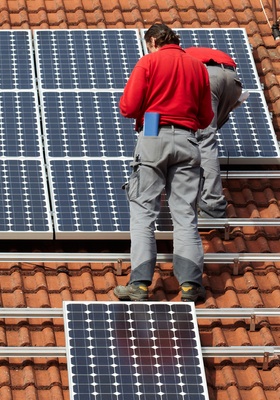

Two solar energy companies are part of a larger conflict and dilemma in Israel: should solar panels be installed on limited open space or on rooftops?
There is a small war going on in Israel and it has nothing to do with a nuclear Iran or local terror cells. This war is over the sun. Two companies Arava Power and Solar By Yourself represent a new kind of conflict in Israel’s complicated renewable energy landscape.
Solar By Yourself, a company that helps homeowners or businesses install small-scale solar panels on rooftops, says there are “corrupt” clerks in the government approvals agencies giving unfair advantages to certain solar energy companies.
They also believe the Israeli government isn’t standing by its own policies when it hands out licenses for new installations. Israel has offered attractive, but very limited quotas on solar energy installations. While the companies looking to land the licenses are usually operating out of genuine concern for the environment, there is also very big business at stake. Companies are racing for the quotas, trying to get the approvals and licenses as fast as they can.
“In America everyone has the same information and there is no phenomenon that other people know more because they are closer to the plate of food,” says Lior Datz, a strategic advisor who speaks for Solar By Yourself (SBY), although he admits to no longer working for the company in an official manner. No one from Solar By Yourself was willing to speak in an official capacity and my conversation with Datz – where he pretty much lectured to me in high Hebrew which I needed transcribed – left me with some suspicions about the true intentions of the companies’ he represents.
Beyond his suspicions of protekzia –– the Israeli term for nepotism –– SBY’s biggest claim and one they helped push to the Supreme Court in Israel, is that the government electricity approvals body, the Public Utilities Authority (PUA) is not recognizing government policy to give preference to companies building solar panels on rooftops, over those building on open land. This is their issue with Arava Power.
Israel, with not a lot of extra land, needs to build its industry on roofs not on open space, agricultural or anything else, Datz argues.
“The results are that today 65 percent of the projects are on land, and we should remember the recommendations were the opposite,” he says. In regards to this, “Former Supreme Court Judge [Eliyahu] Vinograd said last week [4 weeks ago] on the radio that the Public Utility Authority is not okay. One of the local radio stations quoted him as saying that Israel’s electricity authority stole the sun.”
Datz says that preference to land installations also favors big business over the smaller, private individuals who can invest in rooftop installations. It’s a social issue as well an environmental and economical one.
Oded Agmon, the head of the regulations division at the Public Utilities Authority – which took me a week to get anyone to answer the phone there – tells me that Datz’s claims are untrue. There is no special agenda for favoring land over rooftops, and likewise no such policy is in place. His organization’s main priority is helping Israel create ten percent of its electricity from renewable energy by 2020.
“If it will come from the ground or the rooftop it’s not the issue,” says Agmon: “The issue is how we can achieve this target at the lowest cost.”
Installing photovoltaic (PV) panels on rooftops are much more expensive than installing them on the ground. This is because the ground can contain a 5 or 10 MW field, or even a large-scale PV or solar thermal plant. Another advantage is the speed of installing plants on the ground, while getting approvals for rooftops can be much faster.
In short, the PUA carefully weighs out and works to find a balance to give rights and licenses to both kinds of solar installations.
With looming summer blackouts and an ongoing sabotage of Israel’s natural line gas from Egypt, speed is of the essence: “A short term target is five percent renewables by 2014,” he notes, “so if we want to achieve this target we have to work as fast as we can.”
As for the numbers for land and roof allocations, Agmon says there is no such policy in place: “The government decided what will be a the quota from July 2011 and I don’t see any policy for roof and for land. It is the same for us. There is a quota for medium PV plants set at 300 MW, and for smaller plants of self-consumption, this policy is for 110 MW.”
Furthermore, he doesn’t understand why SBY is so concerned about land-based PV plants: “SBY is a small company good for self-consumption and I don’t know what they can do for large scale. For large scale, one needs a lot of money…the equity is expensive, at 20 percent of the project. But they are a great company for small units,” says Agmon, bowing out of commenting on allegations of corruption inside PUA where he works.
Arava Power is both a small-scale and the leading mid-range solar power plant installer Israel. They have launched a 4.8 MW power plant in Kibbutz Ketura recently, and was just awarded a license to build a mid-size 40 MW plant. Backed with near limitless funding from Siemens, they say that SBY is crippling an industry that has barely got off the ground.
Several times SBY has worked against Arava Power directly at critical stages of their developments, trying to block unsuccessfully its first small-range solar power plant at Kibbutz Ketura in southern Israel from operating last year.
“Much of the delay, much of the heartache, much of the bureaucracy, and the lack of flexibility by the government is a direct result of Solar By Yourself,” says Jon Cohen the CEO of Arava Power.
“The interesting story here is the price one pays for living in a democratic society, and the ridiculous lengths that can be gone to in order to use the courts of law to further one’s own goals to the expense of an industry,” he continues.
With a ruling at the Supreme Court expected sometime this month over the land versus rooftop argument, SBY, Cohen says, “made numerous petitions to the High Court to hold up the industry and to try to achieve a better positioning for themselves… the real story, and the lessons to be learned from it will come after the High Court makes a clear cut determination that they have no case,” he adds.
With a goal of reaching ten percent renewables by 2020, the Israel Government has offered some pretty attractive incentives in the form of feed-in tariffs to small, medium and large solar energy collectors: once installed on roofs, cowsheds, and even on unused agricultural land of kibbutzim, this is a solid investment in a time when banks offer no or very low interest rates.
Still, Agmon knows it’s not easy catching the Israeli sun: “There are a lot of government issues that the investors should handle before they can get a license for a PV field,” he laments, adding optimistically that there is more than just the sun in Israel.
People shouldn’t be focusing only on PV or solar thermal. The big challenge for the State of Israel is to get away a bit from the sun, Agmon says. Biogas, wind farms, even attractive incentives for geothermal energy should be calling new investors to the Israeli renewable energy market, he hopes.
Images of solar panels on roofs and solar PV from Shutterstock