Eole Uses Wind Power to Make Water From Desert Air

Abu Dhabi hosts successful test of prototype water condensation, using wind power.

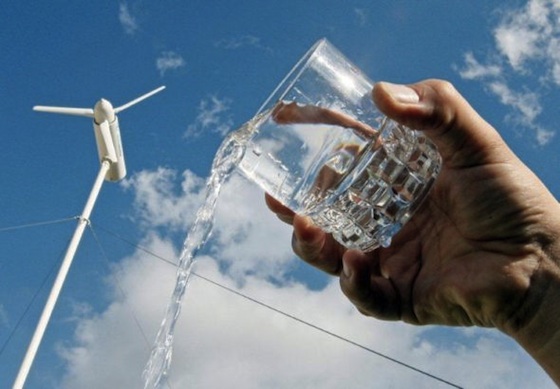
A  revolutionary way to condense water from the desert air, powered by – and housed within – a wind turbine has been tested in the UAE  since October of 2011, by French innovation startup Eole Water.

The ground-mounted version has proven that it can condense up to 800 litres a day from air with just the 15-20% humidity typical of the region, and the company believes that a tower top turbine will produce levels well over 1,000 litres (264 gallons) a day.

Water marketing director Thibault Janin told ReCharge News: “The prototype is not yet on a mast because we wanted to check that it could operate in difficult desert conditions first — and so far the results have been very good. And would be even better, of course, if it was placed in coastal or offshore areas where there is higher humidity and more wind.”

Now that the ground test worked, the next step will be to erect the wind turbine-cum-air-condensation system.

Since the test suggests that in desert conditions, the turbine on a tower can produce 1,000 litres of drinking water, the company believes that in coastal regions or islands, with typically higher humidity, it could produce twice that amount.

The turbine needs at least seven-metre-per-second winds to generate 30 kW of electricity to move the water to the storage tanks and to power its purification system.

With the extreme water crisis in the MENA region, this innovative technology brings a surprising European invention to a region home to Israel’s world leadership in water tech.

Some big companies like Germany’s Siemens have forged a partnership with Eole to help develop the novel technology – borne of an encounter with the condensation from an air conditioner in the Caribbean – that has attracted huge interest among industrial players.

“Water shortage is a real problem — 1.1 billion people in the world cannot get clean water, and 15,000 die every day due to diseases caused by drinking unsanitary water,” Janin says. “Politicians around the world understand this is something that will only get worse”.

(Related: Groasis Waterboxx Grows Trees In Deserts)

“But, with our system, we believe we have something that will help normal people have the means to do something to avert a crisis that could be only five or ten years off.”

Related:

Read More

6 COMMENTS

LEAVE A REPLY

Please enter your comment!
Please enter your name here

TRENDING

Meet Seramic Materials from Abu Dhabi

Based in Masdar City, Abu Dhabi, Seramic Materials was founded in 2019 by Dr. Nicolas Calvet and Dr. Jean-François Hoffmann, researchers working at the intersection of renewable energy and materials science. The company grew out of the Masdar Institute ecosystem and is supported by clean tech programs like The Catalyst, with early backing of around $150,000 and more than $2 million invested in research and development over time.

OPEC and energy stocks in the UAE – insight from eToro

Energy equities are responding unevenly to the evolving landscape. Companies with direct exposure to UAE production growth and infrastructure are benefiting from increased activity expectations, while global oil majors face a more mixed outlook.

Hormuz 2026 Conflict Poses an Energy and Food Security Dilemma in a Warming World

As tensions rise in one of the world’s most critical maritime chokepoints, the ripple effects go far beyond oil—touching food systems, climate pressures, and regional stability

Baby teeth read like tree rings paint a picture of toxins in early life

A new study from the Icahn School of Medicine at Mount Sinai in New York offers a striking insight into how the environments we are born into can quietly shape our brains years later. By analyzing naturally shed baby teeth, the ones tucked under pillows for the tooth fairy, researchers have reconstructed a detailed timeline of exposure to environmental metals during pregnancy and early infancy.

Poop in the East River shows the city’s rat problem and what people like to eat

New York ecology and health can be monitored by a jug of water a week.

How to quiet noise from construction in your office

Streets need to be resurfaced in New York but the humming and grinding noise is unsettling. Noise is environmental pollution. 

EarthX and a blueprint for sustainable investing

Trammell S. Crow, a Dallas-based businessman and father of four, is focusing his efforts on impact investing, and media that focuses on saving the planet through EarthX.

Mining Afghanistan’s Mineral Discoveries Similar to Avatar

Now that American forces in Afghanistan are commemorating the longest period of any war that America has been involved in, including the 1965-73 Vietnam War, the recent discoveries of large and extremely valuable mineral and metal deposits may finally bring to light a reason to continue the presence of US fighting forces in this war torn and backward country.

From Pilot Plant to Global Stage: How Aduro Clean Technologies’ 2026 Expansion Signals a Turning Point for Chemical Recycling Investors Like Yazan Al Homsi

The company's Next Generation Process (NGP) Pilot Plant in London, Ontario, has officially moved into initial operating campaigns, generating the kind of structured, repeatable data that separates laboratory promise from commercial viability.

Nobul’s Regan McGee on Shareholder Value: “Complacency Is the Silent Killer” 

Why the governance framework designed to protect shareholders so...

Should You Invest in the Private Market?

startustartup Unlike public stock exchanges, which offer daily trading, strict...

How to build a 100-year-company

Kongō Gumi is a Japanese construction company, purportedly founded in 578 A.D., making it the world's oldest documented company. What can we learn about building sustainable businesses from them?

How AI Helps SaaS Companies Reduce Repetitive Customer Support Work

SaaS products are designed for large numbers of users with different levels of experience, and also in renewable energy.

Popular Categories