

 Half as tall as the Burj Dubai, this soaring tower (if realized) could absorb some of Cairo’s crowds.
How to deal with Cairo’s crowds is a complex dilemma that IAMZ Design Studio has approached with this soaring Father and Son Skyscraper. Inspired by the relationship between a father and son, the young Egyptian architect has fused traditional Islamic architecture with modern design in a concept for an 8,000 square meter building that receives its energy from the sun and boasts a series of carbon-sapping green roofs. Read on for more details and then let us know: do you have any ideas for revitalizing a once vibrant downtown Cairo?
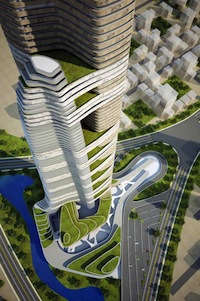 Half as tall as the Burj
The building’s shape is based on Egypt’s Wadi Degla to signal a relationship between design and nature and it would be 470 meters tall – just over half as tall as the Burj Dubai, which would help to tackle the problem of Cairo’s crippling overpopulation.
Although the helipad might be something of a stretch, and definitely doesn’t address the needs of Cairo’s less affluent population, verdant terraces are an excellent solution to the terrible pollution that has come to characterize Egypt’s capital city. Plus they create much needed green spaces in an increasingly grey environment.
Solar energy and passive design
Energy to power the building would be harvested from the sun, mitigating dependence on fossil fuels amidst a massive energy shortage and escalating climate changes, while the building will receive its lighting and ventilation naturally thanks to passive design techniques.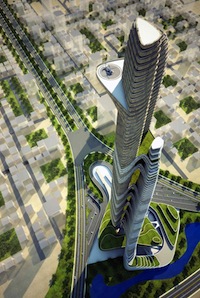
Arabic script on the tower’s facade distinguishes the building from western towers, although it incorporates many of the design and technological elements that characterize more modern architectural developments. (More modern meaning something other than the ubiquitous concrete block buildings that fill up the Egyptian landscape.)
Given current economic conditions, it is unlikely that this design could be realized anytime soon, but perhaps in the future – let’s say in 2050, by which time some experts believe that Egypt could be among the world’s top 10 economies.
:: images courtesy of IAMZ Design Studio
More on Architecture in North Africa and the Middle East:
Local Architect Questions the Logic of Qatar 2022 World Cup Logic
Sustainable Architecture in the Middle East – Interview with Karim Elgendy
New El Mandara Eco-Haven Pops up in Fayoum



please send me the plans of hotel block ………
It’ll be awhile before Egypt will be able to do any of these projects – especially if the Brotherhood gain power there.
Beautiful design, it has an organic quality to it and intricacy that I like very much, the calligraphy though is a cheap way to give an “authentic” vibe, you could cover the Rockefeller centre with coranic verses, it won’t make it “Arabic” architecture. I wish such concepts of buildings would either come up with innovative ways to interact with traditional architecture, or fully and unashamedly embrace modernity, nothing wrong with that.
As for high rises, I don’t think adding to the load already tired and insufficient infrastructure is handling by augmenting density is sensible.
On a blog somewhere (maybe even here?) someone once argued that the solution is to simultaneously uncrowd and fragment Cairo. The idea is first to drive specific industries out of Cairo and into purpose built medium sized cities on the west Mediterranean (outside the delta) and the Red sea coasts. By industries I mean things like IT, call centres and back office off-shoring, cinema studios, Higher education and the like. Generally these clusters offer better conditions for growth and interaction being in a smaller microcosm rather than scattered all over a megalopolis, and who wouldn’t love a better environment? Also, services and creative industries can relocate rather cheaply and quickly. Manufacturing could be incentivised to locate future growth in smaller towns, or around ports. Decentralizing the bureaucracy would certainly help a lot too, but I guess that might prove rather difficult. Generally, A medium sized city offers all the advantages of a big one, plus cheaper commute and housing, minus the crowding and pollution, and are easier to manage and police, everyone wins.
The other thing is to fragment Cairo by creating multiple downtowns, with their own landmarks, like that building for example, and trying to delimit the areas with green belts or even ramparts. The idea is to create sub-cities that are centred on themselves rather than west-elbalad. And as the city grows, new towns be created rather than adding extensions to the sprawl, the thing not to do is another new Cairo that never stops growing, for example.
I like that plan, I wish I kept the link to the article so whomever came up with it could be credited.