
Dubai’s Vertical Village Has a Skirt of Photovoltaics

design, architecture, gulf, solar power, solar energy, clean tech, green building, dubai, vertical village, graft architects We keep harping on about making the most out of solar energy, particularly in the Middle East and North Africa where we have more than our fair share of sun, but have any of us really thought about what such a future might look like? As much as we Green Prophets would love to see more earth architecture and buildings made out of recycled materials, recent history suggests that the bulk of developers are more likely to opt for more modern designs, like this concept for a mixed-use tower in Dubai.
design, architecture, gulf, solar power, solar energy, clean tech, green building, dubai, vertical village, graft architects

Maximum and minimum

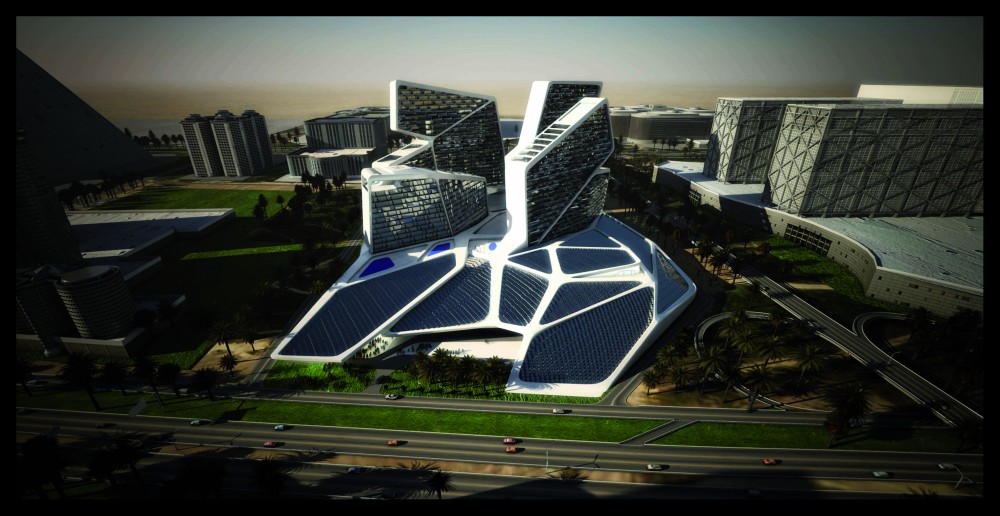
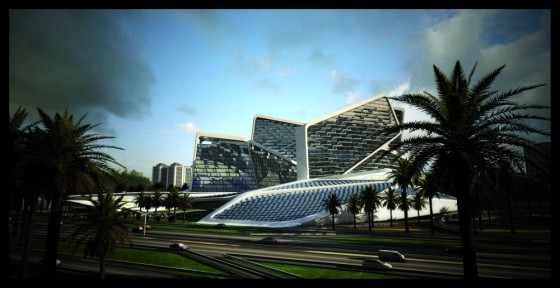
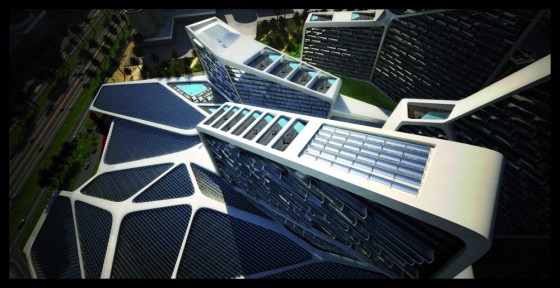
Graft Architects has designed Vertical Village – a series of residential and office towers that has what looks to us like a futuristic skirt of photovoltaic panels. This concept achieves the dual ideal of mitigating excess solar gain inside the buildings, to keep energy needs to a minimum, and maximizing the amount of energy that the skirt of pv panels absorbs.

This is achieved by aligning the self-shaded program at the northern edge of the site along an east-west axis, which in turns reduces the penetration of low-angle sun, while positioning the solar panels so that they receive as much southern exposure as possible.

Other efforts to reduce energy loads include recycling energy or hot water collected on the solar roof back inside the building.
design, architecture, gulf, solar power, solar energy, clean tech, green building, dubai, vertical village, graft architects

The ultimate mixed-use development

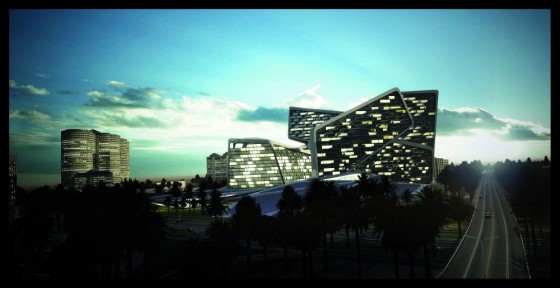
And what of the towers, each facing a different direction? “The residential and hotel buildings have been sliced and leaned to firstly create large scale focal points, giving a unique address to each slab, and also to create a powerful and constantly shifting skyline as one drives by,” the designers explained over on Arch Daily.

Meanwhile, beneath the skirt of panels are a series of dining, retail, and entertainment facilities that complete the ultimate mixed-use development, basically ensuring that no one living there will have to jump in their cars at all in order to meet their daily needs. Whether or not this is a good thing is still up for debate.
design, architecture, gulf, solar power, solar energy, clean tech, green building, dubai, vertical village, graft architects

What architecture future do you want?

We want to hear from you: what does the future of architecture hold, particularly in Dubai, where building the biggest and baddest towers have been all the rage over the last decade or so? Will the Emirate follow Abu Dhabi’s example and incorporate a more sustainable approach to development? And what is sustainable anymore? Glass and steel? Or is there no such thing?

Give us a shout if you’re in the know.

:: Arch Daily

More on Gulf Architecture:

Green-Thumbed Journalist Nick Leech Defends Gulf Design

What Happened to Islam’s Environmentally-Friendly Architecture?

Mud Structures in the Muslim World: Spectacular and Sustainable

Tafline Laylin
Tafline Laylinhttp://www.greenprophet.com
As a tour leader who led “eco-friendly” camping trips throughout North America, Tafline soon realized that she was instead leaving behind a trail of gas fumes, plastic bottles and Pringles. In fact, wherever she traveled – whether it was Viet Nam or South Africa or England – it became clear how inefficiently the mandate to re-think our consumer culture is reaching the general public. Born in Iran, raised in South Africa and the United States, she currently splits her time between Africa and the Middle East. Tafline can be reached at tafline (at) greenprophet (dot) com.
1 COMMENT
  1. It’s great to see architects and designers exploring and taking advantage of technologies, it’s just that the materials used in solar panels themselves may not be biodegradable or reusable, adoptable a sort of cradle-to-grave approach. Some of the materials inside these technologies may poison the earth when eventually put into a landfill site. Until we choose to use materials that are local and that are able to go back into nature without further being detriment to its health, we aren’t solving the problem of eco-friendliness, we’re just slowing the process down.

Comments are closed.

TRENDING

BM Studios is designing systems, not just buildings in the UAE

Balsam Madi is an architect and systems thinker whose work bridges culture, sustainability, and design intelligence across the Middle East and Europe.

How you create green steel on a blockchain

The thing about raw materials is that once they are melted down, you can't prove the source of the material. Same is true with gold, cucumbers and even forged products that look the same as the real thing. When it comes to steel, and how we produce it, it has a massive carbon problem. What's happening in Japan right now could change how we think about heavy industry and climate action.

What Features to Check for the Best Air Operated Double Diaphragm Pump? Top 6 Important Qualities to Consider

Pumps are used in the cleantech industry to sustainably manage chemicals that may be dangerous to the environment

Life-Cycle Thinking Under Fire: Industrial Ecology Mission Amid Geopolitical Conflict

the relationship between the natural environment and industrial processes to promote sustainable development. The aim of this idea is to minimize environmental impacts and promote efficiency by integrating production and consumption development.

Ivanpah’s Sunset: Why the Collapse of a $2.2 Billion Solar Dream Threatens the Future of Renewable Energy

California is shutting down its Ivanpah CSP (Concentrated Solar Power) project, raising concerns about the future of CSP investments. Moshe Luz, a key scientist in the field, spoke to Green Prophet to address misconceptions and share insights. He argued that claims of bird deaths from CSP are myths and that Ivanpah's closure could hinder future renewable energy projects by discouraging investors from taking risks. Luz emphasized the need for bold investments to advance renewable technology.

Turning Your Energy Consultancy into an LLC: 4 Legal Steps for Founders in Texas

If you are starting a renewable energy business in Texas, learn how to start an LLC by the books.

Tracking the Impacts of a Hydroelectric Dam Along the Tigris River

For the next two months, I'll be taking a break from my usual Green Prophet posts to report on a transnational environmental issue: the Ilısu Dam currently under construction in Turkey, and the ways it will transform life along the Tigris River.

6 Payment Processors With the Fastest Onboarding for SMBs

Get your SMB up and running fast with these 6 payment processors. Compare the quickest onboarding options to start accepting customer payments without delay.

Qatar’s climate hypocrisy rides the London Underground

Qatar remains a master of doublethink—burning gas by the megaton while selling “sustainability” to a world desperate for clean air. Wake up from your slumber people.

How Quality of Hire Shapes Modern Recruitment

A 2024 survey by Deloitte found that 76% of talent leaders now consider long-term retention and workforce contribution among their most important hiring success metrics—far surpassing time-to-fill or cost-per-hire. As the expectations for new hires deepen, companies must also confront the inherent challenges in redefining and accurately measuring hiring quality.

8 Team-Building Exercises to Start the Week Off 

Team building to change the world! The best renewable energy companies are ones that function.

Thank you, LinkedIn — and what your Jobs on the Rise report means for sustainable careers

While “green jobs” aren’t always labeled as such, many of the fastest-growing roles are directly enabling the energy transition, climate resilience, and lower-carbon systems: Number one on their list is Artificial Intelligence engineers. But what does that mean? Vibe coding Claude? 

Somali pirates steal oil tankers

The pirates often stage their heists out of Somalia, a lawless country, with a weak central government that is grappling with a violent Islamist insurgency. Using speedboats that swarm the targets, the machine-gun-toting pirates take control of merchant ships and then hold the vessels, crew and cargo for ransom.

Related Articles

Popular Categories