

The German renewable energy giant Siemens Energy has just secured its first wind turbine orders within Africa, with orders for two new wind farms going up in Morocco.
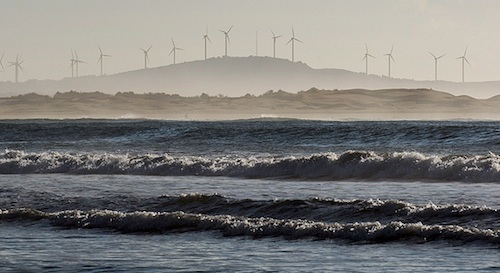
Siemens will supply turbines with a total capacity of 100 MW, 50 MW to the Haouma Wind Farm project in Northern Morocco, and 50 MW to Foum El Oued in Southern Morocco. Siemens has a 50 year history in Morocco, and supplied the electrical infrastructure for Morocco’s 60 MW-Essaouira wind farm (shown), so it would be natural for Morocco to turn to the engineering giant now that it is launching its renewable energy sector.
Plus – Siemens is one of the biggest backers of the Desertec Initiative – now beginning in Morocco.
Although 100 MW is a very small first order from an entire continent, Siemens is clearly banking on a future there. The company is announcing plans to establish a regional Wind Power Business Unit Middle East to focus on the MENA region as part of a new Wind Power Division.
The company says that Africa is an emerging wind market with Morocco currently being number two in installations.
Haouma will have 22 of Siemens’ very large 2.3 MW turbines, and Foum El Oued, which is in one of the windiest areas of Morocco in the municipality of Laâyoune, 9 kilometers south east of the port of Laâyoune in Southern Morocco, will also get 22 of the same capacity.
Siemens has signed a contract with Nareva Holding for the delivery of all 44 turbines, and the contract entails not just delivery but also installation and commissioning and a five-year service contract for each project, once they begin commercial operation in 2013.
Morocco is a very attractive investment region for renewables as its government is committed to very ambitious renewable energy development, with plans to get 26% of Morocco’s electricity from wind power by 2020.
These goals are among the highest in the world. Denmark, the world leader in wind, plans for 42% wind power by 2020, but it has been working up to this level for some decades.
China – the world leader in installed capacity plans to get 17% from wind. Recent world leader Germany plans for about 16%. A few US states are as ambitious. Iowa, with a similar electric demand as Morocco, now gets 20% of its electricity from wind.
More than merely ambitious, Morocco appears to be competently able to implement the plan, with the first of the projects already in place on time, and on target. The country began its first wind installations already, going from 54 MW in 2004, up to 286 MW by the end of 2010.
A healthy oil shock in 2008 steered the country in a new direction. By the end of 2009 a royal energy plan was issued calling for Morocco to end its dependence on oil (60%) and gas (6%). Laws were passed to enable foreign investment and financial support in the country.
“For decades, we searched for energy sources in Morocco,” says Dr. Driss Zejli at the Centre National pour la Recherche Scientifique et Technique. “We looked in the right places, but we were looking for the wrong things, namely oil and gas.”
“Morocco has two trump cards,” says Zejli. “First, we can store electricity in pump hydro units in the Atlas Mountains; one such facility is already up and running. Secondly, we have a high-voltage link with Algeria and power lines to Spain with a capacity of 1,400 MW. So one day we’ll be able to export electricity rather than purchasing it as we do now.”
Related stories:



Great news for green energy but wouldn’t solar energy be better in Morocco? spirulina