
Measure Your Ecological Footprint

ecological footprint

When looking for country-specific environmental indicators, it is often difficult to find a single indicator that  holistically summarizes the environmental situation in a tractable and visual manner. This is the first part of two articles (the second one on your water footprint is here). Two interactive environmental info graphics will be explored to help you better understand what is happening in our green planet, what you can do to change your habits for a greener future and which environmental issues need special attention. Let’s start with your ecological footprint and biocapacity.

Ecological footprint and Biocapacity:

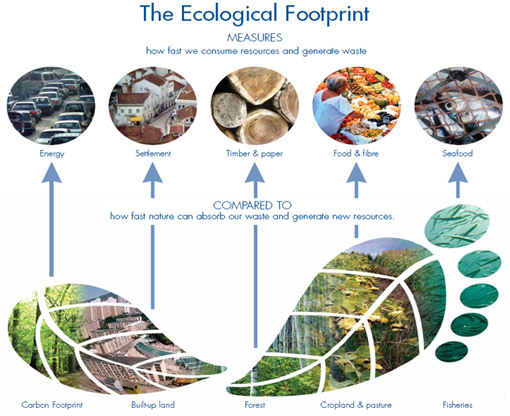
The Ecological Footprint measures how much land and water area a human population requires to produce the resource it consumes and to absorb its carbon dioxide emissions. It is measured in global hectares per capita, where the global hectare (gha) is normalized to the area-weighted average productivity of the specific land type for that year.

This normalization process is essential because each land type has a different productivity levels or yield factor (more formally called biocapacity), which needs to be taken into account to ensure “footprints” can be compared globally.
ecological footprint

A global hectare of cropland, for example, occupies a smaller area than pasture land, because cropland is much more biologically productive. Conversely a larger area of pasture is needed to provide the same biocapacity as one hectare of cropland.

Ecological deficit or reserve:

The total Ecological Footprint minus the Total Biocapacity of a country is equal to the Ecological deficit or reserve (depending on whether Ecological footprint is greater of smaller than total Biocapacity).

So, if there is a regional or national ecological deficit, it means that the region is essentially importing biocapacity through trade.

A global deficit, however, cannot be compensated through trade and therefore leads to a global overshoot of resources resulting in depletion of natural capital.

The global results are predictable and worrying:

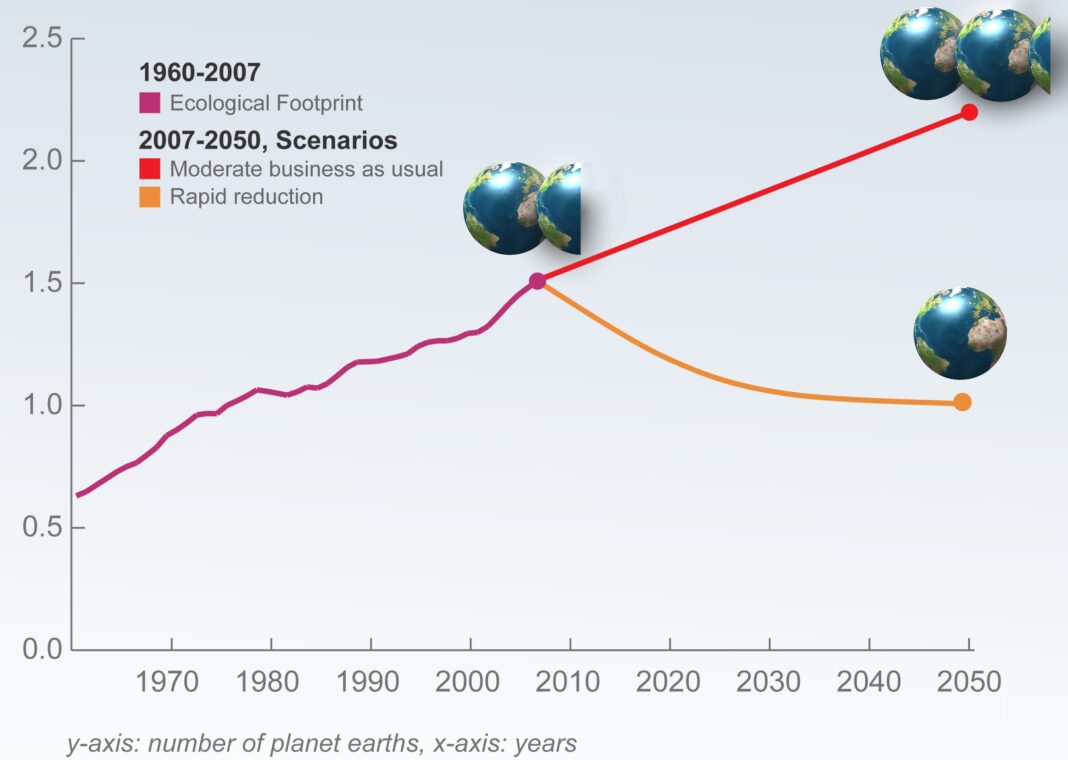
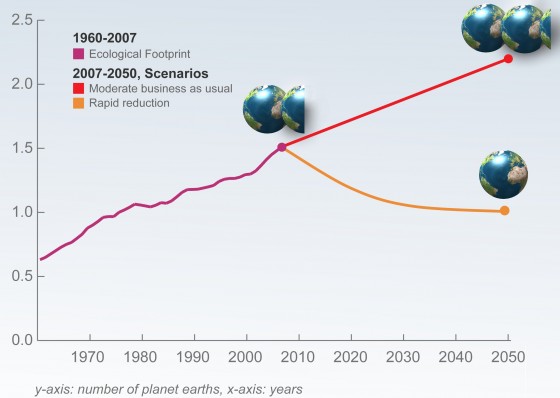
“Since the 1970s, humanity has been in ecological overshoot with annual demand on resources exceeding what Earth can regenerate each year.  It now takes the Earth one year and six months to regenerate what we use in a year.”

“There are only 15.71 global hectares available per person on a renewable basis. Currently, we are overshooting the Earth’s biological capacity by nearly 50%. To sustain present levels of consumption, we would need: 1.5 Earths.”

To get a more detailed overview of the current global situation, the global footprint network has presented calculations of the National Accounts (2010) in the Ecological Footprint Atlas ,  Annual Reports are also great resources for  country specific data . A really great interactive map visually tracks the Ecological Footprint and Biocapacity for each country through time.

These sources of information are crucial because they allows us to essentially point fingers at countries or regions that have the responsibility to compensate and offset the ecological pressures they are imposing at the global scale. How this offsetting should be done is obviously a little more complicated but at least we know who is responsible, as it were.

In fact:

“After the UAE was ranked as having the highest per person Ecological Footprint, the local government launched an ambitious Ecological Footprint Initiative. The UAE is now investing US $15 billion towards developing clean energy.”

 How many “earths” does it take to support your lifestyle?

Environmental responsibility also comes at an individual and personal level. Take this very quick quiz that calculates your personal ecological footprint and how many “earths” would be required if the entire human population were to adopt your consumption patterns.

Not only will you be surprised by the results, but you will also start to think more about what you can do to minimize your footprint.

**For more detailed analysis on how the Human Development Index correlates with the Ecological footprint through time there is the “Trendalyzer”  tool which allows you to select different variables and view trends through time for all countries and regions.

::Footprint Network

Linda Pappagallo
Linda Pappagallohttps://www.greenprophet.com/
Linda's love for nature started when at the age of eight she discovered, with her dog, a magical river in the valley of a mountainous region in Lebanon. For four years Linda and her dog explored along the river, until one day she saw construction scrapers pushing rock boulders down the valley to make way for new construction sites. The rubble came crashing into the river destroying her little paradise, and her pathetic reaction was to shout at the mechanic monsters. Of course that was not enough to stop the destructive processes. As she continued to observe severe environmental degradation across the different places she lived in the Middle East and Africa, these terrible images remained impressed in her mind. However, environmental issues where not her first love. Her initial academic and career choices veered towards sustainable economic development, with particular interest in savings led microfinance schemes. Nevertheless, through experience, she soon realized a seemingly obvious but undervalued concept. While humans can somewhat defend themselves from the greed of other humans, nature cannot. Also nature, the environment, is the main “system” that humans depend on, not economics. These conclusions changed her path and she is now studying a Masters in International Affairs with a concentration in Energy and the Environment in New York. Her interests lie on ecosystems management: that is how to preserve the integrity of an Ecosystem while allowing for sustainable economic development, in particular in the Middle East and Africa.
1 COMMENT

LEAVE A REPLY

Please enter your comment!
Please enter your name here

TRENDING

Bahrain, Qatar, Kuwait and the UAE among world’s top 10 wasters

Bahrain, in the Middle East is one of the most...

Project to Reduce Water and Electricity Consumption in 300 Mosques in Dubai

The 'Green Mosques' project hopes to help conserve water...

Eco-Lessons To Empower Women In Abu Dhabi

 As the environmental movement in the Middle East blossoms,...

Solar Energy Developers Find Themselves in Green Versus Green Debate Over Coyote Land

Coyote land or parking space for solar energy? Ask...

Israel's Army Makes Advances In Green, But Victory Comes First

Does the Israeli Army read Green Prophet? Following our recent...

Qatar’s climate hypocrisy rides the London Underground

Qatar remains a master of doublethink—burning gas by the megaton while selling “sustainability” to a world desperate for clean air. Wake up from your slumber people.

How Quality of Hire Shapes Modern Recruitment

A 2024 survey by Deloitte found that 76% of talent leaders now consider long-term retention and workforce contribution among their most important hiring success metrics—far surpassing time-to-fill or cost-per-hire. As the expectations for new hires deepen, companies must also confront the inherent challenges in redefining and accurately measuring hiring quality.

8 Team-Building Exercises to Start the Week Off 

Team building to change the world! The best renewable energy companies are ones that function.

Thank you, LinkedIn — and what your Jobs on the Rise report means for sustainable careers

While “green jobs” aren’t always labeled as such, many of the fastest-growing roles are directly enabling the energy transition, climate resilience, and lower-carbon systems: Number one on their list is Artificial Intelligence engineers. But what does that mean? Vibe coding Claude? 

Somali pirates steal oil tankers

The pirates often stage their heists out of Somalia, a lawless country, with a weak central government that is grappling with a violent Islamist insurgency. Using speedboats that swarm the targets, the machine-gun-toting pirates take control of merchant ships and then hold the vessels, crew and cargo for ransom.

Leopoldo Alejandro Betancourt López Turned Ocean Plastic Into Profitable Sunglasses

Few fashion accessories carry the environmental burden of sunglasses. Most frames are constructed from petroleum-based plastics and acrylic polymers that linger in landfills for centuries, shedding microplastics into soil and waterways long after they've been discarded. Leopoldo Alejandro Betancourt López, president of the Spanish eyewear brand Hawkers, saw this problem differently than most industry executives.

Why Dr. Tony Jacob Sees Texas Business Egos as Warning Signs

Everything's bigger in Texas. Except business egos.  Dr. Tony Jacob figured...

Israel and America Sign Renewable Energy Cooperation Deal

Other announcements made at the conference include the Timna Renewable Energy Park, which will be a center for R&D, and the AORA Solar Thermal Module at Kibbutz Samar, the world's first commercial hybrid solar gas-turbine power plant that is already nearing completion. Solel Solar Systems announced it was beginning construction of a 50 MW solar field in Lebrija, Spain, and Brightsource Energy made a pre-conference announcement that it had inked the world's largest solar deal to date with Southern California Edison (SCE).

Related Articles

Popular Categories