
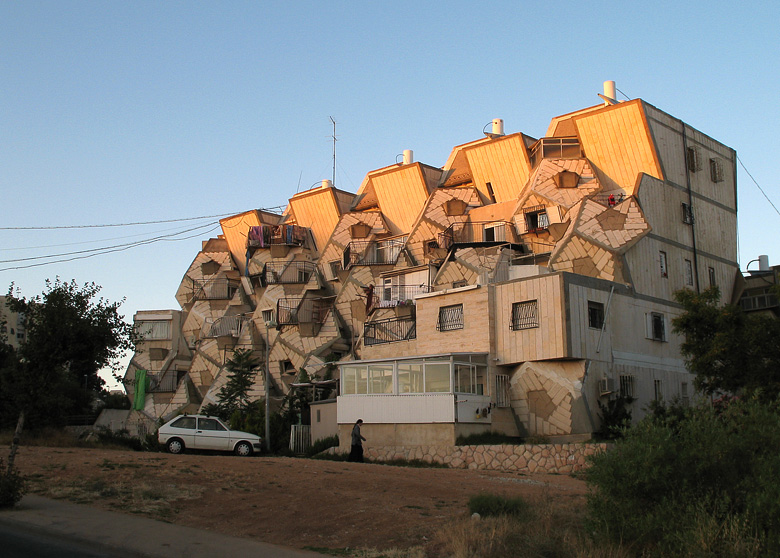

 A hastily constructed building in Israel designed in 1972 seemed like a good idea at a time, but now it has evolved into a bizarre eyesore and a sanctuary for the country’s Orthodox Jews.
We’ve seen many funky buildings on Green Prophet, including Moshe Safdie’s famous Habitat ’67 and beehive shaped architecture in Syria, but the difference between them and Ramot Polin lies in functionality. While each of the former projects produced cozy, livable residential space, Ramot Polin apartments are cramped, dark, and beset with problems.
Designed by Zvi Hecker after the 6 Day War in 1972, the 720 unit complex built in Jerusalem was an architectural experiment that was supposed to encourage middle-income Orthodox families to settle. Instead, the crumbling Ramot Polin complex now provides sanctuary to low income religious groups.
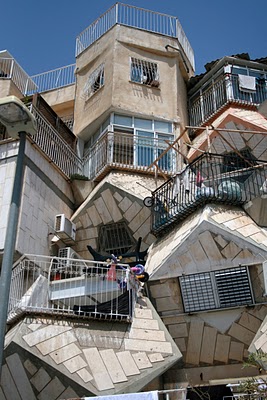 One big fat fail
Ramot Polin was designed as a cheap and modular solution to the then Israeli leadership’s desire to create an iconic living space on newly appropriated land in northern Jerusalem.
At the time, Hecker’s 3-D system of dodecahedrons (outer walls comprised of 12 pentagonal faces) seemed to meet all of the requirements: a fast-build modular design cast in concrete and covered in the ubiquitous Jerusalem stone, it was sufficiently funky to distinguish it from other developments and cheap.
In sustainable architecture, modular is typically welcomed since it reduces the use of materials and results in greater building efficiency, but according to Adam Nathaniel Furman, the geometric apartments of Ramot Polin entail a big fat fail. On his blog World Bin, the designer notes:
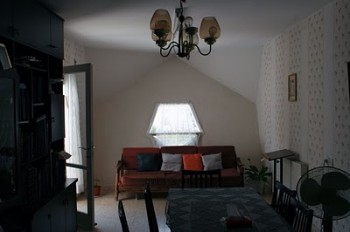
The interior spaces are monumentally impractical, with large areas of unusable walls, horribly cramped balconies, windows that seem especially designed for children to fall out of, issues everywhere with rain screening, drainage, and lack of natural light, all amounting to the development from the beginning not attracting the middle income, secular families it was originally intended for.
Organic architecture
But Furman is less concerned with the new, unofficial “improvements” made to the buildings by now longstanding residents. Rooms and windows have been enlarged, geometric edges have been softened, air-conditioning units have been installed, and balconies have been opened up. He believes these adjustments follow the designers original aim to create an organic architecture that grows as needed.
The critics are less impressed. Haartetz writer Noam Dvir says, “The buildings’ original character is being lost; not one building remains in its original condition.”
More importantly, and this may be the reason behind such renewed interest in what is a rather dated project, the complex has become an ideal outpost for Haredi families that crave freedom to practice what many consider to be an increasingly unreasonable form of Orthodox Judaism.
A sanctuary for radical Orthodox
Not only do the cheap rents suit one of the poorest sectors of Israeli society, but Ramot Polin’s remote location on the top of a hill provides just the right amount of isolation for the Haredi, according to Furman.
We love architecture that bends the rules – from Nader Khalili’s earth buildings that are fit for space to buildings carefully chiseled into the side of a rock face – but this story demonstrates how any kind of hasty construction (and dare we say bad intention) is bound to end in failure.
On the other hand, attunement to nature combined with timeless architectural techniques can result in buildings that last hundreds of years. Yemen’s Manhattan of the Desert is an excellent testament to this.
Lead image via Wikicommons. All others via World Bin
More on Israeli Architecture:
Bring Moshe Safdie’s Green Building to the Middle East
Yaniv Pardo Unveils Twisting Tower for Israel
Construction of Israel’s First LEED Platinum Eco-Building by Geotectura Begins



Maybe just a tad hastily written Tafline?
I think the key word here, and what Tafline probably meant, is “isolation”. Other than the salubrity, sustainability and aesthetics of the architecture, which are open to debate of course, there is this mono-cultural community, issued from a minority, economically disadvantaged, literally physically isolated from the rest of society. That, everyone will agree, is a recipe for disaster, as many many *projects* and *cités* dotting Europe and the US demonstrates, if historical examples weren’t enough to teach us. On top, the combination of apparently ill thought architecture and rigid religious beliefs is worrying.
I am distraught by your article- Would the buildings make any more sense if they were currently occupied by the secular population that they were built for? “but now it has evolved into a bizarre eyesore and a sanctuary for the country’s Orthodox Jews”- really? isn’t most of northern jerusalem occupied by orthodox jews? and a sanctuary from what? i’m pretty sure it was the cheap rent that brought them. and the “bizarreness” of the “eyesore” really stems from families trying to make the rather challenging architecture useful to live in, a natural evolution of an originally very impractical building (your article doesn’t include pictures of unchanged interiors- crazy angled walls that challenge our usual use of walls, corners, rooms and furniture)
You wrote: “supposed to encourage middle-income Orthodox families to settle.”
I don’t know where you got that information. It was Teddy Kollek’s great idea that it be sold to secular families, in order to create a secular stronghold.
You wrote: “newly appropriated land”.
This is based on a travesty. The land was owned by Kollel Polin, an Orthodox group, before 1948. When the land was regained in 1967, instead of giving the jews back their land, the State kept it and sold it. Since no secularist was willing to live in such a mostrosity, the price hit rock bottom due to zero demand. Kollel Polin, the original owners, bought it back from the State and sold it to Orthodox families. Hence its name, Ramot Polin.
Rochelle, apologies for not responding sooner. I have been out of town. I understand your concerns; it definitely was not my intention to disparage the lower income group. I only stated that originally the government hoped to encourage a certain demographic but was not successful at doing so.
You write: “the 720 unit complex…was an architectural experiment…supposed to encourage middle-income Orthodox families to settle. Instead, the crumbling Ramot Polin complex now provides sanctuary to low income religious groups.”
Do you realize your language expresses disrespect for 1 group while approving another? Using “groups” for the low income people you don’t like dehumanizes them vs “families” for your preferred people – cheap & unworthy of journalism. I live near this architectural monstrosity, and I know residents there who are “modern orthodox” – it is inhabited by a more diverse population than you claim. No one there wants it or likes it but it is affordable for them. It is very hard for middle class people as well as poorer people to find any affordable housing in Jerusalem. If this were torn down, it would take at least 5 to 10 years to get through the bureaucratic morass needed before something else could be built to replace it.